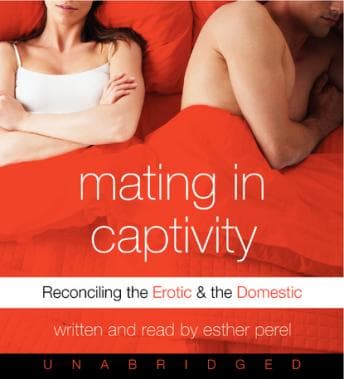

Look, I started this audiobook on a Tuesday morning jog through Cambridge, and by the time I got home, I was sitting on my front steps in sweaty running clothes, completely forgetting I had a department meeting in an hour. That's the Esther Perel effect.
Here's the thing about Mating in Captivity that grabbed me immediately: Perel treats her couples like case studies. And I mean that as the highest compliment. She's doing what I try to do with fictional characters - asking the uncomfortable "why" questions. Why does the partner who desperately wants more sex suddenly lose interest when it's freely available? Why do we create the very distance we claim to hate? The research actually shows that desire requires a gap, a space between people. Perel gets this on a cellular level.
The central paradox she explores - that security and eroticism are fundamentally at odds - kept me rooted to those front steps. We want our partners to be our best friends, our co-parents, our financial partners, our emotional support systems. And then we're shocked, SHOCKED, when the mystery evaporates. Perel basically says: what did you expect? You can't simultaneously merge into one person and maintain the otherness that desire requires. My therapist would have thoughts about this, and honestly, I think she'd agree.
Now, about the narration. Perel reads her own work, and this is one of those cases where author-narration is absolutely the right call. Her Belgian accent is... distinctive. I'm not going to pretend it isn't. Some listeners find it challenging, and I get it - there were moments early on where I had to rewind because my brain was processing the accent instead of the content. But here's what I found: once I settled in (maybe twenty minutes?), the accent became part of the experience. There's something almost therapeutic about her delivery. Warm but direct. Compassionate but unflinching. She sounds like the couples therapist you'd actually want to see - the one who won't let you get away with your usual deflections.
What makes this audiobook compelling is how Perel uses her clinical cases. She doesn't just describe problems; she dissects the psychological architecture underneath. When she talks about a couple where the wife has lost all desire, she doesn't stop at "they need to communicate better" (ugh, the most useless advice in relationship literature). She digs into the wife's relationship with her own body, her mother's messages about female sexuality, the way motherhood restructured her identity. That exploration of female sexuality as constructed rather than innate reminded me of Fanny Hill: Memoirs of a Woman of Pleasure, though obviously from a very different historical lens. This is how our erotic selves are built, not given.
I found myself asking: why does this feel so different from other relationship books? And I think it's because Perel isn't trying to fix you. She's trying to make you think. She's provocative in the original sense - she provokes. She'll say things like "love enjoys knowing everything about you; desire needs mystery" and just... let it sit there. No seven-step program. No exercises at the end of chapters. Just uncomfortable truths you have to figure out what to do with.
Psychologically, this tracks completely. The human mind has patterns, and Perel understands them. She knows that we're not rational creatures who occasionally have feelings - we're emotional creatures who occasionally rationalize. Her approach to eroticism is fundamentally about reclaiming imagination and risk in relationships that have become too safe, too predictable, too... domestic.
The pacing is solid. Eight hours feels right for this material. It's dense enough that you'll want to pause and think, but Perel's conversational style keeps it from becoming a slog. I listened over about a week - morning runs, cooking dinner (yes, alone, don't start), and one very long Sunday afternoon with too much chai.
Some criticisms are fair. If you're looking for a how-to manual, this isn't it. Perel is more philosopher than technician. She'll illuminate the problem brilliantly and then basically say "figure it out." That frustrated me occasionally. The focus is heavily on heterosexual couples, though she does acknowledge other relationship structures. And yes, the accent thing is real - if you struggle with non-American accents, maybe sample first.
But honestly? Perel understands human nature in a way that most self-help writers don't. She's not selling you a fantasy of perfect intimacy. She's asking you to accept that desire is inherently transgressive, that eroticism lives in the space between who we are and who we might be.
Who Should Listen (And Who Should Skip)
This is required listening for anyone in a long-term relationship who's wondered where the spark went. Or for anyone interested in why humans are so spectacularly bad at wanting what we have. Skip it if you need concrete action steps or struggle with non-American accents. Perel won't give you easy answers. But she'll give you better questions.
And sometimes that's worth more.