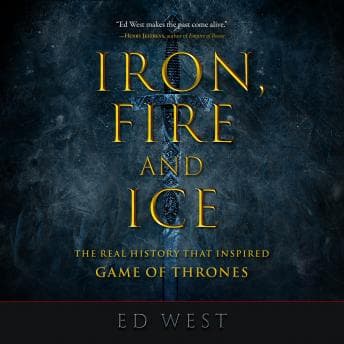

Twenty hours of medieval history connecting real events to Westeros. That's a serious commitment, and I want to tell you upfront - it's worth the time.
I started this one during a late-night drive back from a client site in San Antonio, and by the time I pulled into my driveway, I'd been sitting in the truck for an extra forty minutes because Ed West was walking me through the actual Scottish massacre that inspired the Red Wedding. The Black Dinner of 1440 and the Massacre of Glencoe in 1692 - both real events where hosts murdered their guests. Martin didn't have to invent much. He just had to pick which atrocity to borrow from.
History Doesn't Need Dragons to Be Brutal
Let me cut to the chase: this book works because West doesn't just draw surface-level parallels. He goes deep. The Wars of the Roses section alone could be its own book - the rivalry between Margaret of Anjou and the Yorkist faction maps onto Cersei and the Stark conflict with uncomfortable precision. Margaret was every bit the ruthless political operator Cersei wishes she was, and West lays out her story with enough detail that you stop thinking about Game of Thrones entirely and just get absorbed in the actual history.
The Dothraki-as-steppe-nomads chapter is where West really did his homework. He traces the line from Huns to Magyars to Mongols, showing how Martin compressed centuries of horse-warrior culture into a single fictional people. The detail about Mongol warriors drinking blood from cuts on their horses' necks during long rides - that's the kind of specific, visceral stuff that makes you understand why Martin's world feels so lived-in. Because someone already lived it.
Where the book gets a little uneven is in its structure. At 20 hours, West covers religion, warfare, torture, succession politics, the role of women in medieval power structures, even climate (the medieval warm period and the Little Ice Age as inspiration for Martin's seasons). That's ambitious. Sometimes it feels like West is writing three books at once - a Game of Thrones companion, a medieval history survey, and a social history of pre-modern Europe. Around hours 12-14, I'll admit my attention drifted during some of the more granular discussions about medieval church politics. Not because it wasn't interesting on its own terms, but because the connection back to Martin's work got thin. There are stretches where you forget this is supposed to be about Game of Thrones at all.
But honestly? That's not entirely a bad thing. Some of the best sections are the ones where West just lets the history breathe. The account of the death of William the Conqueror's grandson Eustace - possibly poisoned, eerily parallel to Joffrey's death at his own wedding feast - is genuinely chilling without needing the fictional comparison.
Rory Barnett's Posh British Accent Is the Right Call
Barnett reads this like an Oxford lecturer who actually wants you to stay awake. His posh British delivery fits the material perfectly - you're hearing about English and European medieval history, and the accent grounds you in that world. He's clear, well-paced, and walks the line between enthusiasm and gravity. When he's covering the rack, burnings at the stake, and battlefield beheadings (and there's plenty of all three), he doesn't sensationalize it but doesn't shy away either. No dramatic voice acting here - this is straight narration, and for a 20-hour history book, that's exactly what you want.
I listened at 1.25x and it felt right. Barnett's natural pace is deliberate enough that the speed bump keeps things moving without losing clarity.
Who's This Actually For?
If you're a Game of Thrones fan who's read the books and watched the show and you want to understand where it all came from - absolutely, get this. But here's the thing: if you're a history person who couldn't care less about Westeros, this still works as a solid medieval history survey. West knows his material, and the GoT framework is more of an entry point than a crutch.
If you need tight, focused narrative nonfiction with a clear through-line, this might frustrate you. It's sprawling. It's encyclopedic at times. I've seen this scenario play out in real life - you brief someone on everything they need to know and then some, and sometimes the "and then some" is where the gold is buried.
Skip it if bad things happening to medieval people bothers you. The content warnings here are real - this is the actual history that made Game of Thrones possible, and that history is soaked in blood.
Ranger slept through most of this one, but he perked up during the battle descriptions. Good boy knows what matters.
Mission Debrief
Worth your time? Here's the debrief: it's 20 hours of genuinely interesting history that happens to have a Game of Thrones hook. It's about four hours too long and occasionally loses the thread, but when it's locked on target, it's excellent. The real history is more savage, more strange, and more fascinating than anything Martin invented. West makes that case convincingly. Thomas Paine made a similar case in Common Sense - that the truth of what people actually lived through, stripped of mythology and flattery, is more galvanizing than anything a storyteller could fabricate.



![Steve Jobs [unabridged audiobook] audiobook cover](/_next/image?url=https%3A%2F%2Fcovers.audiobooks.com%2Fimages%2Fcovers%2Ffull%2F9788499923406.jpg&w=1920&q=75)