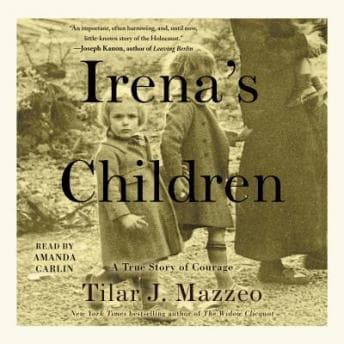

What do you do when a mother hands you her baby and you both know she'll probably never see that child again?
I was sitting in my kitchen at 8 AM, post-shift, eggs going cold on the stove, listening to the last hour of this book. Carlos came downstairs and found me just... standing there. Spatula in one hand, tears running down my face. I blamed allergies. He didn't buy it.
The List in the Bottles Under the Apple Tree
Here's what got me. Irena Sendler wasn't some wealthy socialite with connections and resources to burn. She was a social worker. A social worker. She walked into the Warsaw Ghetto with a public health badge and started asking Jewish mothers to give her their children. Think about that ask for a second. Think about being on either side of that conversation. Mazzeo doesn't shy away from the impossible weight of those doorstep moments - the families who said yes, the families who said no, the families who said no and then were deported to Treblinka days later.
What really wrecked me was the detail about the list. Irena kept the real names and identities of every single child she smuggled out - 2,500 of them - written on tissue paper and buried in glass jars under an apple tree in her friend's garden. She did this so families could be reunited after the war. She couldn't have known that over ninety percent of those parents would never come back to claim their children. That detail alone. I had to pull over the car on a different listening session because I couldn't see the road.
The methods of smuggling are the stuff of actual nightmares dressed as logistics: kids hidden in coffins, carried through sewers, tucked under overcoats, passed through secret passages in buildings that straddled the ghetto wall. Mazzeo lays these out with the clinical precision of someone who's done serious archival research, and honestly? As someone who deals with life-and-death logistics every shift - who has to stay calm while coordinating chaos - the operational details of Irena's network hit different for me. This wasn't one woman acting alone. This was an underground system of tradesmen, resistance fighters, nuns, and ordinary people who decided that saving children was worth dying for. And many of them did die for it.
Amanda Carlin Knows When to Be Quiet
The narration is steady. And I mean that as the highest compliment. Carlin doesn't dramatize the horror - she doesn't need to. Her delivery is gently modulated, almost restrained, which is exactly what material this brutal requires. She uses a light Polish accent for dialogue here and there, nothing heavy-handed, just enough to place you geographically. The real skill is in her pacing during the worst passages - descriptions of ghetto conditions, the roundups, the betrayals. She reads them the way a good trauma nurse delivers bad news: clearly, with composure, giving you room to feel it without performing the feeling for you.
At ten and a half hours, it's a significant listen. There are stretches in the middle where the historical context gets dense - Mazzeo is thorough about the political landscape, the competing resistance factions, the timeline of the occupation - and I won't pretend my attention didn't drift once or twice during a particularly exhausting drive home. But every time I thought the pace was slowing, she'd drop another detail about a specific child, a specific escape, a specific moment of courage so absurd it sounds fictional. And it wasn't. I've read a fair bit of historical fiction that tries to capture this kind of horror, and most of it can't come close — Death Danced at Midnight at least understands that restraint is sometimes the only honest approach to darkness.
Who Needs This Book (And Who Should Brace Themselves)
If you read Schindler's List and thought "I want to know the stories we didn't hear" - this is it. If you're a parent, be warned: the scenes involving mothers making the choice to hand over their children will gut you. I work in a trauma center. I have seen children in terrible situations. This book still broke something in me.
It's not a light listen. Don't put this on during meal prep expecting background noise. This demands your attention and your heart. But if you're the kind of person who believes we owe it to these stories to actually hear them - really hear them - then yes. Absolutely yes.
My mom called me the other day asking what I was listening to. I told her about Irena Sendler - a woman who used her professional access, her medical credentials, her bureaucratic cover to save thousands of lives. My mom got quiet for a second and said, "So she was like a nurse." My mom would love this. (She still thinks I should've been a doctor.)
Shift Change: The Final Note
Irena Sendler was arrested by the Gestapo. They broke her legs and her feet. She never gave up a single name. She was sentenced to death, then rescued by the resistance through a bribed guard. She lived to be 98 years old. The list survived. The children survived.
Some stories don't need embellishment. They just need someone to tell them straight. Mazzeo and Carlin did that. Night shift approved - but keep tissues in your glove box.