
Everyone talks about this book like it's some groundbreaking revelation about honesty. It's not. And that's actually what makes it interesting.
I grabbed this one on a Monday morning when my usual sci-fi queue was empty (I'd binged through three books over a weekend debugging session - don't ask). Figured a 5-hour business book would be low-effort filler for the week. What I got instead was a clinical psychologist reframing "integrity" as something way broader than "don't lie to people," and honestly? Some of it stuck.
Not Your Sunday School Definition
Here's the thing - Cloud's thesis is that integrity isn't a moral binary. It's structural. Like, he literally uses the engineering metaphor of a ship's hull having integrity - all the parts holding together under pressure. His six qualities (connecting, facing reality, finishing well, embracing negatives, growing, understanding transcendence) read less like a self-help checklist and more like a diagnostic framework. If you've ever done a root cause analysis on why a project failed and the answer was "the tech lead couldn't have hard conversations," that's the kind of failure mode Cloud is mapping.
The business case studies are where this either clicks or doesn't for you. He draws heavily from his consulting work - CEOs who could close deals but couldn't maintain relationships, leaders who were brilliant strategists but avoided negative feedback until it metastasized. He's specific enough about the patterns that you start mentally tagging people you know. I caught myself thinking about three different engineering managers before hour two.
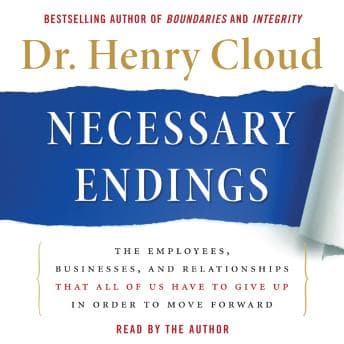
But - and this is my gripe - he revisits his foundational concepts pretty heavily if you've read any of his other stuff (Boundaries, Necessary Endings). There's a "greatest hits" quality to some sections where you feel like he's repackaging ideas he's explored better elsewhere. If this is your first Henry Cloud book, you'll probably get more out of it than I did.
Author-Narrated: The Consulting Session You Didn't Schedule
Cloud narrates this himself, and it has that very specific energy of a smart therapist who's also done a lot of corporate speaking. Clear, methodical, a little bit like he's explaining something to an executive who needs to hear it but doesn't want to. No vocal fireworks, no dramatic pauses for effect. Just a guy who's thought about this stuff for decades walking you through it.
The upside: it feels authentic. You're getting the concepts filtered through the person who developed them, with the natural emphasis on the parts he thinks matter most. The downside: at 5 hours 15 minutes, there's not a lot of vocal variety to keep your attention during the sections that drag. And some sections do drag - particularly the transcendence chapter near the end, which felt like it belonged in a different book.
I bumped this to 1.75x by hour three. At that speed it's a clean 3-commute listen, and honestly, the pacing improves. Cloud's natural delivery is measured enough that the speedup makes it feel more conversational rather than chipmunk-y.
The Blog Post Question
Okay, here's where I have to be honest. Could this have been a blog post? No - there's enough substance across the six dimensions that it genuinely needs the space. Could it have been a tighter book? Absolutely. The ROI on this audiobook is decent but not exceptional. You'll get two or three genuinely useful mental models (his framework for "embracing the negative" as a growth mechanism rather than something to avoid is legitimately good), some business anecdotes that illustrate the points well, and a few sections where you zone out because the point was made ten minutes ago.
Compared to something like Brené Brown's Dare to Lead, which covers adjacent territory, Cloud is more clinical and less emotionally engaging. Compared to Ray Dalio's Principles, he's warmer but less systematic. It lives in this middle zone - not dry enough to be a textbook, not personal enough to be a memoir, not actionable enough to be a playbook. I landed in a similar middle zone with You, Happier — another book that's more diagnostic than prescriptive, and earns maybe 70% of its runtime.
Who This Is Actually For (And Who Should Skip)
Perfect for: anyone in a leadership role who keeps hitting the same interpersonal walls and can't figure out why. Also good if you're new to Cloud's work - this is a solid entry point to his thinking, even if it's not his best.
Skip for: anyone expecting a book about honesty and ethics in the traditional sense. Also skip if you've already read Boundaries and Necessary Endings - you'll recognize too much of the framework.
Perfect for: train, gym. Skip for: deep work (it's not dense enough to reward focused attention).
Worth a Credit? Probably Not - But Worth Your Commute Time
At 5 hours, this is a low-commitment listen that delivers maybe 3.5 hours of actual insight. I don't regret the time, but I also wouldn't pay full price when Libby exists. The character-as-infrastructure metaphor has genuinely changed how I think about a couple of my skip-level conversations at work, and that alone makes it worth the bandwidth. Just don't expect it to change your life - expect it to give you slightly better language for problems you already knew you had.