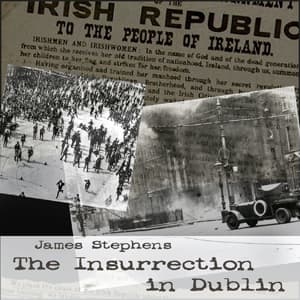

"The rifles were crackling from the direction of Portobello Bridge."
That line hit me somewhere around the forty-minute mark, and I had to set down my coffee. I was sitting on the back porch at 0600, Ranger sprawled at my feet, listening to a dead man describe gunfire in his city like he was reporting the weather. James Stephens wasn't a soldier. He was a novelist who happened to be walking around Dublin during Easter Week 1916, and what he produced is one of the most honest pieces of combat-adjacent reporting I've ever encountered.
Let me cut to the chase: this is a two-hour primary source document, not a polished history. And that's exactly what makes it valuable.
A Civilian Walking Through a War Zone
Stephens wasn't embedded with anybody. He wasn't trying to be brave or heroic. He was a guy who went to work at the National Gallery and found his city had turned into a battlefield. What struck me - and what I think most listeners will miss if they're expecting a conventional history - is how accurately he captures the civilian experience of sudden urban conflict. The confusion. The rumors that spread faster than facts. The way people cluster in groups on street corners, half-terrified and half-fascinated, trading contradictory information about what's happening two blocks away.
I've seen this scenario play out in real life. Baghdad, 2004. You'd talk to locals who lived three streets from a firefight and they'd have five completely different versions of what happened. Stephens nails that fog-of-war confusion without even knowing the term. He describes rifle volleys from St. Stephen's Green and the strange normalcy of people going about their business while bullets are flying. That juxtaposition isn't literary craft - it's just what war in a city actually looks like.
The book is structured as a day-by-day diary, Monday through Saturday of Easter Week. Each entry gets progressively more tense as the reality of the Rising sinks in. Early on, Stephens treats it almost with curiosity. By Thursday, he understands people are dying.
What You're Getting (And What You're Not)
Here's where I need to be straight with you. This is a LibriVox recording by a narrator called Iremonger, and the production values reflect that. It's a volunteer effort - clean enough, competent enough, but don't expect studio-grade sound design or a performance that's going to win any Audie awards. The narration is clear and doesn't get in the way of the text, which for a historical document like this is honestly all I need. No dramatic music, no sound effects, no embellishment. Just one voice reading Stephens' words.
At two hours and ten minutes, this is barely a long podcast episode. I knocked it out in a single morning. The brevity is actually a strength - Stephens didn't pad this thing. He wrote what he saw, day by day, and stopped when the shooting stopped. There's no retrospective analysis, no attempt to place the Rising in the broader context of Irish independence. That stuff came later, from other writers. This is raw, immediate, and unapologetically subjective.
The author clearly did their homework - well, Stephens didn't need to do homework. He was the homework. He was literally there. And his background as a novelist means the prose has moments of genuine beauty mixed with the grim reporting. He notices things a journalist might not: the quality of light on a street, the expression on a woman's face, the absurd politeness of Dubliners even during an armed rebellion. That same quality of observation — a writer's eye cutting through chaos to find the human detail that makes history feel real — kept reminding me of Nurse: Inside Denmark's Most Sensational Criminal Trial, another account where being present in the room matters more than any retrospective analysis ever could.
Who Should Grab This
If you're a history buff who wants the textbook version of the Easter Rising with maps and troop movements and political analysis, this isn't it. Go find a proper military history. But if you want to know what it felt like to be an ordinary person caught in the middle of an insurrection - the sounds, the rumors, the fear, the strange boredom between the gunfire - Stephens delivers that in a way no retrospective account can.
Anyone who's been downrange will recognize the authenticity here. And anyone who hasn't will get closer to understanding the civilian experience of urban combat than most fiction ever manages.
It's free through LibriVox, which means the price-to-value ratio is about as good as it gets.
Mission Debrief
Worth your time? Here's the debrief: it's a short, honest, eyewitness account of a pivotal moment in Irish history, read competently if not spectacularly. Two hours of your life for a perspective you genuinely can't get anywhere else. Stephens died in 1950, but his words from Easter Week 1916 are still doing their job - putting you on those Dublin streets with the crack of rifles echoing off the Georgian facades. Ranger slept through the whole thing, but I didn't.





![Steve Jobs [unabridged audiobook] audiobook cover](/_next/image?url=https%3A%2F%2Fcovers.audiobooks.com%2Fimages%2Fcovers%2Ffull%2F9788499923406.jpg&w=1920&q=75)