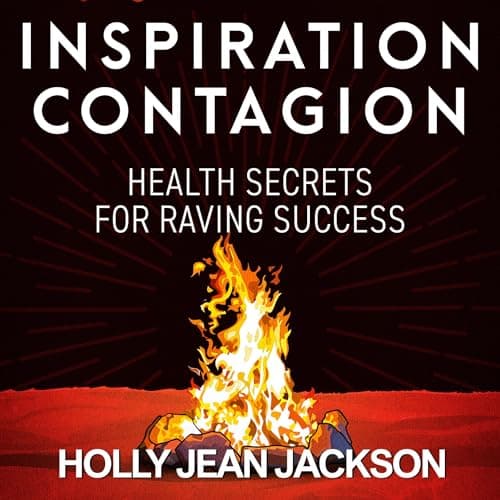

I expected the usual self-help playbook — you know the one. Vague affirmations, a tragic backstory deployed for emotional leverage, and then fourteen chapters of 'just believe in yourself.' So when I started Inspiration Contagion while chopping onions for a dal that was rapidly becoming more ambitious than my evening warranted, I was prepared to be underwhelmed. The title alone has that motivational-poster energy. But here's the thing: Holly Jean Jackson does something I didn't anticipate. She actually follows through.
Let me explain what I mean by that.
The Rare Self-Help Book That Shows Its Work
Jackson comes from the podcast world — she hosts the Inspiration Contagion podcast, interviewing what she calls 'transformational leaders' — and you can feel that background in the book's structure. It reads like a well-organized interview series with herself as subject. She'll share a personal story (chronic pain, health crises, the kind of dark chapters that would fuel a lesser book's entire emotional arc) and then — and this is the part that surprised me — she pivots immediately to specific strategies. Not 'try journaling.' Actual steps. Holistic health practices, habit-replacement frameworks, actionable wellness routines.
The research actually shows that self-help books fail most often at the bridge between inspiration and implementation. Jackson seems aware of this gap, almost impatient with it. She doesn't linger in the darkness-to-light narrative arc the way many authors do, milking the 'I was broken' story for maximum emotional payoff before handing you a pamphlet of generic advice. She treats the stories as case studies — which, as someone who literally analyzes fictional characters as case studies, I respect. The same purposeful structure is what made Big Leap stick with me — Gay Hendricks also uses personal narrative as evidence rather than atmosphere. The stories serve the strategy, not the other way around.
At six hours and nineteen minutes, it's tight. No bloat. That's worth noting because so many books in this category pad their runtime with repetitive anecdotes that all prove the same point. Jackson keeps moving.
Where Liz Leafloor Lands (And Where She Doesn't)
Here's where I have to be honest about what I don't know. Liz Leafloor's narration is... fine? I found myself asking: why does a self-help narrator's voice so rarely match the urgency of the material? Leafloor reads clearly and steadily, which works for the instructional sections — when Jackson is walking you through specific health and wellness strategies, you want that clean, measured delivery. But during the more personal stories, the ones about pain and despair and hard-won hope, the performance stays at roughly the same emotional register. It's not bad narration. It's just narration that doesn't fully distinguish between 'here's what nearly broke me' and 'here's step three.'
I will say this: for a single-narrator self-help audiobook, the production is clean. No audio artifacts, no weird editing cuts. The pacing matches Jackson's writing style, which tends toward the energetic and direct. If you're listening at 1.25x (which I did for the last two hours while the dal simmered), it flows well.
The Psychology of 'Contagion' — Does It Actually Work?
The book's central premise — that inspiration is contagious, that you can catch it and spread it — is psychologically interesting if not exactly novel. There's real research on emotional contagion, and Jackson gestures toward it without getting bogged down in citations (this is not an academic text, and it doesn't pretend to be, which I appreciate more than you'd think). What makes this particular framework compelling is Jackson's emphasis on legacy. She frames health and wellness not as self-indulgence but as the infrastructure for leaving something meaningful behind. That reframe — from 'take care of yourself because you deserve it' to 'take care of yourself because the world needs what you're building' — is genuinely clever. It sidesteps the narcissism trap that plagues a lot of wellness content.
But — and my therapist would have thoughts about this — Jackson sometimes skips too quickly past the emotional complexity of chronic pain. She's clearly lived it, and her strategies come from real experience. But the book occasionally treats suffering as a problem to be solved with the right toolkit, when sometimes suffering is also a thing to be sat with. The 'actionable strategies' emphasis is the book's greatest strength and its one blind spot.
Who Gets the Most Out of This
If you're the kind of person who's read ten self-help books and felt inspired by all of them and changed nothing — Jackson is basically writing for you. She's not interested in making you feel warm. She's interested in making you move. But if you're deep in the weeds of chronic pain or grief and what you need right now is someone to just acknowledge how hard it is without immediately handing you a to-do list, this might feel rushed in the wrong places.
My Prescription, No Co-Pay Required
Inspiration Contagion is a solid, no-nonsense self-help audiobook that earns its runtime. It won't change your life in one listen — nothing will, and anyone who tells you otherwise is selling something — but it gives you actual tools instead of just feelings. Book of Delights is essentially the opposite thesis — Ross Gay argues that noticing is enough, that feeling something deeply is its own form of action — and honestly, I think both books belong on the same shelf. Jackson understands human motivation better than most people writing in this space. The narration serves the content without elevating it. Worth your time, especially if you've been stuck in the inspiration-without-action loop. My dal turned out pretty good, too.