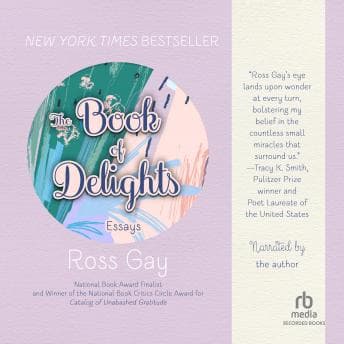

I was on a 5 AM flight to Denver - red-eye, middle seat, the whole nightmare - when I started this. Couldn't sleep anyway, so I figured I'd knock out something short. Five hours later, I landed feeling like I'd just had the most productive therapy session of my life. Didn't see that coming.
Here's the thing about Ross Gay's Book of Delights: it shouldn't work as a business-minded person's listen. It's a poet writing daily essays about things that made him happy over one year. No frameworks. No actionable takeaways. No chapter on optimizing your morning routine. And yet - and I'm almost embarrassed to admit this - it might be the most useful book I've listened to in six months.
What My Parents Knew That McKinsey Never Taught Me
My parents found delight in small things. My dad would get genuinely excited about a particularly good persimmon from the Korean grocery. My mom still talks about the regular customer who always folded his own shirts before bringing them in. I spent eight years at McKinsey learning to optimize everything, and somewhere along the way I forgot how to notice anything.
Gay's essays are tiny - some just a paragraph, some a few pages. He writes about a stranger helping him carry luggage. About the word "vehicular vernacular" (which he reads with such obvious pleasure you can hear him grinning). About fig trees and hugs and the complicated joy of existing as a Black man in America while still finding reasons to celebrate.
At 5 hours, not a minute is wasted. Finally, a book that respects your time.
The Anti-Business Book That's Actually Good for Business
I've listened to maybe 200 business books. Most of them are one good Harvard Business Review article stretched into 10 hours of filler. Gay's book is the opposite problem - it's so dense with actual insight that I kept pausing to think. On a red-eye. When I should've been sleeping.
Here's what I mean: Gay writes about gratitude, but not in the toxic positivity way that makes me want to throw my phone. He's clear-eyed about the terrors - ecological destruction, racism, loss. But he's also paying attention to what's good. And paying attention - really paying attention - is maybe the most underrated skill in business. I've seen entire consulting engagements fail because nobody bothered to notice what was actually happening. That kind of intentional noticing shows up differently in Wuthering Heights, where the narrator forces you to slow down and pay attention to every wind-swept moor and complicated emotion.
My 2.0x speed couldn't save this one. I tried. But Gay reads his own work with this conversational warmth that gets lost when you speed it up. His cadence matters. The pauses matter. I dropped to 1.25x by the second essay and never went back. (Jenny would say I'm being harsh on myself. Jenny is right.)
A Poet Reading His Own Joy
Gay reading his own essays is the whole point. There's no dramatic character work here - it's just a poet talking to you like you're sharing a bench in a garden somewhere. His voice is pleasant, upbeat, and completely unpretentious. When he hits a phrase he loves ("vehicular vernacular" appears multiple times, and he clearly delights in saying it each time), you can hear the smile.
No production bells and whistles. No music. Just Gay's voice and his observations. It's almost meditative, which I mean as a compliment from someone who usually finds meditation insufferable.
Fair warning: there are f-bombs. Not constant, but present. If that bothers you, know going in.
Who Gets Value Here (And Who Won't)
Listen if you're burned out on optimization culture and need someone to remind you that noticing a good tomato is a valid use of your attention. If you run a business or lead a team and you've forgotten why you started. If you want something short for commutes that doesn't feel like homework.
Skip if you need frameworks, action items, or anything resembling a traditional structure. If you're looking for business content, this ain't it. If poetry makes you uncomfortable (though Gay's prose is accessible - this isn't academic).
Worth Your Credit? Here's the Math
I recommended this to three founder clients last month. Two of them texted me after saying it changed how they run their morning standups. I don't fully understand how that works, but I believe them.
At 5 hours, it's shorter than most business books, and it'll do more for your actual wellbeing than any productivity hack. The ROI here isn't measurable in the traditional sense, but my parents would've understood it immediately. Sometimes the return is just... noticing that you're alive and things are occasionally wonderful.
This is what my parents did instinctively. Now it has a TED talk. And honestly? I'm glad it does.









