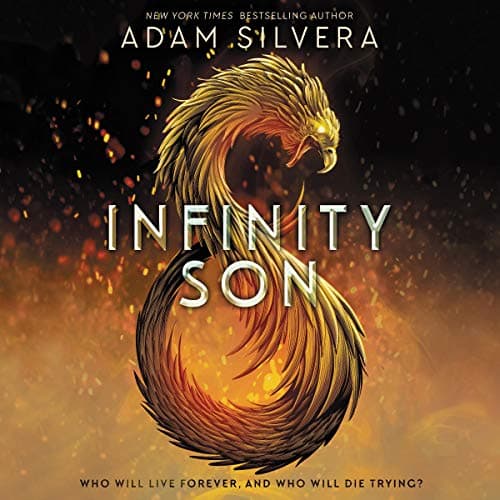

Most listeners seem to agree that Infinity Son has a killer concept but doesn't always deliver on its promise. Having burned through it over a week of commutes, I'd say that's about right — but I'd also argue the audiobook format rescues this story in ways the print version probably can't.
Here's the setup you need before you press play: Emil and Brighton are brothers in a version of New York City where some people are born with magical powers (celestials) and others steal those powers by butchering endangered magical creatures (specters). Brighton is the ambitious one, an aspiring social media influencer who documents the vigilante Spell Walkers and desperately wishes he had powers of his own. Emil is the quiet one who just wants everyone to stop killing each other. Then Emil manifests phoenix-like fire abilities during a street brawl, and the brother who never wanted to fight becomes the one everyone needs. The brother who wanted nothing more than to fight gets left behind. That tension — jealousy corroding love, duty crushing reluctance — is the real story here, and it's the part Silvera does best.
Let me get straight to why you should consider the audio version specifically: four narrators split the work, and the casting decisions are sharp. Robbie Daymond handles Emil with this restrained, anxious delivery that makes you feel the weight pressing down on a kid who just wanted to be left alone. There's a scene early on where Emil first uses his powers and the fear in Daymond's voice — not excitement, not triumph, just raw fear — sets the tone for everything that follows. Kirby Heyborne plays Brighton with a buzzing, almost jittery energy that captures that particular brand of young ambition where confidence and insecurity are basically the same thing. When Brighton livestreams the Spell Walkers, Heyborne hits this performative enthusiasm that you can tell is half genuine admiration and half personal branding. It's a specific, annoying, deeply human quality, and he nails it. Maria Liatis and Elliot Knight fill out the remaining POVs with clean, distinct work.
The multiple narrators solve a real structural problem here. Silvera jumps between perspectives constantly, and in print I can see how that would cause whiplash. In audio, you know whose head you're in within the first syllable. I was weaving through traffic on the Brooklyn Bridge approach — not the ideal moment for narrative confusion — and never once lost track of who was talking. The format genuinely improves the experience.
So where does the story itself wobble? The world-building comes at you like someone dumping out a box of puzzle pieces. Specters, celestials, phoenixes, alchemists, blood creatures, the Spell Walkers, some kind of ancient cycle of violence — there's a lot of mythology crammed into eight and a half hours, and the rules don't always stick on first pass. I rewound twice during one commute to catch how a specific power system worked because Silvera had already moved on to the next action sequence. The pacing has this herky-jerky quality: intense fight, emotional processing, intense fight, character moment, another fight. No consistent rhythm. The narrators smooth over the transitions with their performances, but you can feel the structure underneath lurching.
Compared to They Both Die at the End, which hit like a gut punch because it stayed focused and intimate, Infinity Son trades emotional precision for scope. The feelings are still there — Emil falling for someone while the world burns around him, Brighton's jealousy curdling into something ugly — but they're competing with a lot of plot machinery for your attention. If you came to Silvera for that devastating, intimate emotional impact, you'll find it here in smaller doses, diluted by the fantasy framework.
The LGBTQ+ representation works because it's just there, built into the characters rather than set apart for examination. Emil's developing relationship with another character unfolds with the same clumsy sweetness you'd find in any YA romance, and the narrators handle those quieter moments with genuine warmth. It never feels like a statement; it feels like a person.
The cliffhanger ending will either hook you or irritate you. I landed on the irritated side — the story felt like it was finally finding its footing right when it pulled the emergency brake. But that's the deal with series openers, and at least this one leaves you wanting more rather than feeling indifferent.
Who should listen: If you're shopping for a YA urban fantasy with heart, strong LGBTQ+ rep, and a genuinely excellent four-narrator audio cast, this earns its credit. Who should skip: If dense, rules-heavy world-building frustrates you on first pass, or you need a complete story arc without a cliffhanger, queue up something else. Just know either way — you're signing up for a series, not a standalone.