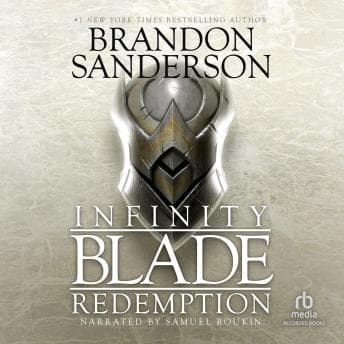
What happens when Brandon Sanderson writes a video game tie-in novel? Does he phone it in, or does he somehow create an actual magic system for a mobile game about stabbing immortals?
Look, I'll be honest - I started this audiobook because I needed something for my commute that wasn't my thesis advisor's disappointed emails. The Infinity Blade games were these gorgeous iOS action RPGs that I played way back in undergrad, but I never expected Sanderson to actually *Sanderson* them. You know what I mean? The guy can't help himself. Even in a 4.5-hour tie-in novel, he's building lore about deathless immortals, ancient technology that's basically magic, and conspiracies that fold back on themselves like origami made of plot twists.
When Video Game Logic Becomes Actual World-Building
Here's the thing about this book - it takes the respawn mechanic from the games (you die, you come back, you try again) and turns it into genuine mythology. The Deathless aren't just bosses you fight. They're ancient beings trapped in cycles of violence and politics, and Siris - our protagonist - is trying to break free from all of it. The Worker of Secrets as the big bad? *Chef's kiss*. Sanderson does that thing he always does where the villain's motivations actually make a twisted kind of sense.
The magic system here - and yes, there's a magic system, because of course there is - involves these Quantum Identity Patterns (QIPs) that determine who you are across deaths and rebirths. It's basically "what if your soul was code that could be hacked?" My D&D group would absolutely steal this for a campaign. The tech-magic blend reminds me of Warbreaker's Awakening, but with more swords and less color theory. That same video-game-turned-mythology vibe shows up in The Last Wish, where monster-hunting mechanics become actual folklore.
If you haven't played the games, fair warning: this is the second book in the series, and it assumes you know what's going on. Some reviewers got lost, and I get it. There's a lot of proper nouns flying around. But honestly? I think you can piece it together. Sanderson's pretty good at contextual exposition.
Samuel Roukin Nailed It (Mostly)
I need to talk about this narrator because he genuinely surprised me. Samuel Roukin brings distinct voices to each character - Siris sounds different from the God King, who sounds different from Isa. The emotional beats land. There's this moment where Siris is dealing with the division within himself (literally - it's a plot thing) and Roukin captures that internal conflict without going full melodrama.
The pacing gets a little uneven in the middle section. There's some political maneuvering and rebellion-building that drags compared to the action sequences. At 1.25x speed, it smoothed out nicely. But when the story picks up? Roukin's delivery during the fight scenes and revelations is genuinely gripping. One reviewer said he "gives the characters such life and such vivid personality" and yeah, that tracks. He's not Steven Pacey, but who is? (No one. The answer is no one.)
The Sanderson Signature Move
You know how Sanderson always has that moment where everything clicks together and you realize the weird detail from chapter two was actually foreshadowing? This book does that. The secrets about the Deathless, the true nature of the world, the origins of the Infinity Blade itself - it all connects. It's not Stormlight-level complexity, but for a 4.5-hour listen, the progression is satisfying.
The ending, though. Look. It's a cliffhanger. If you're sensitive to those, maybe wait until you have the next book queued up. I finished this at 11 PM and immediately started searching for the third one. (There is one. It's called Infinity Blade: Awakening. Wait, no - that's the first one. The third is... okay, the publication order is weird. Just know there's more.)
Roll for Initiative (Or Don't)
This is for Sanderson completionists, fantasy gamers, and anyone who wants a tight, action-packed story with actual world-building. The violence is present but not gratuitous - it's a story about warriors and death, so. Yeah. Swords happen.
Skip if you need everything explained from page one, or if cliffhangers physically pain you. Also maybe skip if you're looking for something that'll help you focus on your thesis. It will not. Ask me how I know.
I listened to this instead of writing my thesis. Worth it.