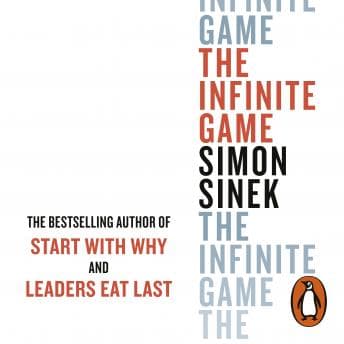

What if the reason your company's quarterly goals feel so soul-crushing is because you're playing the wrong game entirely?
I was stuck on a delayed Caltrain at Millbrae - the kind of delay where they won't tell you how long, just "momentarily" on repeat - when Sinek's central thesis clicked for me. Finite games have known players, fixed rules, clear endpoints. Infinite games have shifting players, changeable rules, and the goal is just to keep playing. Business, he argues, is an infinite game that too many leaders treat as finite. And suddenly I understood why every "we need to crush Q4" all-hands feels so... exhausting.
The Core Loop (And Why It Actually Compiles)
Sinek's framework boils down to five essential practices: just cause, trusting teams, worthy rivals, existential flexibility, and the courage to lead. It's basically design patterns for organizational longevity. The "worthy rival" concept hit me hardest - instead of obsessing over competitors to beat them, you study them to improve yourself. He uses Apple and Microsoft as his running example, and while that's a bit tired, he actually digs into specific moments: how Microsoft's Zune team was so focused on "beating the iPod" that they missed the smartphone shift entirely.
The science - well, game theory - actually holds up. Speaking of business books that actually cite their sources properly, How To Lie With Statistics does the same thing with data literacy—no hand-waving, just solid foundations. James Carse's original finite/infinite game distinction gets proper credit, and Sinek extends it thoughtfully rather than just slapping a business veneer on academic work. I appreciated that he acknowledges when he's simplifying.
Author-Narrated: The Double-Edged Sword
Sinek reads his own work, and look, the man knows how to deliver a TED talk. His pacing is deliberate, his enthusiasm is genuine, and he has this way of emphasizing key phrases that makes them stick. When he says "a just cause is not the same as a mission statement," you can hear the frustration he's felt explaining this to executives who don't get it.
But here's the thing about author-narrated business books: you're getting the keynote speaker, not the storyteller. Sinek's delivery is calm and measured - great for absorbing concepts, less great for staying engaged during the third example of "company that prioritized short-term gains and suffered." At 1.5x, it's perfect. At 1.0x, I found my mind wandering to work Slack notifications.
Could've Been a Blog Post? Almost.
Okay, I have to address the elephant. At just under 7 hours, this isn't a long audiobook. But some listeners feel - and I partly agree - that the core ideas could've been a substantial article. The first two hours are genuinely excellent. The middle section rehashes examples that start feeling redundant. By the time he's explaining the difference between finite and infinite thinking for the fourth time with a slightly different corporate anecdote, you're like "yes, Simon, I got it three examples ago."
The genre tax is real, though. Business audiobooks are almost always like this. At least Sinek's examples are concrete and his anecdotes are genuinely researched rather than made up. The Victorinox (Swiss Army knife company) story about how they survived the post-9/11 airline knife ban by pivoting to travel gear rather than laying off workers - that's the kind of specific case study that makes the repetition worthwhile.
Perfect For: Commute, Gym. Skip For: Deep Work.
This is background-friendly in the best way. You can miss a few sentences while checking your transfer and not lose the thread. The concepts are sticky enough that you'll retain the framework even at half-attention. I wouldn't recommend it for focused listening - you'll get frustrated by the pacing. But for a long drive or a gym session where you want something more substantial than a podcast? Solid choice.
If you've read Start With Why, you'll recognize Sinek's voice and approach. This feels like the logical next step in his thinking - less about individual purpose, more about organizational design. If you haven't read his previous work, this actually stands alone fine.
The ROI Calculation
Bottom Line: Worth your commute if you're in any kind of leadership role or just want language for why your company's "beat the competition" culture feels wrong. The framework is genuinely useful - I've already caught myself using "infinite game" in a design doc about technical debt. The narration is professional if a bit monotone. The length is appropriate for the content, though tighter editing would've helped.
Who should skip: If you're allergic to business books that use Apple as an example, or if you need your audiobooks to move at thriller pace. Also skip if you've already internalized "long-term thinking good, short-term thinking bad" - you won't get much new here.
Who should listen: Mid-level managers questioning why their org feels so reactive. Founders building something they want to last. Engineers like me who want vocabulary for pushing back on "we'll fix it after launch" cultures. Anyone who's ever sat in a quarterly planning meeting and thought "but why are we doing any of this?"
I finished this in 3 commutes at 1.5x. Didn't change my life, but it gave me a mental model I've used twice already this week. That's the same practical ROI I got from How To Win Friends And Influence People—frameworks you actually deploy in real conversations, not just nod along to. For a business audiobook, that's a win.