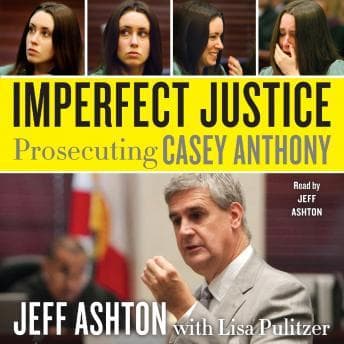

I was stress-cooking biryani at 10 PM—the kind of elaborate, three-hour project you undertake when your brain won't stop spinning—and I needed something to occupy the analytical parts of my mind while my hands worked through the layers of rice and meat. Jeff Ashton's account of the Casey Anthony prosecution seemed appropriate. A case study in failed justice, narrated by one of the key players. What could go wrong?
Quite a bit, as it turns out. But not in the ways I expected.
The Prosecutor on the Couch
Here's what fascinated me about this audiobook: Jeff Ashton is simultaneously the author, narrator, and—whether he intended it or not—the most revealing case study in the entire 11-hour runtime. The protagonist exhibits classic defensive attribution. He lost one of the most high-profile cases in American legal history, and the book reads like an extended exercise in external locus of control. The jury didn't understand. The defense played dirty. The media circus derailed everything.
Is he wrong? Not entirely. But my therapist would have thoughts about this character.
What makes this compelling—and I do mean genuinely compelling despite my criticisms—is Ashton's insider access to the investigation. The forensic evidence presentation is meticulous. The air sample analysis from Casey's trunk, the chloroform searches on her computer, the duct tape matching—he walks through each piece with the precision of someone who spent years building this case. You can hear him reconstructing the narrative he presented to that jury, and it's persuasive.
But then he'll describe a courtroom moment where he smirked or laughed at the defense, got reprimanded by the judge, and he recounts it with this tone that suggests he still thinks he was right to do it. And I found myself asking: why does a 30-year veteran prosecutor with 70 homicide trials under his belt behave like this in the most important case of his career?
When the Narrator Becomes the Evidence
This is where author-narrated true crime gets psychologically interesting. Ashton reading his own words means you're not just getting information—you're getting affect. And his affect is... complicated.
Some listeners have called him arrogant. That's fair. There's a self-satisfaction in how he describes his own legal maneuvers that borders on preening. But I'd argue it's more nuanced than simple arrogance. This is a man processing public failure through the only framework he has: prosecutorial certainty. He knows Casey Anthony killed her daughter. The evidence told him so. The jury's failure to convict doesn't change the facts for him—it just means the system failed.
The problem is that this certainty bleeds into the narration in ways that undercut his credibility. When he describes Jose Baez's defense tactics, the contempt in his voice is palpable. When he recounts the verdict, there's genuine bewilderment. He never quite arrives at the introspection you want from this kind of book. Prosecutors who lose high-profile cases often struggle with this exact pattern—the inability to separate "I built a strong case" from "I failed to communicate that case effectively."
Ashton does both. He built a strong case. And he also, by his own admission, engaged in courtroom behavior that may have alienated the jury. The book never fully reconciles these truths.
Forensics, Timelines, and What's Actually Here
Let me be clear: the actual content is valuable. If you followed the Casey Anthony trial and wanted to understand the prosecution's perspective, this delivers. The timeline of Caylee's disappearance, the 31 days Casey spent partying before reporting her daughter missing, the forensic evidence chain—Ashton presents it all with prosecutorial thoroughness.
The comparison that kept coming to mind was Vincent Bugliosi's Helter Skelter. Both are prosecutor-authored accounts of sensational trials. But where Bugliosi maintained a certain clinical distance even while being deeply invested, Ashton can't quite manage it. His emotional investment is too raw, too present. Which makes this a less reliable legal document but a more fascinating psychological one. The same kind of insider perspective—though with far more self-awareness—shows up in Eat a Peach: A Memoir, where the narrator's willingness to examine himself actually enhances the story.
At 11 hours and 35 minutes, it's a substantial commitment. I'd recommend 1.25x speed—Ashton's delivery is measured enough that you won't lose anything, and the legal detail can drag in places.
Listen If You Want the Inside Story, Skip If You Want Introspection
True crime completists who followed this case will find value here. If you want the prosecution's side of the story, this is as inside as you'll get. Legal procedural enthusiasts will appreciate the forensic detail. But if you're looking for genuine reflection on why the prosecution lost, for a reckoning with what went wrong beyond "the jury didn't get it"—you'll be frustrated. I was. (My biryani turned out perfectly, though. Small victories.)
Case Closed, Questions Open
Jeff Ashton wrote a book about Casey Anthony and accidentally wrote a book about Jeff Ashton. For a psychology researcher, that's actually more interesting than what he intended. But I suspect most listeners want the former, not the latter. The legal content is solid. The self-awareness is lacking. The narration is competent but colored by an emotional investment that some will find authentic and others will find grating.
It's imperfect justice, indeed. Just not only in the ways he meant.