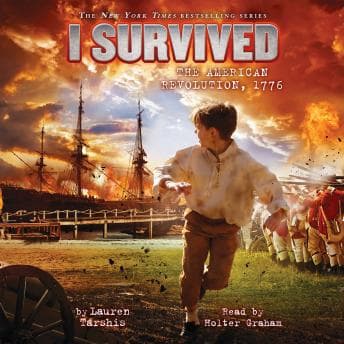

An eleven-year-old fleeing an abusive uncle and stumbling into the Battle of Brooklyn is, frankly, a setup my psychology brain can't resist.
I was chopping onions for a chana masala on a Sunday evening when I started this one — two hours felt like the right commitment for a kids' historical fiction book I'd grabbed on a whim. And look, I know I'm not the target audience. But Lauren Tarshis writes these I Survived books with a psychological clarity about trauma and survival that honestly puts some adult fiction to shame. So here I am, thirty-one years old, tearing up over an eleven-year-old Continental Army adjacent kid while my onions burn.
Nate Fox and the Psychology of Escape
The protagonist exhibits classic avoidant attachment patterns, and Tarshis earns every one of them. Nathaniel Fox isn't some plucky kid who dreams of liberty and freedom. He's a child laborer under a cruel uncle — Uriah Storch, whose name alone sounds like a Dickensian punishment — and his decision to flee isn't patriotic. It's survival. I found myself asking: why does Nate really end up in the middle of the Revolution? And the answer is painfully simple. He has nowhere else to go.
This is a fascinating case study in how children process danger. Nate doesn't understand the political tensions between America and England. He barely understands why soldiers are everywhere. Tarshis doesn't pretend an eleven-year-old would have sophisticated ideological commitments. Instead, Nate's war experience is filtered through the lens of a kid who already knows what it feels like to be trapped and powerless — his uncle taught him that. The Revolution just scales up the threat. Psychologically, this tracks beautifully. Kids who've experienced domestic abuse often have a strange, terrible preparedness for chaos. They've already been living in a war zone. I traced a similar pattern in Dear Mr. Henshaw, where a kid's emotional survival toolkit is built entirely around circumstances adults created for him — Leigh Botts doesn't choose his chaos either, and Beverley Cleary doesn't flinch from that.
At just over two hours, the book moves fast — almost too fast. You feel the compression. Nate goes from fleeing Storch to landing in New York City to being caught in what will become one of the bloodiest early battles of the war. There's not a lot of breathing room, which works for the intended young audience but left me wanting more interior time with Nate. I wanted to sit with his fear longer.
Holter Graham Does the Heavy Lifting
Holter Graham narrates with a steady, clear delivery that's well-calibrated for younger listeners — no vocal pyrotechnics, no distracting character voices competing for attention. For a single-narrator production with no sound effects or music, the weight falls entirely on Graham's ability to carry emotional stakes through his voice alone. He does. The war scenes have genuine urgency in his pacing; you can hear him lean into Nate's panic without tipping into melodrama. It's restrained work, which I appreciate.
That said, I wish I could tell you more about how he differentiates characters — the research is thin here, and honestly, in a two-hour listen with a tight cast, there's limited opportunity for vocal range. Graham's strength is tone rather than character voices. He understands that Nate's story is fundamentally about fear, and he narrates accordingly — controlled tension throughout, with the volume turned up (figuratively) when the battle arrives.
If I have a complaint, it's that at this length, I'd almost recommend 1x speed or even slower for kids. There's historical content packed into these two hours that deserves absorption time, especially for the target age range.
The Research Nerd in Me Approves (Mostly)
Tarshis is known for including solid historical research, and you can feel it here. The setup of New York City on the brink of the Battle of Brooklyn — the biggest engagement of the early Revolution — gives Nate a real, specific historical moment to inhabit rather than some vague "Revolution times" backdrop. The author understands human nature well enough to ground the big history in small, personal stakes. Nate doesn't care about independence. He cares about not dying. That's honest.
Where it falls slightly short is in the compression problem I mentioned. Two hours to establish an abusive home life, a flight, a journey to New York, AND a major battle? That's a lot. The emotional beats are all correct, but some feel rushed. My therapist would have thoughts about how quickly Nate processes his trauma — but then again, this is a book for eight-to-twelve-year-olds, not a clinical case study. (Even if I keep treating it like one.)
Who's This Really For?
Kids aged 8-12 who are curious about history but need a human entry point. Parents looking for audiobooks that won't insult anyone's intelligence. And apparently, psychology researchers making chana masala who get unexpectedly invested in the attachment patterns of fictional colonial children.
Skip it if you need complex character arcs or long-form storytelling. This is a sprint, not a marathon. But it's a well-constructed sprint.
My Clinical Assessment
Solid, psychologically honest children's historical fiction that respects its audience enough to show war as terrifying rather than glorious. At two hours, it's a perfect car ride or weekend listen for families. Not quite worth a full credit given the brevity — grab it on sale or through your library app. But Tarshis knows what she's doing with character motivation, and that's more than I can say for half the adult thrillers on my shelf.