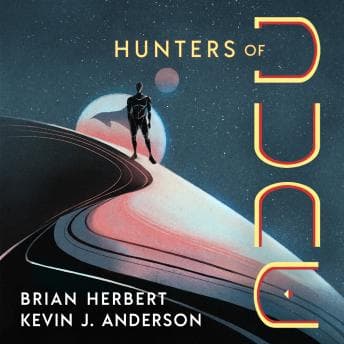

Can a sequel written from someone else's notes ever truly capture the original magic? That's the question I kept wrestling with across all twenty hours of Hunters of Dune, and honestly, I'm still not sure I have a clean answer.
Look, I need to get something out of the way first. I'm a Frank Herbert purist. The original Dune is basically my Bible - the spice, the politics, the Bene Gesserit scheming. It's Sanderson-level world-building before Sanderson was even a thing. I had similar reservations going into Once and Future Witches, another sprawling world with intricate political systems—though that one leans more into historical fantasy than space opera. So when Brian Herbert and Kevin J. Anderson started expanding the universe based on Frank's notes, I was skeptical. Still am, kind of. But here's the thing - I listened to this entire beast while grinding through some procedural generation code (not for my thesis, don't tell Dr. Patel), and I didn't hate it. I actually... enjoyed it? Mostly?
The Duncan Idaho Problem (And Why It Works Here)
So we've got Duncan's no-ship fleeing through uncharted space, a crew of refugees including Sheeana who can control sandworms (still one of the coolest abilities in sci-fi, fight me), and they're being hunted by this mysterious Enemy that even the terrifying Honored Matres are running from. The setup is genuinely compelling. And then they start bringing back gholas of classic characters - Paul, Chani, Lady Jessica, Stilgar, Thufir Hawat, even Wellington Yueh. My D&D group would absolutely lose their minds over this kind of character resurrection mechanic.
The problem? It sometimes feels like fan service rather than organic storytelling. Like, yes, I want to see these characters again. But the writing lacks that dense, philosophical weight that made Frank's prose feel like you were reading something important. Brian and Kevin write more... accessibly? Which isn't inherently bad, but it's different. You feel that difference.
Scott Brick Does the Heavy Lifting
Here's where I have to give credit where it's due. Scott Brick's narration is what kept me locked in through the slower stretches. The man won an Audie for Dune: The Butlerian Jihad, and you can hear why. Twenty hours is a marathon, and some narrators start phoning it in around hour fifteen. Not Brick. His pacing stays steady, his character voices remain distinct, and he brings genuine enthusiasm to material that could easily become monotonous.
Now, some listeners call his style "pompous and wooden." I can see where they're coming from - there's a formality to his delivery that doesn't exactly scream warmth. But honestly? For Dune? That kind of works. This isn't a cozy fantasy. It's political intrigue and genetic manipulation and the fate of humanity. A little pomposity fits the vibe. Steven Pacey this is not, but Brick knows what he's doing.
The character differentiation is solid too. When you've got Paul Muad'Dib and Duncan Idaho and Sheeana all in the same scene, you need to know who's talking. Brick handles that. Not flashy, but reliable - like a good DM who doesn't do voices but always keeps the story moving.
Who Should Strap In (And Who Should Skip)
Okay, real talk. If you haven't read the original six Frank Herbert novels, start there. Please. This is not your entry point. You'll be completely lost, and you'll miss why any of this matters.
But if you've already done the pilgrimage through Dune, Dune Messiah, Children of Dune, God Emperor, Heretics, and Chapterhouse? And you've been wondering for twenty years what happened to that no-ship fleeing into the unknown? This scratches that itch. It's not the same as getting a lost Frank Herbert manuscript, but it's something. The progression is satisfying in a comfort-food kind of way. Skip it if you need that dense philosophical prose or you'll spend the whole time comparing it unfavorably to Frank's work.
I listened during long coding sessions and some late-night gaming, and the steady pacing worked perfectly for background immersion. Not so demanding that I lost the plot when debugging, but engaging enough that I looked forward to putting my headphones back on.
Rolling a Nat 20 on Closure
Is this a work that stands alongside the original? No. The writing is more straightforward, less philosophical, occasionally clunky. But is it an enjoyable space opera that respects the source material and gives fans some closure? Yeah, actually. Yes, it's 40 hours when you include Sandworms of Dune. Yes, it's worth it - if you're already invested.
Scott Brick carries this thing on his shoulders, and the production is clean and professional throughout. I'm not going to pretend this replaced my thesis work with anything productive, but at least I was entertained while procrastinating. The Stormlight Archive can wait another week.
If you don't like info-dumps, this isn't for you (but you're wrong). And if you're expecting Frank Herbert's dense prose, recalibrate those expectations. But for Dune completionists who want to know how the saga ends? Strap in. The spice must flow.