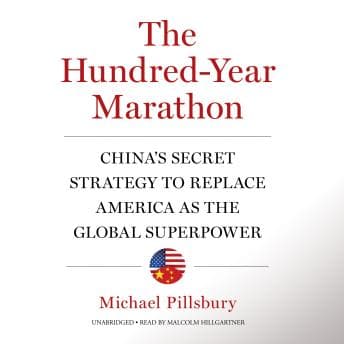

Michael Pillsbury's book made me angry. Not at the book itself — at myself, and at about four decades of American strategic thinking I was part of.
Let me cut to the chase: The Hundred-Year Marathon is the most important book on national security I've listened to in years, and it's going to make a lot of people uncomfortable. Good. Uncomfortable is where clear thinking starts.
The Intelligence Failure Nobody Wants to Own
Pillsbury's central argument is brutally simple: China has been running a long-game strategy to replace the United States as the world's dominant power by 2049, and we've been helping them do it. What makes this book hit harder than your average DC policy paper is that Pillsbury isn't some outsider lobbing grenades. He's a Mandarin-speaking insider who spent decades as one of the biggest advocates for US-China engagement — and he's essentially writing a mea culpa for getting it wrong.
That takes guts. I've sat in enough briefing rooms to know that admitting you misread the threat environment is career suicide in most circles. Pillsbury walks through how Chinese strategists drew on ancient texts like the Warring States period playbooks — shi (strategic advantage), the concept of assassinating with a borrowed sword — and applied them to modern geopolitics. He's not talking about Sun Tzu quotes on motivational posters. He's talking about a deliberate, multi-generational framework where the US was cast as the hegemon to be slowly displaced.
I've seen this scenario play out in real life on a smaller scale. In counterinsurgency, you learn fast that your adversary's timeline might be completely different from yours. We think in election cycles. They think in centuries. Pillsbury makes that asymmetry visceral.
Where the Homework Shows — and Where It Doesn't
The author clearly did their homework on the intelligence side. The sections covering declassified documents and interviews with Chinese defectors are the strongest parts of the book. Pillsbury's account of how Chinese military hawks privately discussed America as a declining power — even while smiling through diplomatic handshakes — is the kind of stuff that should be required reading at the War College.
But here's where it lost me a bit: Pillsbury sometimes oversimplifies the Chinese side into a monolithic strategic actor. Anyone who's worked coalition operations knows that even authoritarian governments have internal factions, competing priorities, bureaucratic turf wars. He acknowledges the "hawks" versus moderates dynamic but keeps defaulting to the hawks as the real voice of Beijing. Maybe he's right. But the argument would be stronger with more acknowledgment of internal Chinese debate.
The book also gets repetitive in spots. Around the six-hour mark, I felt like he'd made the same point about American naiveté three or four times. At 9.5 hours, it's not a massive time commitment, but a tighter edit would've sharpened the impact. I was driving back from a client meeting in San Antonio — long stretch of I-35 with nothing but Ranger sleeping in the back seat — and even with the road to fill, I caught myself drifting during the middle chapters.
Hillgartner Does the Job
Malcolm Hillgartner narrates this with the kind of clean, professional delivery you want for policy-heavy material. No theatrics, no weird inflections on Chinese names (which matters — nothing pulls you out faster than a narrator butchering Mandarin terms). He reads it like a well-briefed aide presenting findings, which fits the material perfectly. Not flashy, but solid. The man was named an AudioFile Best Voice for a reason.
At 1.25x, pacing felt just right. Hillgartner's natural cadence is measured enough that the speed bump doesn't lose any clarity.
Who Needs This Brief
If you work in security, defense, foreign policy, or frankly just care about where the US sits on the global chessboard — this is mandatory reading. Pillsbury wrote this in 2015, and watching his predictions track against the last decade of China's moves is genuinely unsettling.
If you want a balanced, both-sides-have-a-point diplomatic treatment? This isn't it. Pillsbury has a thesis and he hammers it. Some will call it alarmist. I'd call it a worst-case planning document — and in my line of work, you plan for worst cases or you plan funerals. George Lakoff's All New Don't Think of an Elephant! covers different terrain but lands a similar gut punch about how the side that controls the frame of a debate wins it — worth reading alongside this one if you want to understand why American messaging on China keeps losing ground.
Skip it if you need action sequences or narrative tension. This is a policy book dressed in spy-story clothes. The intelligence anecdotes are fascinating, but long stretches are pure strategic analysis.
Mission Debrief
Worth your time? Here's the debrief: Read this not because you'll agree with every word, but because understanding the argument is non-optional if you want to talk seriously about US-China relations. Pillsbury changed my thinking on a few things, and I don't say that lightly after 25 years of forming opinions in classified spaces. The middle sags, the argument occasionally overreaches, but the core thesis is a cold bucket of water to the face.
Ranger slept through most of it. But Ranger also sleeps through thunderstorms, so his standards are different from mine.







![Steve Jobs [unabridged audiobook] audiobook cover](/_next/image?url=https%3A%2F%2Fcovers.audiobooks.com%2Fimages%2Fcovers%2Ffull%2F9788499923406.jpg&w=1920&q=75)