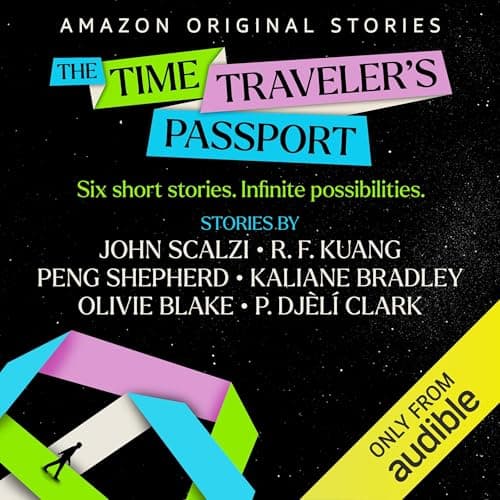

Six authors, six narrators, six time travel stories, seven hours. I started this at 2AM on a Wednesday because a cascading failure in our storage layer had me wide awake and too wired to sleep but too fried to actually think. Perfect state of mind for a short story anthology, it turns out.
Bottom Line: Worth your commute, but unevenly. Three of the six stories punch way above their weight class. The other three are... fine. You're basically getting a really solid three-hour collection bundled with a decent-but-forgettable three-hour collection.
The Hits That Justify the Runtime
Scalzi's "3 Days, 9 Months, 27 Years" is the opener, and it's the most Scalzi thing Scalzi has ever Scalzied - a time travel technician who has to stop being the person behind the controls and actually do something. The title itself is a puzzle box (the number pattern is not accidental, and when you realize what it maps to, it clicks in a way that's genuinely satisfying). Malcolm Hillgartner narrates it, and his dry, almost bureaucratic delivery fits the technician POV perfectly - like listening to an SRE describe an incident review that happens to involve temporal mechanics. Multiple listeners flagged Hillgartner as a standout and yeah, he earned it.
P. Djèlí Clark's "Cronus" is the closer and it's the heaviest story in the collection. A young Black woman in a segregated dystopia uncovering a time-bending secret - Clark takes the horror of Jim Crow logic and extrapolates it into a future that feels sickeningly plausible. A'rese Emokpae's narration carries real weight here. She got singled out by listeners as a five-star favorite and I get it - there's a simmering anger in her delivery that builds across the story without ever tipping into melodrama.
Kaliane Bradley's "A Visit to the Husband Archive" is the weird one, in the best way. A woman discovers hidden potential in a dystopia built around memory and identity - and if you've read The Ministry of Time, you'll recognize Bradley's obsession with how institutions catalog human connection. Mirai narrates, and does solid work keeping the dreamlike quality intact without making it feel floaty or detached.
The Stories That Could've Been Blog Posts
Okay, that's harsh. But R. F. Kuang's "Making Space" - about a childless couple taking in a mysterious boy - felt like it was building toward a revelation that never fully detonated. The ominous setup is strong but the payoff felt truncated, like the last ten minutes of a thriller where the credits roll during the climax. Peng Shepherd's time-traveling salesman story ("For a Limited Time Only") has a great premise - searching for the moments that truly matter - but plays it safer than I wanted. And Olivie Blake's vampire frenemies story is fun in a "reading-a-good-fanfic" kind of way but feels like it wandered in from a different anthology.
None of the weaker stories are bad. They're just operating at a different ambition level. It's like reviewing a PR where three files are elegant solutions and three files are functional but could use another refactor pass.
Six Narrators, No Consistency Tax
This is where anthologies usually fall apart in audio - you get narrator whiplash bouncing between voices. But because each story is self-contained with its own narrator, it actually works like switching between podcast episodes. You reset expectations with each story. Hillgartner, Walsh, and Emokpae are the clear MVPs. Jonathan Davis (who I know from a ton of sci-fi narration) is solid on the Kuang story but doesn't get enough material to really flex. Nobody phones it in, which for a six-narrator production is genuinely rare.
No sound effects, no music, no full-cast gimmicks. Clean, straightforward narration across the board. At 1.5x the whole thing clocks in under five hours - I finished it across two commutes and that late-night insomnia session.
Who Gets a Ticket (And Who Stays Home)
Pick this up if you want a time travel sampler platter from authors who each interpret the concept differently - Scalzi goes mechanical, Clark goes political, Bradley goes psychological. Skip if you need every story in a collection to land equally hard, because the quality gradient here is real. I ran into that same uneven-anthology problem with Point of Proximity, though that one never quite managed even three stories I wanted to keep thinking about afterward. Also skip if you want connected stories - these are completely standalone, no shared universe, no throughline beyond the theme.
The ROI on this audiobook is decent but not spectacular. At seven hours you're not making a huge commitment, and the three strongest stories would've been worth a credit on their own. The other three are pleasant but forgettable filler.
Commute Verdict: Three Stops, Not Six
I keep thinking about Scalzi's number pattern and Clark's ending. Two days later, those are the ones that stuck. For a short story collection, getting two stories to lodge in your brain permanently is actually a pretty good hit rate. Just don't expect all six to clear the bar.