
What if the reason you can't think clearly isn't because you're dumb, but because someone designed the confusion on purpose?
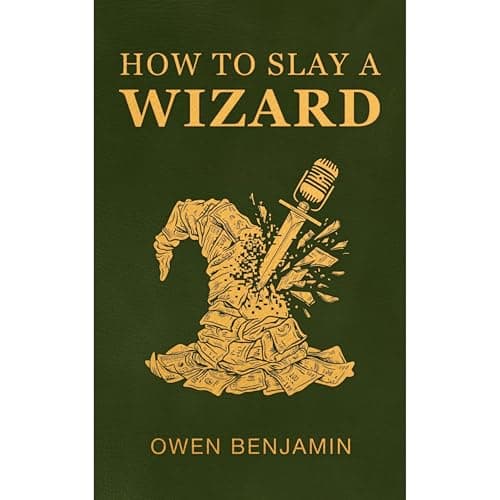
That question kept rattling around my head while I listened to Owen Benjamin's How to Slay a Wizard during a long stretch of solo yard work last weekend. Benjamin's central thesis is genuinely interesting, even when I wasn't sure I agreed with every thread he pulled. But let me break this down into what actually matters if you're deciding whether to spend a credit.
The Concept: Spells, Spelling, and the Machinery of Manipulation
Here's what the book actually is: a five-hour breakdown of how language, institutions, and social pressure are used to manipulate people into believing things that don't serve them. Benjamin uses "wizard" not as a fantasy trope but as a framework — wizards are the people who cast spells through words, and "spelling" is, well, spelling. It's a cute conceit that could easily collapse under its own cleverness, but Benjamin mostly keeps it aloft. He walks through fiat currency, propaganda architecture, the psychology of con artists, and the spiritual rot that turns an ordinary liar into something more dangerous. The wizard metaphor acts as connective tissue, linking topics that might otherwise feel like a conspiracy grab bag into something with a recognizable shape.
What works: Benjamin has a comedian's instinct for timing and analogy. Even in print — even read by a synthetic voice — his sense of rhythm comes through. He's genuinely funny in places, and the comparison he draws between spells and jokes that never land their punchline is one of those ideas that sticks with you after the audio stops. He's at his best when he's concrete: dissecting a specific piece of language, showing you the mechanism of a particular lie, walking you through how a con requires the mark's active participation. That last point is the book's real thesis, and it's a strong one. Every spell needs your cooperation. You are the missing ingredient. That's not a new idea — Chomsky and Bernays have been in this neighborhood — but Benjamin frames it with a directness and dark humor that feels distinct.
Where the Spell Breaks
The book occasionally drifts into territory where Benjamin's confidence outpaces his evidence. Some of his claims land with the force of revelation if you're already sympathetic to his worldview, but feel more like assertions if you're not. He's painting with a very broad brush in places, and the connections between, say, the food pyramid and the nature of the cosmos can feel held together more by rhetorical momentum than by rigorous argument. If you're the kind of listener who needs receipts with every claim, you'll occasionally find yourself wanting more.
At just over five hours, the pacing is brisk. Benjamin doesn't linger — he makes his point, supports it with a few examples, connects it to the larger framework, and moves on. This works in the book's favor since it never drags, but it also means some ideas that deserve deeper examination get the same surface treatment as throwaway observations.
The AI Narration Problem
Now, the elephant in the room: this is narrated by Audible's Virtual Voice, which means AI-generated text-to-speech. For a book written by a professional comedian — a guy whose entire career is built on delivery, timing, and vocal texture — this is a baffling choice. The narration is clear and consistent, and it handles Benjamin's direct, declarative prose well enough. But you can feel the absence of a human behind the mic. The jokes land flatter than they should. The moments that should hit with quiet weight just... proceed. It's like watching a stand-up set transcribed into a PowerPoint and read aloud by Siri's more serious cousin. The content survives, but something real is lost.
The Gist: Buy, Wait, or Skip?
Let me be plain: if you enjoy argument-driven books that connect language, manipulation, and social systems — and you can tolerate assertive claims without exhaustive sourcing — this will probably hook you. The wizard framework is clever, the pacing is tight, and Benjamin's ability to make abstract concepts feel tangible is a real skill. Multiple listeners have called it "timeless truth," and while I wouldn't go that far, the pattern-recognition it teaches you does tend to stick.
If you need documented evidence for every intellectual leap, or if AI narration flattening a comedian's timing sounds like a dealbreaker, skip the audio and grab the ebook instead. The ideas are worth engaging with, but this audiobook format actively undermines what makes Benjamin's voice — his actual voice — worth listening to.
Speaking of books where the author's actual voice and argument are inseparable from the experience, No God but One: Allah or Jesus? is another one where a human narrator carrying genuine conviction makes all the difference — the evidence-heavy approach there scratches a completely different itch, but if you like your ideas argued with real stakes, it's worth a look.
The comparable titles listed alongside this book are an odd bunch — Lord of the Flies, The Kybalion, Homer's epics. The books that kept coming to mind for me were more in the vein of Robert Anton Wilson's Prometheus Rising or Neil Postman's Amusing Ourselves to Death: books that ask you to look at invisible structures shaping your perception and then give you a vocabulary for seeing them. Benjamin isn't operating at that academic level, but he's playing in the same sandbox, and his comedian's eye gives him an angle those writers didn't have.
The AI narration and short runtime keep this from being worth a full credit. The ideas are sharp enough to cut through the synthetic delivery, but I'd love to hear Benjamin read this himself someday. Until then, wait for a sale or stream it — and consider picking up the print edition if the framework grabs you.