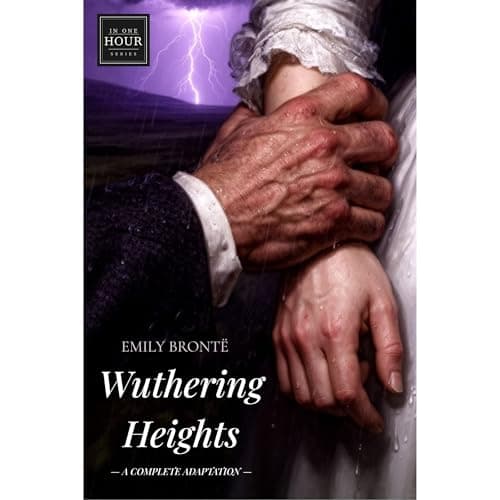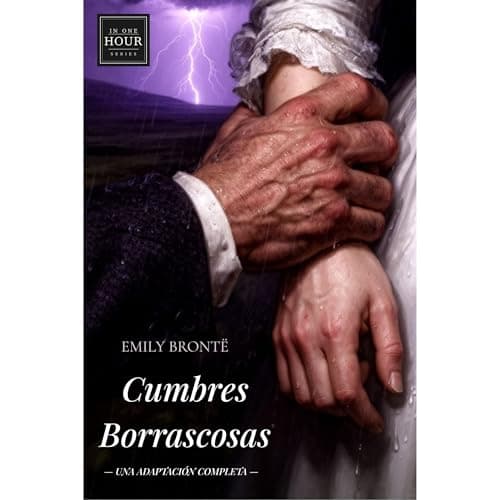

People keep telling me condensed classics are the future. That younger readers need shortcuts, that nobody has time for four hundred pages of Victorian prose anymore. I sat on my porch last Tuesday evening — the dogwoods just starting to brown at the edges, summer pushing hard into fall — and I thought, let me give this a fair hearing. Cumbres Borrascosas en Una Hora. Wuthering Heights in sixty minutes. My late husband and I read the original aloud one winter, trading chapters back and forth, and it took us the better part of two weeks. So I poured my sweet tea, set the playback to 0.85x like I always do, and pressed play.
And baby, my heart just about broke. But not for the reasons Brontë intended.
The Ghost at the Window Deserves Better Than a Machine
Let me be clear about what this is and what it isn't. Henry Bugalho's adaptation — the actual text — is a genuine effort. He's not writing CliffsNotes. He's rewriting the full arc of the novel in modern, accessible Spanish prose, and that's a legitimate project. The confession scene, Catherine's "Yo soy Heathcliff," Lockwood's encounter with the ghost tapping at the windowpane — these moments are all present, and the prose moves with enough force that you can feel Bugalho respects the source material.
But here's where everything falls apart. The narrator is a computer. A Virtual Voice. And Wuthering Heights — a novel built entirely on the volcanic difference between how Heathcliff speaks and how Nelly Dean speaks and how Lockwood speaks — gets flattened into one monotone digital reading. Catherine's wild desperation sounds exactly like Lockwood's mannered bewilderment. Heathcliff's return, which should land like a thunderclap, arrives with all the drama of a GPS giving directions.
Forty years of teaching literature taught me that voice carries meaning. The pause before a devastating line. The slight tremor when a character says something they can't take back. None of that exists here. It's not narration. It's text-to-speech with good enunciation.
A Love Story Read Without Love
I tried — I really tried — to hear past the robotic delivery. Around the twenty-minute mark, when Catherine is torn between Edgar's comfort and Heathcliff's wildness, I closed my eyes and willed myself to feel something. The words on the page (so to speak) were doing their job. But the voice reading them had no idea what those words cost. No understanding that "I am Heathcliff" is not information — it's a wound.
The second-generation love story, young Cathy and Hareton finding something gentler in the wreckage their elders left behind, barely registers at all. That quiet revolution needs warmth in the telling. It needs a narrator who can shift from gothic fury to something tender and hesitant. What it got was the same flat, synthesized tone that read the table of contents.
I will say this: if you're learning Spanish at an intermediate level, the clear pronunciation is genuinely useful. Every word is crisp. You won't struggle with mumbled consonants or swallowed syllables. As a language tool, I can see the value. But as an audiobook experience? As a way to encounter one of the most passionate novels in the English language, even in translation? No. That same longing for a story to reach through and actually hold you — Sun Also Rises did that for me, even in translation, because every word felt chosen by a human hand for a human heart.
Who This Porch Is Open To — And Who Should Keep Walking
If you're studying Spanish and want to absorb the Wuthering Heights plot before the 2026 film, this gets the job done in under two hours. Bugalho's adaptation is honest work, and the brevity is the point. You get every major scene, every character arc, compressed but not gutted.
But if you're coming for the emotional experience — if you want to feel the moors and the wind and the terrible beauty of two people who destroy everything they touch — you will feel cheated. The AI narration strips the soul right out of it. At a hundred minutes, the story already has no room to breathe. Pair that with a voice that doesn't know how to breathe either, and you've got something efficient but hollow.
My late husband would have set this down after five minutes and reached for our battered paperback instead. Some stories need time to breathe. This one needed time and a human voice, and it got neither.
The Lesson I Keep Learning
I don't begrudge anyone their shortcuts. Lord knows my students needed them sometimes. But there's a difference between making a classic accessible and making it convenient. Bugalho's text walks that line with care. The Virtual Voice pushes it right over the edge into convenience, and Brontë's moors go silent.
Read this adaptation if you want — I suspect the text version serves it better. But don't listen to it expecting communion with Catherine and Heathcliff. The machine doesn't know they're ghosts. It doesn't know they're in love. It doesn't know anything at all.