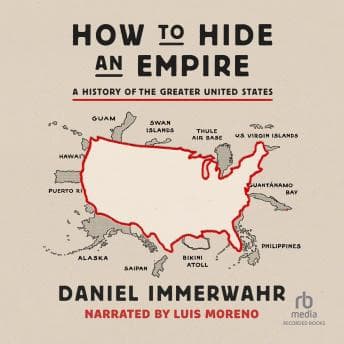

"The Philippines was the site of the most destructive event on U.S. soil."
That line hit me somewhere around hour three, driving back from a client meeting in Houston. I actually pulled over. Not because I didn't believe it—I've seen enough classified briefings to know our official history has some serious gaps—but because I'd never heard anyone say it that plainly. Sherman's March To The Sea taught me early that our most brutal chapters get sanitized the fastest. The Battle of Manila in 1945. American territory. Over 100,000 civilians dead. And most Americans couldn't find it on a map.
Let me cut to the chase: this book rewired how I think about American power projection, and I've spent 25 years thinking about exactly that.
The Empire You Were Never Briefed On
Immerwahr isn't some anti-American polemicist. He's a historian who noticed something obvious that nobody talks about—we have territories. We've always had territories. And the story of how we got them, what we did with them, and why we pretend they don't exist is genuinely fascinating.
The Guano Islands Act of 1856—and yes, we're talking about bird droppings—gave American citizens the right to claim any uninhabited island with guano deposits for the United States. That's how we ended up with over a hundred islands at one point. Bird poop was that valuable for fertilizer and explosives. Immerwahr clearly did his homework here, and the details are wild.
But it's not just historical curiosities. The Puerto Rico chapters hit hard. U.S. doctors using Puerto Ricans for medical experiments they'd never have conducted in Kansas. Independence fighters shooting up Congress in 1954—an actual armed attack on the U.S. Capitol that most Americans have never heard of. Immerwahr connects dots I'd never considered, even after three decades of studying geopolitics. Friday Night Lights did something similar for me with small-town America—showed me a whole world I thought I understood but really didn't.
Luis Moreno Earns His Paycheck
Seventeen and a half hours is a commitment. That's about a week of my normal driving schedule. Moreno makes it work. He's got this ability to deliver the bitter reality—and there's plenty of it—with the same clarity he brings to Immerwahr's genuinely funny asides. The book has humor, which surprised me. Dry, academic humor, but humor nonetheless.
No accent issues, no pronunciation stumbles on the Filipino, Spanish, or Hawaiian terms that come up constantly. For a book covering this much geographic territory, that matters. I've bailed on audiobooks where the narrator butchers place names I've actually been to—nothing breaks immersion faster. Moreno handles it all.
Where Strategy Meets History
I've seen this scenario play out in real life—the tension between formal empire and what Immerwahr calls "pointillist" empire. After World War II, we stopped wanting colonies. Too expensive, too politically messy. Instead, we built bases. Standardized everything from screw threads to radio frequencies. Created a global infrastructure that didn't require us to govern anyone directly but gave us reach everywhere.
The chapters on standardization sound boring. They're not. The story of how the U.S. military's logistics requirements basically created the modern globalized economy—that's the kind of connection that makes you see everything differently. I spent 25 years in that system. Never thought about it this way.
The book does slow down in spots—some of the post-war economics chapters require more focus than your average commute allows. I'd recommend dedicated listening for those sections, not background while you're doing something else. But even the dense parts reward attention.
Who's This Intel For?
If you want to understand how American power actually works—not the mythology, not the flag-waving, not the cynical counter-narrative either—this is your briefing. History buffs, policy wonks, anyone who's served overseas and wondered about the bigger picture. Skip it if you need action to stay engaged or if 17+ hours of academic history sounds like punishment.
Mission Debrief
Immerwahr's thesis is straightforward—the United States has always been an empire, we just got really good at hiding it, first from others and eventually from ourselves. The fifty states on the map are the logo version of America. The full picture includes 4 million people in territories who can't vote for president.
Ranger slept through most of this one—not enough gunfire for his taste. But I kept pausing to take notes, which I almost never do. That's the highest compliment I can give a history book.
Mission accomplished. Buy it.





![Steve Jobs [unabridged audiobook] audiobook cover](/_next/image?url=https%3A%2F%2Fcovers.audiobooks.com%2Fimages%2Fcovers%2Ffull%2F9788499923406.jpg&w=1920&q=75)