
"Heartbreak is a master manipulator."
That line hit me somewhere around the forty-minute mark, mid-jog through Cambridge, and I actually stopped running. Just stood there on the path near the river like a weirdo, catching my breath and thinking about every patient case study I've ever read on rumination cycles. Because that's exactly what Winch is describing here - not heartbreak as some poetic abstraction, but heartbreak as a cognitive hijacking. And as someone who spends her professional life studying how people's minds trap them in loops, I found myself nodding so hard I probably looked unhinged to passing joggers.
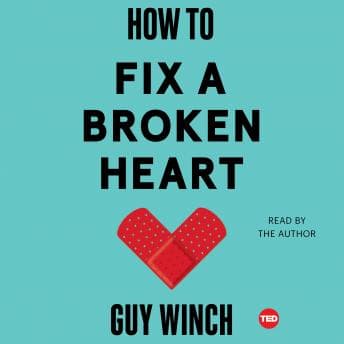
Guy Winch's How to Fix a Broken Heart is basically a 2-hour-47-minute therapy session with a psychologist who actually likes you. Which sounds dismissive, but I mean it as genuine praise.
Your Brain on Heartbreak (The Part I Nerded Out Over)
Here's what Winch gets right that a lot of pop psychology gets wrong: he treats heartbreak as a legitimate psychological event with measurable cognitive consequences. The research he cites on how emotional pain lowers reasoning ability and creative problem-solving? That's real. The way he describes the withdrawal-like symptoms of romantic loss - the compulsive checking of an ex's social media, the idealization of someone who was actually making you miserable - this is a fascinating case study in how attachment systems go haywire.
The research actually shows that the brain regions activated during heartbreak overlap significantly with those involved in physical pain and addiction. The kind of deep-dive into how an extraordinary mind processes emotion and pain differently is something Born On A Blue Day does from a completely different angle - and reading it alongside Winch made me rethink some of my assumptions about what "normal" emotional processing even looks like. Winch knows this literature, and he presents it in a way that doesn't feel like a lecture. He's drawing from his clinical practice, sharing patient stories (anonymized, obviously) that illustrate how heartbreak makes otherwise rational people behave in deeply irrational ways. The protagonist of every heartbreak story exhibits classic rumination patterns - replaying moments, searching for meaning in things that have none - and Winch names this tendency without judgment.
What I appreciated most, psychologically speaking, is his insistence that recovery starts with a decision. Not a feeling. A decision. That's consistent with what we know about behavioral activation in depression treatment. You don't wait until you feel like moving on. You choose to move on, and the feelings eventually follow. It's unsexy advice. It's also correct.
The Pet Loss Problem (And Why It Almost Lost Me)
Okay. So. The book covers two types of heartbreak: romantic loss and the death of a beloved pet. And I understand why Winch includes both - disenfranchised grief is a real phenomenon, and pet owners genuinely suffer from a lack of social recognition for their pain. The research supports this.
But psychologically, this doesn't quite track as a unified book. The toggling between "your partner left you" and "your dog died" creates these jarring tonal shifts that kept pulling me out of the listening experience. I'd be deep in a section about the cognitive distortions that follow a breakup - really good, clinically precise stuff - and then suddenly we're discussing the loss of a cat named Muffin, and my brain had to recalibrate entirely. The grief mechanisms overlap, sure, but the lived experience is different enough that the transitions feel forced rather than illuminating.
I found myself asking: why does this book try to serve two audiences when it could've gone deeper with one? A longer, more focused treatment of either topic would've been stronger. At under three hours, both subjects get competent but somewhat surface-level coverage.
Winch Behind the Mic (TED Talk Energy, For Better and Worse)
Having the author narrate his own psychology book is always a gamble. Winch wins that gamble - mostly. His delivery has the warmth and measured pacing of his TED talks, which means he knows exactly when to pause for effect and when to lean into the emotional weight of a story. There's a gentleness in his voice that feels clinical in the best way - like a therapist who's genuinely rooting for you but won't lie to you about how hard the work is.
The production is clean, with a bit of music at the close that doesn't overstay its welcome. But I'll say this: at 2 hours 47 minutes, this is a short listen. TED-talk-length thinking expanded to book length. Some of the practical advice - meditate, journal, remove reminders of your ex - lands as common knowledge dressed in a lab coat. My therapist would have thoughts about this book, actually, and I think she'd say: "Good primer, but you'll need more than this."
Who Needs This (And Who Doesn't)
If you're currently in the thick of heartbreak and you need someone smart and kind to explain why your brain is betraying you? This is genuinely useful. Winch validates the experience without enabling the wallowing, which is a hard line to walk.
If you've read any significant amount of attachment theory or grief psychology, you'll find familiar territory here. Not bad territory - just familiar. And if you're looking for a deep clinical dive, this isn't it. It's an introduction wearing a bow tie.
My Clinical Note
I finished this standing in my kitchen, stirring dal that was definitely about to burn, thinking about how many of my research subjects have described exactly the cognitive patterns Winch outlines. He understands human nature - specifically, the part of human nature that makes us cling to pain because letting go feels like losing the person twice. That insight alone is worth the listen. I just wish the book had trusted itself enough to go deeper instead of wider.