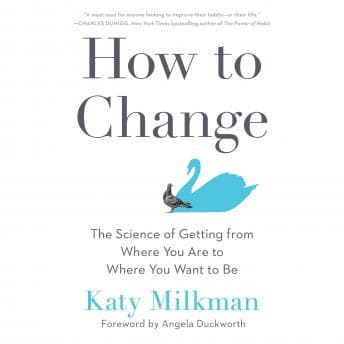

Jenny and I were reorganizing the garage at 10 PM on a Tuesday — her idea, not mine — when I put this on through the Bluetooth speaker. She lasted about twenty minutes before she said, "This is just someone telling you stories about other people who changed their habits." And honestly? She wasn't entirely wrong. But she also wasn't entirely right.
The 6-Hour Behavioral Science Sampler Platter
Bottom line: Katy Milkman wrote a solid primer on behavior change science that respects your time at 6 hours and 14 minutes. That's practically a pamphlet by business book standards. The key concepts — temptation bundling, fresh starts, commitment devices, copy-paste strategies — are well-organized and genuinely useful. Milkman's framework of diagnosing your specific barrier to change before picking a solution is smarter than 90% of the "just set goals and hustle" advice polluting the self-help shelf.
Here's what I actually took away: her concept of temptation bundling (pairing something you need to do with something you want to do) is the kind of thing my parents did instinctively. My mom used to watch Korean dramas while prepping clothes for pressing. She didn't need a Wharton professor to tell her that. But Milkman's contribution is the research backing — she ran the gym study where people who could only listen to their favorite audiobooks at the gym worked out more. As someone who's literally listening to audiobooks during every waking activity, I felt seen.
The fresh start effect chapter is the one I'd recommend to startup founders. The idea that temporal landmarks — new year, new quarter, Monday morning, post-birthday — create psychological openings for behavior change? I've seen this work. I had a client who relaunched their internal productivity initiative three times before it stuck, and the time it worked was right after they moved offices. New space, new start. Milkman would've predicted that.
Where the Anecdote Machine Starts Grinding
But Jenny's garage critique holds some weight. The book's structure is essentially: introduce barrier → tell three to four stories about people or studies related to that barrier → summarize the principle → repeat. By hour four, the pattern becomes predictable enough that you're anticipating the structure rather than being surprised by the insights. One listener nailed it when they said it felt like "an extremely repetitive and unending series of anecdotes." That's harsh. But at 2.0x speed, the repetition was manageable — I'd say at 1.0x it would test your patience.
The dual narration is interesting. Milkman reads most of the book herself, and she's clear and approachable — like a really good professor who knows how to hold a lecture hall. Angela Duckworth handles the foreword and pops in periodically. Their voices complement each other well enough, though neither is going to win narrator-of-the-year awards. It's competent, pleasant, and gets out of the way of the content. Which is exactly what you want from a science-backed nonfiction book.
What frustrated me is that Milkman sometimes stops short of the hard questions. She talks about commitment devices — like Ulysses tying himself to the mast — but doesn't spend enough time on what happens when commitment devices fail. I've seen three different companies implement penalty-based commitment systems for sales teams, and in every case, people gamed the system within two quarters. The real world is messier than the studies suggest, and I wanted more of that messiness.
Who Gets the ROI
If you're new to behavioral science — you haven't read Nudge, Atomic Habits, Thinking Fast and Slow — this is actually a great starting point. It's organized by problem type rather than by theory, which makes it immediately actionable. Manager trying to get a team to adopt new software? There's a chapter for that. Trying to save more money but keep impulse-buying? She's got you.
If you've already consumed the behavioral science greatest hits, you'll recognize a lot of the underlying research. The anecdote-heavy approach reminded me of a completely different genre doing the same thing — Killer Across the Table uses case study after case study to build its framework too, and it works better there partly because the subject matter keeps you too unsettled to notice the repetition. You might feel like one listener who said they "nearly gaslit myself into thinking I must have read the book prior." The novelty factor drops significantly if you've been in this space.
Skip this if you want deep theory or if you're looking for something that challenges the behavioral science orthodoxy. This is a synthesis book, not a paradigm shift.
The Consulting Engagement Is Over
At 6 hours, Milkman delivers maybe 4.5 hours of genuinely useful content — which is a better ratio than most business books I've reviewed. The framework of matching your specific obstacle to a specific strategy is worth the listen. The other hour and a half of repetitive anecdotes? My 2.0x speed handled that just fine.
Jenny finished organizing the garage without me. She says I owe her. She's right. But I did learn three techniques I'm already using with clients, so I'm calling that a net positive on the evening.