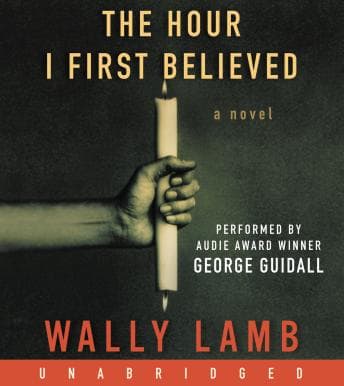

Everyone told me this was Wally Lamb's Columbine novel. And it is — for about the first five hours. Then it becomes something else entirely, something sprawling and unruly and occasionally maddening, and I'm still not sure whether that's a flaw or the whole point.
I started this one on a Saturday morning walk along the lakefront with Denise. By the time we got home, I wasn't ready to take the earbuds out. That should tell you something. Twenty-five hours later — and this is a genuine twenty-five-hour commitment, no shortcuts — I'm sitting here at my kitchen table at nearly midnight thinking about how a novel about a school shooting turned into a meditation on American trauma spanning five generations, the women's suffrage movement, and the prison-industrial complex. Wally Lamb doesn't do small.
A Fellow English Teacher Who Refuses to Stay in His Lane
Here's what got me: Lamb was a high school English teacher. Like me. Twenty-some years in the classroom. You can feel it in the way Caelum Quirk talks about his students, in the way faculty meetings drone on in the background of his life, in the bone-deep exhaustion of caring about young people who are surrounded by a world that keeps failing them. When Caelum gets the call about Columbine, there's this specific dread that only teachers understand — the arithmetic of it, counting which rooms, which hallways, whether your person was in the building.
But Lamb doesn't let you sit with that dread comfortably. He drags you from Littleton back to a Connecticut farmhouse, then back through 150 years of Quirk family history. Nineteenth-century diary entries from Caelum's ancestors. Letters about the Civil War, about women fighting for the vote, about institutional cruelty. Some listeners — and I get this — find the historical threads confusing or bloated. There's a legitimate argument that this is three or four novellas stitched together. My students would say "Mr. Williams, what's the POINT?" And I'd say the point is that American violence isn't an event. It's an inheritance.
Whether Lamb earns that thesis across 750-odd pages is the question. Sometimes yes. Sometimes the connective tissue between Columbine and, say, the women's prison subplot feels more like ambition than execution. I respect the reach even when the grasp slips.
George Guidall and the Maureen Problem
Let's talk about Guidall. The man is a legend — three Audies, hundreds of titles — and for most of this audiobook, he's doing exactly what great narration should do: disappearing into the text. His Caelum is weary and decent, the kind of voice you'd trust to tell you the truth even when the truth is ugly. And when Guidall reads the killers' journal entries? Chilling. Genuinely chilling. He doesn't sensationalize them. He reads them flat, almost clinical, which makes them worse. The narrator understands that pause is punctuation, and Guidall uses silence in those passages the way a good director uses a held shot.
The nineteenth-century letters are where Guidall really surprised me. He shifts his diction — more formal cadence, slightly different breathing — and you feel the century change. It's subtle work. Not showy. The kind of thing you'd miss at 1.5x speed. (Don't you dare.)
But here's the thing everyone argues about: Maureen. Guidall's voice for her has been called — and I'm quoting a listener here — "a really bad drag queen." That's harsh. But I understand the reaction. There's something slightly off about his register for her, a breathiness that feels performative rather than inhabited. It's not ruinous, but in a novel where Maureen's PTSD is the emotional engine for the first third, you need to believe her completely. I believed her about 70% of the time. The other 30%, I was aware of George Guidall doing a voice.
For a 25-hour listen, that's a significant wobble. But it's also the only real wobble. Every other character — Caelum's aunt Lolly, the various historical voices, even minor players — lands.
Who This Is For (and Who Should Run)
If you loved Lamb's I Know This Much Is True — which Guidall also narrated — this is its spiritual successor, though messier and more ambitious. If you're looking for a tight thriller about Columbine, you will be frustrated by hour eight. If you can surrender to a novel that wants to be about everything — grief, addiction, American history, the weight of family secrets, whether we can outrun what shaped us — there's real power here. Uneven power, but real.
This demands focused listening. I tried it during a faculty meeting once and immediately lost the thread of a diary entry from 1862. (Sorry, Principal Martinez. Though to be fair, I also lost the thread of your equity initiative update.) Save it for long walks. Long drives. Late nights when you can't sleep and you want a book that feels as restless as you do.
The Assignment I'd Give My Students
I'd tell them to read the first hundred pages and the last fifty. Then I'd ask: does the distance between those two points feel earned? I think it does — barely, imperfectly, in the way that real grief is imperfect. Lamb swings for something enormous here. He doesn't quite clear the fence, but the ball hits the warning track, and I'd rather watch that than a safe bunt any day.
This is why we still read the classics — and why some contemporary novels deserve to sit next to them, even with their flaws showing. My students would hate this. I love it. Mostly. The only other novel I've listened to recently that made me feel this conflicted about whether messiness is a feature or a bug was Nights in Rodanthe — though Lamb is swinging at something considerably heavier than Sparks ever attempts.