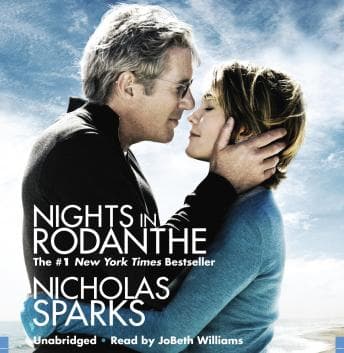

What do you do when you've spent fifteen years watching people at their worst moments - codes, traumas, the 3 AM confessions of patients who know they're dying - and you just need something that lets you feel something simple for once?
You listen to Nicholas Sparks. Don't judge me.
I finished this one pulling into my driveway after a particularly brutal night shift. Three codes, one didn't make it, and I sat in my car for an extra twenty minutes because JoBeth Williams was describing the storm rolling into Rodanthe and I needed to hear how it ended. Carlos texted asking if I was okay. I blamed allergies. It was not allergies.
The Formula That Works Anyway
Look, I'm not going to pretend this isn't exactly what you think it is. Divorced woman, 45. Successful surgeon, 54. Coastal inn. Storm brewing. Two wounded people finding each other. You could write the beats on a napkin.
But here's the thing - at 5 hours and 20 minutes, Sparks doesn't waste your time. He knows what he's doing. Adrienne's exhaustion from caring for her sick father while raising teenagers alone? That hit different. I've seen those caregivers in the hospital. I've been that caregiver. The way she describes just wanting one weekend where nobody needs anything from her - yeah. That's real.
Paul's story is more dramatic (estranged from his son, sold everything, running from a medical mistake in his past), but Williams reads his sections with this quiet weight that makes you believe a surgeon would actually talk that way. Sparks pulls off the same trick in Bend in the Road, where the grief underneath the romance feels too specific to be manufactured. The introspection doesn't feel forced. It feels like someone who's spent too many nights alone with their thoughts.
JoBeth Williams Knows What She's Doing
The narration is the reason to go audio on this one. Williams has this tender quality - she's not performing the romance, she's confiding it. Like she's telling you a story her friend told her, and she still gets emotional remembering it.
She captures Adrienne's sadness without making her pathetic. That's harder than it sounds. A lesser narrator would lean into the "abandoned wife" angle too hard, make you pity her. Williams makes you root for her. There's a difference.
The passion scenes - and yes, there are passion scenes, this is Sparks - she handles with enough restraint that I didn't feel weird listening in my car. (My coworker once caught me listening to a romance audiobook during lunch. The narrator was... enthusiastic. I still can't look her in the eye.)
Who Needs This (And Who Should Skip It)
If you need something that requires zero mental energy but still makes you feel things? This is it. Post-shift decompression. Folding laundry. That long drive to visit your parents when you need to prepare yourself emotionally for your mom's questions about why you're still "just" a nurse.
If you've seen the movie with Richard Gere and Diane Lane, you know the story. The audiobook gives you more of Adrienne's interior life, which I appreciated. She's not just waiting for a man to save her - she's actively choosing to let herself feel something again after years of just surviving.
Skip this if you need complex plots, you hate predictable romance, or you're going to spend the whole time being cynical about the setup. Some of my coworkers would absolutely hate this. They'd call it "unrealistic" and "emotionally manipulative." They're not wrong. But sometimes you want to be emotionally manipulated in a safe, controlled way. That's what fiction is for.
At First Sight is another one I've reached for on those nights when I need exactly that - Sparks doing what only Sparks does, no apologies.Clocking Out
Is it formulaic? Yes. Did I cry in my car anyway? Also yes.
There's a reason Sparks sells millions of books. He's not trying to reinvent storytelling. He's giving you exactly what the cover promises - two people finding unexpected love, a beautiful setting, some tragedy to make it feel earned. The audiobook format works because Williams' voice becomes this intimate presence during those quiet hours when you need company but don't want to think too hard.
My mom would love this. She'd also spend the whole time telling me I should've married a surgeon instead of Carlos. (Carlos is an electrician. Carlos is perfect. Mom still hasn't recovered from me not becoming a doctor, so she's transferred all her ambitions to my hypothetical husband.)
At 5 hours, it's the perfect length for a round-trip drive to Tucson or two nights of post-shift unwinding. Not every book needs to challenge you. Sometimes you just need to feel something clean and simple before you go back to the chaos.
Carlos asked why I was crying in the car. I blamed allergies.