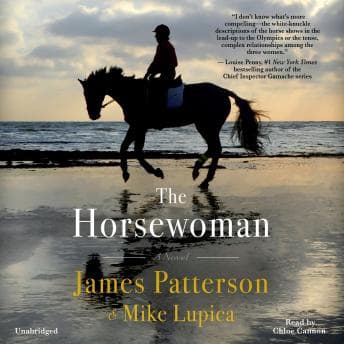

Okay, I need to rant for a second. You give me a book about a mother and daughter competing against each other on the road to the Olympics - THREE generations of complicated women with horses and ambition and probably decades of unspoken resentment - and you make it feel like a Hallmark movie script? James Patterson. Mike Lupica. I expected more from you. I wanted to feel WRECKED and instead I felt... mildly entertained? Like eating a rice cake when someone promised you conchas.
I was deep into a rebrand project for a local coffee shop, laptop surrounded by color swatches, Diego literally sitting on my Pantone book (he does this), and I thought: equestrian drama, mother-daughter tension, Paris Olympics backdrop? This is going to destroy me emotionally. Abuela would have loved this setup - it's basically a telenovela premise. The daughter defying the mother! The mother refusing to step aside! Horses as metaphors for freedom! I was READY.
The Bones Are There But the Meat Is Missing
Here's the thing that kills me. The concept? Incredible. Maggie Atwood is the established champion with Coronado, this gorgeous Belgian warmblood, and her daughter Becky has Sky, a smaller, scrappier Dutch warmblood - and the horse parallel alone should have been enough to build real emotional architecture. The big horse vs. the underdog horse mirroring the mother-daughter power dynamic? That writes itself. But Patterson and Lupica keep everything at surface level. I never felt like I understood WHY Maggie couldn't just be proud of her daughter. I never felt the specific texture of Becky's resentment. The chapters are so short they feel like someone clicking through a slideshow - you get a flash of emotion and then it's gone before it can land.
And listen, I know there are actual equestrian people out there who were apparently losing their minds over technical errors in the horse world details. I'm not that person - I couldn't tell you the difference between a flying lead change and a flying burrito - but when multiple horse people are saying the research feels sloppy, that's a credibility problem. It pulls you out of the story even if you can't name exactly what's wrong. Something just feels... off. Like watching a cooking show where the chef holds the knife weird.
Chloe Cannon Doing Her Best With What She's Got
Chloe Cannon is actually the bright spot here. She handles the emotional peaks well - when Becky and Maggie finally have their confrontation scenes, Cannon leans into the tension without going soap-opera shrill. There's a grandmother character too (the three-generation dynamic was the part I was most excited about), and Cannon shifts her register enough that you can track who's speaking. She's not Julia Whelan - nobody is - but she's solid. Warm when she needs to be, sharp when the competitive scenes demand it.
But here's my frustration: Cannon can only work with what's on the page. And what's on the page keeps pulling its punches. Every time a scene starts to build toward something raw and uncomfortable between mother and daughter, the book cuts away to another competition sequence or a training montage. The emotional moments feel rushed while the riding descriptions - which should be thrilling but end up repetitive - get all the real estate. At 11 hours, this isn't a short listen, and I kept waiting for the gut-punch that never came.
Who's Going to Love This (And Who Won't)
If you want a light, breezy sports-adjacent story with family drama that never gets too heavy, you'll probably enjoy this fine. It moves fast. The chapters are bite-sized. It's the audiobook equivalent of scrolling through your phone - easy consumption, low commitment emotionally. If you're an equestrian person, apparently steer clear unless you can tolerate inaccuracies. And if you're like me - if you come to a mother-daughter story wanting to feel your chest crack open - you're going to be disappointed. I added exactly zero entries to my crying spreadsheet. ZERO. For a book about mothers and daughters and the dreams they share and destroy? That's a failure. Big Lies in a Small Town earned its entry — another story about women, buried ambition, and the weight of what gets passed down — and that one actually did the work.
I kept thinking about what this could have been if someone had slowed down, ditched the Patterson-speed-machine formula, and just let these women breathe on the page. Let the silence between a mother and daughter in a stable at 5 AM actually mean something.
Frida Gave It Two Blinks and Walked Away
She's not wrong. This book felt like a sketch of something that could have been a painting - all the right shapes are there, but nobody filled in the color. My heart wanted to break and it just... didn't. Abuela would have watched this telenovela, sure, but she would have yelled at the TV the whole time about how they're rushing the good parts.