
"The Formics don't negotiate. They don't warn. They just... consume."
Somewhere around hour six, that line hit me while I was supposed to be debugging my procedural terrain generator. (Dr. Patel, if you're reading this, I was absolutely working on my thesis. The audiobook was just... ambient noise. Very productive ambient noise.)
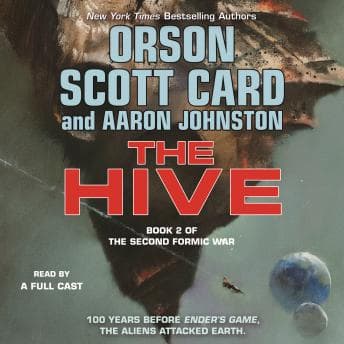
Look, I'm going to be honest with you: The Hive is the middle book of a prequel series to one of the most beloved sci-fi novels ever written. We all know where this ends. Humanity wins, eventually. Ender happens. The question isn't *if* we survive—it's *how*, and Card and Johnston make that journey worth every one of these fifteen hours.
When Nine Narrators Actually Works
Full cast productions can go one of two ways: either it's like watching a movie with your ears, or it's a chaotic mess where you can't tell who's talking. The Hive lands firmly in the first camp. Stefan Rudnicki anchors everything with that gravelly authority he's known for—the man has won more Audies than I have completed thesis chapters, which is saying something (and also nothing, because my chapter count is embarrassingly low).
Gabrielle de Cuir handles the more emotionally complex moments with the kind of precision that earned her those Golden Earphones. And here's the thing that makes full cast work: each narrator essentially owns their characters. You're not getting one person doing seventeen accents of varying quality. You're getting dedicated performances that build over fifteen hours until you forget you're listening to multiple people.
The only weird element? Orson Scott Card himself narrates portions. It's not bad, exactly, but there's something slightly surreal about the author reading his own work alongside professional narrators. Like your D&D DM suddenly reading from the published module instead of improvising.
The Sanderson Problem (But Make It Space)
Here's where I might lose some of you: The Hive is essentially a logistics book. It's about how humanity organizes itself to fight an existential threat. There are committee meetings. Resource allocation discussions. Political maneuvering between nations and corporations who hate each other almost as much as they hate the aliens.
And I *loved* it.
This is Sanderson-level world-building applied to military science fiction. Memory of Light does something similar with its massive coalition warfare, though with more magic and fewer spaceships. Card and Johnston aren't just telling you there's a war coming—they're showing you the supply chains, the manufacturing bottlenecks, the bureaucratic nightmares of getting Earth's fractured nations to cooperate. If you don't like info-dumps, this isn't for you (but you're wrong).
The Formics themselves remain genuinely alien in a way that most sci-fi fails to achieve. They're not just humans with different faces. Their hive-mind structure, their complete inability to comprehend individual consciousness—it creates this constant undercurrent of dread. You can't negotiate with something that doesn't recognize you as a thinking being.
The Pacing Problem Nobody Mentions
Okay, I'll be fair. Around hour ten, there's a stretch where the political machinations start feeling like they're spinning wheels. You've got three or four plotlines juggling simultaneously, and some of them—particularly the corporate espionage elements—don't carry the same weight as the military preparation stuff.
I pushed through at 1.0x because the full cast production deserves it, but I won't judge anyone who bumps to 1.25x during the slower sections. The action sequences, when they hit, absolutely earn your patience. There's a zero-G combat scene that had me pausing my non-existent thesis work to just... sit there. The visceral intensity reminded me of the best moments in Babel—different genres entirely, but both nail that gut-punch emotional impact when the violence finally arrives.
Who Should Enlist (And Who Should Stay Home)
This is for you if:
- You've read Ender's Game and want the full historical context
- You appreciate hard sci-fi that takes logistics seriously
- Full cast productions are your jam
- You don't mind knowing the general outcome because the journey matters more
Skip it if:
- You haven't read The Swarm (book one)—you'll be lost
- Military sci-fi isn't your thing
- You need a standalone experience
- Info-dumps make you want to throw your phone
Roll for Initiative Against the Hive
My D&D group would love this. It's basically a campaign where the party knows they're facing a TPK-level threat and has to convince the entire kingdom to prepare. The Hive doesn't reinvent the wheel—it's a solid middle chapter that advances the pieces toward the endgame we all know is coming.
Is it essential Ender's Game reading? Probably not. Is it fifteen hours of well-produced military sci-fi that scratches a very specific itch? Absolutely. I finished it at 2 AM when I should have been sleeping before my advisor meeting.
Dr. Patel was not impressed with my energy levels. Worth it.