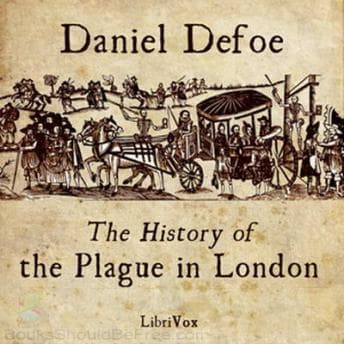

Daniel Defoe wrote the first great piece of literary journalism 57 years before journalism really existed.
I was walking the lakefront with Denise last Saturday — one of those late October mornings where the wind off Lake Michigan makes you question every life choice — and I had this running through my earbuds, and she asked me why I kept stopping to stare at the water. I didn't have a good answer. Something about Defoe's meticulous accounting of the dead — parish by parish, week by week, the numbers climbing and climbing — had me rooted to the spot. In 2024, after everything we went through starting in 2020, this book hits differently than it did when I assigned excerpts to my AP Lit class back in 2018. Back then it was a historical curiosity. Now it's a mirror.
The First Fake Memoir That Told the Truth
Here's what I love about Defoe, and what I always try to explain to my students (who mostly just want to know if it'll be on the test): the man invented a form. He was five years old during the 1665 plague. Five. He published this in 1722, presenting it as the journal of a saddler named H.F. who stayed in London while everyone with money fled. It's fiction wearing the costume of reportage — bills of mortality, city ordinances, burial statistics — and it works because Defoe understood something that took literature another century to figure out: specificity creates belief.
And the specificity here is relentless. H.F. doesn't give you dramatic deathbed scenes. He gives you the logistics of mass burial. He gives you the math of how many bodies fit in a pit. He tells you about the watchmen posted at doors of infected houses and the desperate people who broke out anyway. He describes a man in Aldgate who played a pipe from his window every evening until one evening he didn't. That detail — the silence where music was — that's the kind of thing Hemingway would later build an entire aesthetic around. Defoe got there first.
Twelve Hours of Lists, and Why That's the Point
Let me be honest about the listening experience: this is not a novel in any modern sense. There's no real plot arc. No character development. H.F. walks the city, observes, and reports. Defoe will spend twenty minutes on the specific wording of a public health order, then drop in a sentence about a mother finding her child dead in the street, and move on. The emotional whiplash is devastating precisely because Defoe doesn't dwell on it. It's the same trick he pulls in Moll Flanders, where Moll's crimes and miseries get recounted with such matter-of-fact bookkeeping that you only realize how much you care several chapters too late. He treats human suffering and municipal bureaucracy with the same documentary flatness, and that flatness becomes its own kind of horror.
At twelve hours, there are stretches that test you. The middle sections where H.F. catalogs which parishes were affected and in what order — I'll admit, during hour seven I was grading freshman essays on The Great Gatsby and my attention split. But here's what I've come to appreciate about Defoe's lists: they're doing what we now call "data journalism." He's building an argument through accumulation. The numbers aren't boring. They're unbearable. Each one was a person. That accumulation-as-argument approach is rare in fiction — the only recent book that hit me the same way is The Orphan Master's Son, where the sheer weight of reported detail becomes the emotional payload.
Dennis Sayers narrates with a steady, measured quality that suits the material. This isn't a book that needs theatrical range — there are very few distinct characters to voice — and Sayers seems to understand that. He reads like a man reading from a journal, which is exactly what H.F. is supposed to be. I can't point to any moment where he makes a bold interpretive choice, but I also can't point to a moment where he gets in the way. For a text this old and this dense, "doesn't get in the way" is doing real work. I listened at 1.0x because the prose deserves to be savored, but I'll say this: if you're struggling with the catalog sections, bumping to 1.15x wouldn't be a crime.
Who This Is Really For
If you loved Robinson Crusoe and wondered what Defoe could do with a city instead of an island — this is that book. And if you go looking for what comes after Crusoe's island years, Further Adventures of Robinson Crusoe exists — though fair warning, it's Defoe coasting on a great character rather than Defoe inventing a form. If you lived through lockdowns and want to understand that we are not the first people to argue about quarantine enforcement, this will unsettle you in productive ways. My students would hate this. I love it.
But I want to be clear: this is not beach listening. It's not even commute listening unless your commute involves zero cognitive demands. This is a book for a quiet room, a cup of coffee, and the willingness to sit with something that moves at the pace of dread.
If you're coming to Defoe for the first time, start with Robinson Crusoe. If you've read Crusoe and you're curious about the stranger, darker corners of early English fiction — this is where you go.
The Lesson Plan I'll Never Assign
I keep thinking about bringing this back into my classroom. The full text, not excerpts. I keep imagining the conversations we could have about how a society talks about mass death, about who gets to flee and who has to stay, about the way official language obscures human cost. And then I think about my juniors, who can barely get through a chapter of The Scarlet Letter without checking their phones, and I put the idea back on the shelf.
But I'll keep it in my earbuds. Some books aren't for teaching. They're for carrying with you while you walk along the water and remember that people have always died in overwhelming numbers, and other people have always tried to write it down, and that trying — that stubborn, insufficient, necessary trying — is what literature is for.