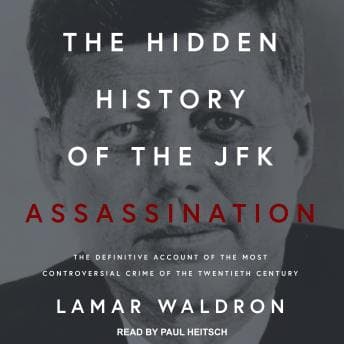

What if the most controversial assassination in American history was never really a mystery at all—just a secret held by the right people?
I was shelving true crime donations at the library last Tuesday, alone after closing because our budget doesn't stretch to evening staff anymore. The fluorescent lights buzz in that way that makes everything feel slightly wrong. Perfect conditions, honestly, for letting Lamar Waldron walk me through exactly how Carlos Marcello allegedly orchestrated the murder of a president.
The Horror of Bureaucratic Evil
Here's what Waldron understands that so many JFK conspiracy books don't: the scariest part isn't shadowy figures in grassy knolls. It's paperwork. It's FBI files that sat classified for decades. It's the mundane machinery of organized crime operating in plain sight while government agencies looked the other way—or worse, actively covered tracks to protect their own operations.
Waldron builds his case methodically, and I mean methodically. Sixteen and a half hours of connecting Marcello, Trafficante, and the institutional failures that let them operate. He draws heavily on the House Select Committee on Assassinations findings from the late 1970s—the one that concluded JFK was "probably assassinated as a result of a conspiracy" and then... nothing happened. That detail alone kept me up past midnight.
The FBI confession from Marcello himself forms the spine of this thing. Waldron uses the godfather's own words to his associates, and there's something deeply unsettling about hearing these admissions narrated in Paul Heitsch's steady, almost clinical voice. No dramatic music. No sound effects. Just the words, laid out like evidence on a coroner's table.
Paul Heitsch: The Documentarian Approach
Heitsch has been producing and engineering spoken word for over two decades, and you can tell. This isn't a performance—it's a presentation. He treats Waldron's investigative journalism with the respect of someone who understands that the material doesn't need embellishment. The horror is already there.
Does this work? Mostly, yes. For a book this dense with names, dates, and interconnected mob figures, Heitsch's clarity is essential. I never lost track of who was connected to whom, which is saying something when you're juggling multiple godfathers, CIA operations, and Kennedy administration officials across nearly seventeen hours.
But—and this is where I got a little restless around hour ten—that same measured approach means there's no acceleration when the narrative demands it. The revelation of Marcello's confession should hit like a gut punch. Instead, it lands with the same weight as everything else. Heitsch commits to consistency, which is admirable, but I wanted him to let loose just once.
When Research Becomes Obsession
Waldron interviewed more than two dozen Kennedy associates, former FBI and Secret Service personnel, military intelligence officers. The man has sources. My podcast listeners know I appreciate receipts, and this book has receipts stacked to the ceiling.
The problem with exhaustive research, though? It can exhaust your listener too. There are stretches where Waldron seems determined to prove he's done the work rather than trusting that we believe him. I found myself speeding up to 1.25x during some of the more repetitive evidentiary sections—not because the information wasn't valuable, but because I'd already gotten the point three examples ago.
This is focused listening material. I tried it during my commute once and completely lost the thread when someone cut me off on the highway. You need to be present for this. Preferably with a notepad if you're the type who wants to follow up on the sources yourself. (I am, and I did, and now I have a reading list that will haunt me for months.)
Who Gets the Clearance—And Who Should Walk Away
If you've read every JFK book and think you know the story, Waldron might actually surprise you. He's not rehashing the greatest hits—he's presenting a specific, argued thesis with the confidence of someone who believes he's solved it. Whether you buy his conclusions is another matter, but the argument is coherent.
Skip this if you want entertainment. This isn't a thriller dressed up as history. It's history that happens to read like a thriller because the actual events were that disturbing. Also skip if you need your narrators to do voices—Heitsch doesn't differentiate characters dramatically, and in a book with this many players, that can occasionally blur things together.
Perfect for: true crime completists, JFK obsessives who've exhausted the mainstream options, anyone who finds institutional failure more terrifying than lone gunmen.
Case Closed? The Files Stay Open
I finished this at 1 AM, Shirley asleep on my chest, staring at the ceiling and thinking about how many government documents are still classified. About how the official story never quite added up, and how Waldron's version—Marcello, the mob, the convenient blindness of agencies with their own secrets to protect—makes a horrible kind of sense. That institutional blindness, the way systems protect themselves at any cost, reminded me of the darker patterns explored in Molecule of More, though from a completely different angle.
Does he prove it beyond doubt? No. But he builds a case that deserves to be heard, and Heitsch delivers it with the gravity it warrants. Sixteen hours is a commitment. For the right listener, it's worth every minute.