
I was grading sophomore essays on The Great Gatsby—yes, the ones where they all discover that the green light is a symbol, as if Fitzgerald buried it in code—when March Murray walked back into her hometown and I completely forgot about Nick Carraway.
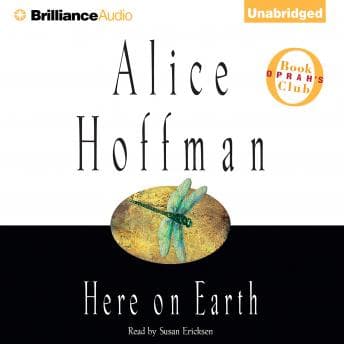
Look, I've been teaching Wuthering Heights for two decades. I know obsessive love. I've seen that same destructive intensity explored in Other Side of the Pillow, though from a completely different angle. I know the kind of passion that burns everything down and leaves you standing in the ashes wondering what the hell just happened. But Alice Hoffman's Here on Earth hit me different. Maybe because I was listening at 11 PM with a stack of ungraded papers and my third cup of coffee, or maybe because Susan Ericksen's voice has this quality that makes you feel like you're being told a secret you shouldn't hear.
The Wuthering Heights of Massachusetts
Hoffman isn't subtle about her influences here, and honestly? I respect that. This is a modern retelling of Brontë's classic, transplanted to a small Massachusetts town with all the gothic atmosphere intact. March Murray is our Catherine, Hollis is Heathcliff, and the moors have been replaced by New England farmland that somehow feels just as haunted.
But here's where Hoffman does something interesting—she strips away the romantic fog that makes us root for Heathcliff. She shows us what obsessive love actually looks like when you're not a Victorian teenager reading by candlelight. It's not romantic. It's terrifying. And Ericksen's narration captures that slow slide from nostalgia into something much darker.
My students would probably hate this book. They want their love stories wrapped in redemption arcs and happy endings. They're not ready for a story that asks whether some loves are actually destruction wearing a pretty mask. (Don't tell them I said that. They already think I'm too cynical about romance.)
Susan Ericksen Gets the Assignment
The narration here is doing heavy lifting. Ericksen has this soothing quality that works perfectly for the story's seductive opening—March returning home, the pull of memory, the way the past keeps reaching for us. But as things get darker, that same smooth voice becomes almost unsettling. You're being lulled into something dangerous, and you know it, but you can't stop listening.
She handles the character work well enough. March's vulnerability comes through clearly, and there's a weariness in how she voices the older characters that feels authentic. I did notice that some of the male voices blend together a bit—Hollis and the other men in March's life don't always feel distinct. But honestly, maybe that's the point? Maybe they're all just variations of the same gravitational pull.
The pacing dragged for me in the middle sections. I'll be honest—I zoned out during a faculty meeting (sorry, Principal Martinez) and missed a chunk, then realized I hadn't missed much. There's a languorous quality to Hoffman's prose that works beautifully in print but can feel slow in audio. I never sped it up, though. The prose deserves to be savored, even when the story meanders.
What the Author Is Really Saying
This is why we still read the classics, and why retellings matter. Hoffman takes a story we think we know—the consuming passion, the return to one's roots, the love that transcends time—and asks us to look harder. Is Heathcliff romantic, or is he a cautionary tale we've been misreading for 150 years?
March's journey is heartbreaking precisely because she's smart enough to see what's happening and still can't stop it. That's the real horror of obsessive love. It's not about being foolish. It's about being human.
I found myself thinking about this book while walking the lakefront with Denise, trying to explain why I was so unsettled. "It's like Wuthering Heights," I said, "but honest." She reminded me that I've been saying Wuthering Heights is problematic for years. She's right. Hoffman just finally showed me what I meant.
Who Should Listen (And Who Should Skip)
If you loved Practical Magic or The Rules of Magic, this is darker territory. Same lyrical prose, same sense of place, but the magic here is psychological rather than literal. It's Hoffman at her most gothic. Fans of literary fiction who want something with emotional weight—this is for you. Skip it if you're looking for a cozy listen or need your love stories to end well. This one lingers in uncomfortable ways.
The audiobook works, but I'd recommend the print version if you're the type who likes to pause and reread sentences. Hoffman's prose rewards that kind of attention. Ericksen does solid work, but some of the novel's beauty gets smoothed over at audio pace.
Worth pausing the faculty meeting for? Absolutely. Just maybe not the best choice for bedtime unless you want to lie awake thinking about the lies we tell ourselves about love.