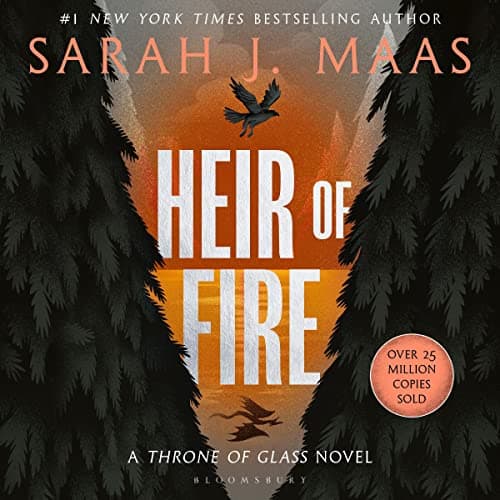

What happens when a fantasy series stops being about assassins and starts being about identity? Because somewhere around hour three of Heir of Fire, I realized Sarah J. Maas had pulled a bait-and-switch on me — and I wasn't even mad about it.
I was supposed to be debugging a procedural dungeon generator for my thesis. Instead I had my headphones in, VS Code open with zero lines written, completely locked into Celaena Sardothien's emotional breakdown on a frozen mountain in Wendlyn. Dr. Patel, if you're reading this: I regret nothing.
The Book Where Maas Levels Up Her Skill Tree
So here's the thing — the first two Throne of Glass books are solid fantasy with a competent protagonist who stabs people. Fun. But Heir of Fire is where Maas clearly decided she wanted to build something bigger. This is her transition from "cool magic assassin" to actual epic fantasy with multiple POVs, political factions, and a magic system that finally gets room to breathe. The fire magic progression Celaena goes through with Rowan Whitethorn? Genuinely satisfying. Watching her go from unable to produce a spark to — well, you know where it's heading, and it still hits.
But the real flex is the Manon Blackbeak chapters. Maas drops you into an entirely separate storyline with iron-toothed witches competing for war mounts, and instead of feeling like a distraction, it's the thing I looked forward to most. Manon choosing her wyvern Abraxos — the broken, undersized one nobody wanted — over the biggest beast? My D&D group would love this. That's the kind of character-building moment that earns loyalty, both from the reader and from a thirteen-winged death lizard. The same scrappy-underdog energy — characters earning their place through grit rather than birthright — is what pulled me through Dirty Magic, too.
The weakest link is probably the Chaol chapters back in Adarlan. They're necessary for the plot architecture, but after spending time with Rowan's brutal training sessions and Manon's Ironteeth politics, cutting back to court intrigue feels like downshifting from fifth gear to second.
Elizabeth Evans: Leveling Up With the Material
Compared to the earlier books, Evans sounds like she found her footing here. Her Rowan has this cold, clipped authority that works perfectly for a centuries-old Fae warrior who's basically over everything. And her Manon — there's this predatory calm she uses that's distinct from every other female voice in the book.
But — and this is real — she overplays the emotional beats sometimes. Celaena's grief scenes are intense on the page, and Evans cranks them to eleven when an eight would've landed harder. Some of Celaena's internal monologue comes out sounding more like a frustrated teenager than a trained killer processing trauma. Not a dealbreaker, but there were moments where I pulled back from the story because the delivery was doing too much.
She's a single narrator handling what amounts to three separate novels worth of character voices, and she mostly pulls it off. That's no small thing for nearly eighteen hours of audio.
How It Stacks Against the Shelf
If you've read A Court of Thorns and Roses, you can feel Maas workshopping the Fae dynamics she'd later perfect there. Rowan is basically a prototype for Rhysand — the immortal male love interest who's harsh on the outside, protective underneath. But Heir of Fire is rougher, angrier, less polished. I honestly prefer that? There's a rawness to Celaena's arc here that ACOTAR sands down in favor of romance.
Pacing-wise, this is closer to a Sanderson setup book than a standalone adventure. You're watching pieces move into position. If you need every chapter to end on an action beat, this will test your patience. If you're the kind of reader who likes watching a magic system unfold and characters earn their power — yeah, this is Sanderson-level world-building in a YA-adjacent package, and I mean that as a compliment.
Yes, it's nearly 18 hours. Yes, it's worth it. But it asks for your attention. This isn't background listening while you're grinding in Baldur's Gate. The three POV threads demand that you track who knows what and where the timelines intersect.
Who Should Listen (And Who Should Skip)
If you love watching magic systems unfold and characters grind for their power-ups — the LitRPG progression crowd, the Sanderson fans, the "I'll sit through a slow build for a massive payoff" people — this is your book. Skip it if you need nonstop action or can't handle 18 hours of setup-heavy epic fantasy with a YA voice.
Roll for Recommendation
I listened to this instead of writing my thesis, and I'd do it again. Heir of Fire is where the Throne of Glass series stops being a guilty pleasure and starts being actual ambitious fantasy. It's messy in places, the narrator occasionally overshoots on drama, and Chaol's sections drag. But the Manon storyline alone is worth the listen, and Celaena's fire magic progression scratches the same itch as a good LitRPG power-up arc. If you're three books deep in this series on audio, this is where it rewards your investment.