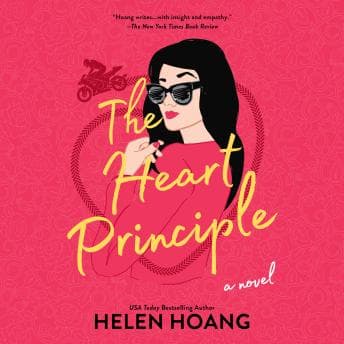

So everyone told me The Heart Principle was the lightest of Helen Hoang's Kiss Quotient series. A fun rom-com. Easy listening. And I went in expecting exactly that - something breezy to get me through a marathon rebrand project at 2 AM with Diego curled on my keyboard and Frida doing her sphinx impression on the printer.
I was so, so wrong.
This Book Came for My Whole Chest
Let me just say: I did not have "sobbing into my stylus while trying to kern a logo" on my Tuesday night bingo card. The Heart Principle starts with the setup of a rom-com - Anna Sun, a violinist who goes viral, tries to figure out casual dating after a breakup, meets Quan Diep, who's sweet and patient and covered in tattoos - and then Helen Hoang pulls the rug out from under you so slowly you don't even realize you're falling until you're already on the floor.
This is not Beach Read territory. This is a book about burnout so bone-deep it becomes clinical. The closest I've come to this emotional weight in a beach-adjacent title was Beach House, and even that one kept the darkness at arm's length in a way Hoang absolutely refuses to do. About losing yourself to other people's expectations until you literally cannot create anymore. Anna's autistic experience isn't a quirky character trait here - it's the engine of her suffering when every person in her life demands she mask harder, perform better, give more. The scenes where she's trying to compose music and nothing comes? Where she's physically unable to practice because her body has just... stopped cooperating? I had to pause the audio and sit with that. Because I've been there. Not with a violin, but with a blank Illustrator canvas at 3 AM when a client wants "something that pops" and your brain is just static.
And then there's Quan's side - dealing with his father's cancer diagnosis, caregiving, watching someone you love deteriorate. Yeah. Two years after losing Abuela, that hit different. I wasn't ready. My spreadsheet got a new entry. Multiple entries.
Natalie Naudus Understood the Assignment (Brian Nishii... Mostly Did)
Here's where I landed on the narration, and it surprised me: Natalie Naudus is phenomenal. Her Anna has this quality - husky but fragile, like she's always one breath away from either laughing or breaking. During the scenes where Anna is spiraling into depression, Naudus drops her voice to almost a whisper, and it's devastating. Not performative sadness. Quiet, exhausted sadness. The kind where you can't even cry properly anymore. That distinction matters.
Brian Nishii is... more complicated. His Quan has this soft, steady warmth that works perfectly for the supportive boyfriend moments - when Quan is patient with Anna, when he's showing up without being asked, Nishii's quiet determination makes you believe this man would wait forever. But - and I feel conflicted saying this - his voice has a youthful quality that occasionally undercuts the heavier scenes. The romantic scenes specifically felt a little thin to me, like the emotional weight of what was happening between these two people needed a lower register, more grit. It's not bad narration. It's narration that sometimes doesn't match the intensity of what Hoang wrote.
The dual narrator format works though. You always know whose head you're in, and the contrast between Anna's increasingly fractured inner world and Quan's steadier (but still hurting) perspective gives you emotional whiplash in the best way.
The Book That Would've Made Abuela Clutch Her Rosary AND Call Her Doctor
I need to talk about the content warnings because they are not decorative. Cancer. Suicidal ideation. Emotional abuse from Anna's family - not the dramatic telenovela kind Abuela and I used to gasp at, but the quiet, insidious kind where people who love you make you smaller every day with their "concern." Anna's mother and her ex-boyfriend, Julian, are the kind of villains who'd never see themselves that way, and honestly those characters made me angrier than any mustache-twirling antagonist ever could.
Hoang is autistic herself, and you can feel it in how she writes Anna's experience - the sensory overwhelm, the scripting of social interactions, the absolute terror of being perceived as "difficult" when you're just trying to survive. It doesn't feel researched. It feels lived.
Who Needs This Book (And Who Should Brace Themselves)
If you want a light romance, this ain't it. If you want a romance that earns its happy ending by dragging you through genuinely dark territory first - burnout, grief, depression, the specific pain of being neurodivergent in a world that rewards masking - then yes. This book felt like sitting with someone who finally says the thing you've been afraid to say out loud. The vibes are not immaculate. The vibes are raw and bruised and tender. And the ending lands because you watched these two people fight like hell to get there.
Listen at 1.0x. You need the pauses.
My Heart Needed a Cigarette After This One
Three crying sessions. One full pause-and-stare-at-the-ceiling moment. Abuela would have loved this one - she always said the best love stories make you suffer first. She wasn't wrong.