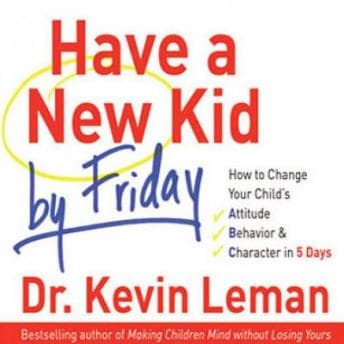

Jenny and I were in the car after a particularly brutal Saturday morning at Target - our five-year-old had thrown himself on the floor in the electronics section because we wouldn't buy a $60 LEGO set, and our eight-year-old had perfected this new thing where she just... stares at you when you ask her to do something. Like a tiny, hostile CEO. Jenny pulled up this audiobook on her phone and said, "We're listening to this. Now." I didn't argue.
Four and a half hours later, I had feelings. Mixed ones.
The Core Framework Is Actually Solid (And Short Enough to Respect)
Bottom line: Kevin Leman's central thesis can be summarized in about 15 minutes, and it's genuinely good advice. Let the reality of the situation be the teacher. Kid forgets their lunch? Don't drive it to school. Kid throws a fit in Target? Leave the cart and go home. Stop lecturing, stop repeating yourself, stop negotiating with tiny terrorists. Say it once, walk away, let consequences do the parenting.
This is what my parents did instinctively. Now it has a TED talk.
Seriously though - my mom never read a parenting book in her life. When I acted up, there were consequences. Immediate, clear, non-negotiable. She didn't give me three warnings and a countdown from ten. She didn't explain her feelings. She just... stopped doing the thing I wanted until I got my act together. Leman essentially packages this into a Monday-through-Friday framework, adds some psychological backing, and calls it a system.
At 4 hours 31 minutes, this is practically a pamphlet by business book standards, and I respect that. Finally, a book that respects your time. The day-by-day structure (Monday: where did your kid's behavior come from, Tuesday: disarming the power struggle, etc.) keeps things moving. I listened at 1.5x - didn't even need my usual 2.0x - because the pacing is already pretty tight.
Where Dr. Leman Lost Me (And Where He Won Me Back)
Here's my issue. Leman's humor is... dad humor. Like, aggressively dad humor. The kind where he tells you a story about a kid named Buford who ate paste, and you can hear him grinning through Wayne Shepherd's narration. Some of it lands. A lot of it feels like he's doing a keynote at a church retreat in 2007, which - to be fair - is probably exactly where a lot of this material was workshopped.
The "Ask Dr. Leman" section at the back - over 100 parenting scenarios alphabetized like a troubleshooting manual - is actually where the real ROI lives. Kid won't go to bed? Page to B. Sibling rivalry? S. It's structured like an FAQ, and for an audiobook, that's a weird format choice. You can't really flip to the section you need when your kid is melting down. This is one of those rare cases where the print version might genuinely be more useful than the audio.
Wayne Shepherd narrates with the steady, reassuring tone of a Christian radio host, which... he literally is. It's fine. Not dynamic, not distracting. He reads Leman's jokes with the appropriate warmth without overselling them. But there's no real performance here - it's a straight read of a practical book, and sometimes you feel the difference between an author narrating their own material with passion versus a professional reading someone else's conviction.
The Consulting Brain Can't Help Itself
I've seen variations of Leman's approach work at companies, by the way. The principle of "say it once, mean it, follow through" is basically the same advice I give founders who can't stop micromanaging their teams. Stop hovering. Set clear expectations. Let people experience the consequences of their choices. It works with adults. It works with kids. It works with that VP of Engineering who keeps missing deadlines because someone always bails him out. I explore this same management parallel in my review of The Making of a Manager, where Julie Zhuo basically applies Leman's logic to first-time leaders.
What Leman doesn't address enough - and this bugged me - is the privilege embedded in some of his advice. "Just leave the grocery store when your kid acts up" is easy when you have the option of going back later. My mom couldn't just abandon a cart of groceries. She had 45 minutes between the end of the lunch rush at the dry cleaners and when she needed to be back. Some of his scenarios assume a flexibility that not every family has. Jenny noticed this too, and she's more charitable than I am about these things.
The five-day timeline is also marketing, not reality. Jenny would say I'm being harsh. Jenny is right. But also - you're not going to undo years of permissive parenting patterns in a business week. What you CAN do is start the shift in five days, and to Leman's credit, he does acknowledge this if you listen past the title's promise.
The Engagement Letter
If you're a parent who's exhausted from negotiating with your kids like they're hostile foreign governments, this is worth the listen. The key takeaway is worth the listen. The other 3.5 hours? Mostly reinforcement and examples, but at this runtime, nothing feels egregiously padded. Skip this if you grew up in a household where consequences were already the default - you'll spend four hours nodding and wondering why this needed to be a book.
For the audiobook format specifically: grab this for a commute or a long drive. But buy the paperback too for that A-to-Z reference section. You'll want it at 9 PM when bedtime negotiations enter hour two.
I texted my mom after finishing it. Told her she'd been doing evidence-based parenting since 1987. She sent back a thumbs-up emoji and asked when we're bringing the kids to visit. Classic.