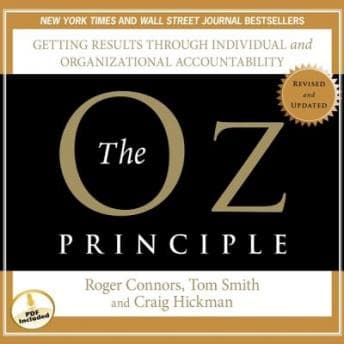

Look, I'm going to be honest - the trademarked phrases in this book almost made me throw my phone out the Caltrain window. See It®, Own It®, Solve It®, Do It®. Above the Line®. Below the Line®. It's like someone went to the trademark office with a shopping cart and just started grabbing everything.
But here's the thing. Once I got past my eye-rolling (somewhere around hour two, heading through Redwood City), the actual framework clicked. And I hate that it clicked, because now I can't un-see it.
The Framework That Haunts My Stand-ups
The core concept is almost annoyingly simple: there's a line. Above it, you're taking accountability and asking "what else can I do?" Below it, you're in victim territory - blaming, waiting, covering your tail. The authors use the Wizard of Oz as their extended metaphor (Dorothy's journey = your journey to accountability, apparently), and while it's a bit cheesy, it actually works for retention.
What got me was how precisely they describe the Below the Line behaviors. I sat there on my morning commute mentally cataloging every time I'd heard these exact patterns in incident post-mortems. "Well, the requirements were unclear." "That's really more of a platform team problem." "I flagged this months ago but nobody listened."
Yeah. I've said all of those. Recently.
The ROI on this audiobook is basically a mirror held up to your own excuse-making patterns. Not comfortable, but useful.
Wayne Shepherd Does the Job
The narration is... fine? Wayne Shepherd has that clean, professional business audiobook voice. He's not going to win any awards for dramatic range, but honestly, for a framework-heavy business book, you don't need Ray Porter doing character voices. You need clarity and good pacing, and Shepherd delivers both.
I listened at 1.75x (my standard for business books that could've been blog posts - though this one actually earns its 8 hours more than most). At that speed, his delivery stayed crisp. No weird audio artifacts, no awkward pauses that get amplified at higher speeds. Clean production throughout.
The one thing I noticed: when he's reading the case study examples, there's zero variation in energy. Every company story sounds the same. It's not a dealbreaker, but if you're already skeptical about business books, this won't convert you.
Where It Gets Real (And Where It Doesn't)
Okay, so here's my actual critique. The book operates on this assumption that if you just accountability-mindset hard enough, you can overcome any organizational dysfunction. And... look, I work at a FAANG company. I've seen what happens when systems are genuinely broken, when incentives are misaligned at the structural level, when the problem actually IS the platform team's fault because they shipped a breaking change without documentation.
Sometimes the obstacle isn't your mindset. Sometimes it's a bad manager, a toxic culture, or a system designed to fail.
The authors would probably say I'm being Below the Line right now. And maybe they have a point - there's always SOMETHING you can do. Big Magic had a similar tension—Gilbert pushes this idea that you can create despite any obstacle, and sometimes I wanted to yell 'but what about systemic barriers?'. But the book could use more nuance about when individual accountability hits its limits.
That said, for the 80% of situations where you DO have more agency than you're exercising? This framework is genuinely useful. I've already caught myself mid-excuse twice this week and mentally asked "okay, but what else can I do?"
(Don't tell my skip-level I'm using trademarked self-help phrases. She already thinks I read too many productivity books.)
Who This Debugs (And Who Should Skip)
This is basically a debugging tool for your own behavior patterns. You don't need to take notes - the framework is simple enough that it'll stick. The examples get repetitive (every company apparently has the same accountability problems), but that repetition actually helps with retention.
Perfect for: anyone in a leadership role, team leads tired of post-mortem finger-pointing, or honestly anyone who suspects they make more excuses than they'd like to admit. Skip if: you're dealing with genuinely toxic systems and need validation, not another framework telling you to try harder. Also skip if trademarked phrases make you irrationally angry - you won't survive the first hour.
I finished this in about 4 commutes. It's not going to change your life, but it might change how you show up in your next one-on-one or post-mortem. For me, that's worth 8 hours.
Ship It?
Would I recommend it to my team? Probably, with caveats. The book is strongest as a shared vocabulary - if everyone knows what "Above the Line" means, it's easier to call out patterns without it feeling personal. But I'd pair it with some real talk about systemic issues too.
Quick Verdict: Worth your commute if you're in any kind of leadership role or just tired of your own excuses. The trademarked phrases are annoying but the framework underneath is solid. Listen at 1.5x minimum.