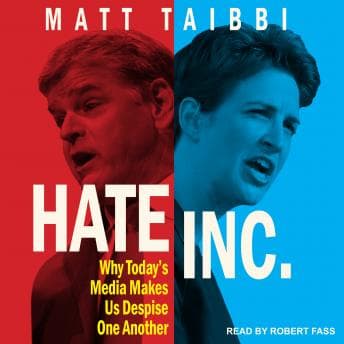

Matt Taibbi wrote a book about why the media makes us hate each other, and honestly, the most unsettling thing about it is how unsurprised I was by every single revelation.
I started this one on a Sunday morning while attempting my mother's rajma recipe — the kind of elaborate cooking project that requires twelve hours of soaking beans and approximately zero mental bandwidth once things are simmering. Perfect conditions for a book that's basically a 12-hour intervention for anyone who consumes American news. And I needed the distraction, because Taibbi's central thesis kept making me pause the wooden spoon mid-stir.
The Noam Chomsky Update Nobody Asked For (But We Needed)
Taibbi frames this book explicitly as a sequel to Chomsky and Herman's Manufacturing Consent, which — if you're a psychology nerd like me — is already fascinating territory. The original argued that media served elite interests through propaganda filters. Taibbi's update? The model has mutated. It's no longer about manufacturing consent for the powerful. It's about manufacturing dissent between us. The profit motive shifted from keeping everyone passively agreeable to keeping everyone actively furious at each other.
This is a fascinating case study in how systemic incentive structures reshape behavior at scale. Taibbi walks through his own career at Rolling Stone, confessing to the exact sins he's diagnosing — the addiction to outrage clicks, the editorial pressure to frame every story as apocalyptic. The confessional element is what saves this from being another smug media critique. He's not standing outside the burning building pointing. He helped light the match. He knows it. That rare combination of insider guilt and genuine reckoning reminds me of Thank You for My Service, where the confessional mode does similar work — the mess of complicity is exactly what gives the whole thing its teeth.
What makes this particularly compelling is his taxonomy of manipulation techniques. He breaks down how cable news creates a "WWE model" of political coverage — faces and heels, predetermined narratives, audience trained to cheer on cue. The research actually shows that partisan media consumption correlates with increased anxiety and decreased trust in institutions, and Taibbi lands on this without being academic about it. He just... shows you the mechanism. Over and over. Fox does this, MSNBC does that, and the techniques are disturbingly mirror-imaged.
When the Insider Confessional Gets Uncomfortable
Here's where I found myself asking: why does Taibbi really think this book will change anything? Because there's a tension running through the whole thing. He diagnoses media manipulation with genuine insight, but the book itself — a polemic written by a journalist selling a book — is participating in the same attention economy he's critiquing. He's aware of this. Sort of. He addresses it sideways, and that halfway self-awareness is both the most honest and most frustrating part of the listen.
Psychologically, though, the framework tracks. Confirmation bias, in-group/out-group dynamics, the dopamine hit of righteous anger — Taibbi isn't using these terms explicitly, but he's describing them with a journalist's eye for the concrete example rather than the abstract principle. As someone who spends her days reading actual research on identity formation, I appreciated that he gets the mechanisms right even when the academic vocabulary isn't there.
The book does drag slightly in the middle sections where Taibbi rehashes specific news cycles — Russiagate coverage gets particularly extended treatment. If you're listening in 2024 or later, some of these examples feel dated in their specifics even as the patterns remain depressingly current. I found my attention wandering somewhere around hour seven, right when the rajma was done and I had no culinary excuse to keep standing in the kitchen.
Robert Fass Does the Heavy Lifting
Robert Fass — a two-time Audie winner, for good reason — handles this with a steady, measured delivery that keeps Taibbi's more incendiary passages from tipping into rant territory. The narration is clean and professional. No dramatic voice shifts, no theatrical affectations, just clear delivery that trusts the text. For a book this charged politically, that restraint matters. Fass lets Taibbi's dry humor land without overselling it, and keeps the confessional sections grounded rather than maudlin. It's the right choice. A more energetic narrator would've turned this into a podcast monologue.
At 12 hours, this is a commitment. Fass earns that time — his pacing is steady enough that I never felt the need to bump up to 1.25x, which for nonfiction of this length says something.
Who Gets the Most From This (And Who'll Throw Their Phone)
If you think your preferred news source is the trustworthy one and it's only the other side that manipulates — this book will irritate you. Taibbi goes after both teams with equal venom. If you can sit with that discomfort, it's worth the listen. If you're already a media literacy person, you'll find the framework familiar but Taibbi's insider perspective adds texture that academic treatments don't provide.
Skip it if you need your political media criticism served with solutions. Taibbi is much better at diagnosis than prescription. My therapist would have thoughts about that — about someone who can articulate exactly what's wrong but can't quite commit to a treatment plan.
The Case File, Closed
The protagonist of this book — and it is Taibbi himself, make no mistake — exhibits classic whistleblower psychology: guilt, grandiosity, genuine insight, and a deep ambivalence about his own complicity. That ambivalence is what makes the book worth reading. A cleaner, more certain version would be less true. The messy confession of a media insider who helped build the machine he now wants to dismantle? That's the real story. And it's one worth 12 hours of your attention — preferably while doing something with your hands, because you'll want something to squeeze.