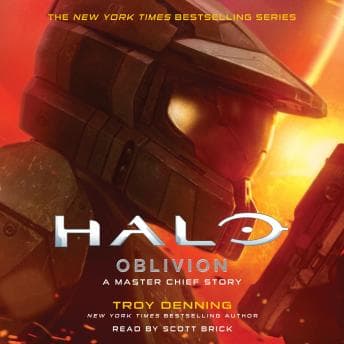

This is basically a trap mission where everyone knows it's a trap but they go anyway — which, honestly, is the most military sci-fi thing ever.
I picked this up during a brutal on-call rotation where my sleep schedule was already wrecked, so listening to Spartans drop onto a hellish planet at 5:45 AM while speed-walking to catch the baby bullet felt weirdly appropriate. Twelve hours of military ops, alien politics, and Master Chief being stoically competent? Sure, sign me up. But here's what I discovered as I worked through it: Halo: Oblivion is a book at war with itself.
Troy Denning Knows How to Write a Firefight (But Maybe Too Many of Them)
Let me give credit where it's due. Denning gets the Halo universe. The Covenant fleet dynamics, the Spartan team coordination, the UNSC chain-of-command friction — it all reads like someone who actually understands the source material rather than slapping a franchise label on a generic space opera. Blue Team's insertion onto the target planet has real tactical weight to it. You can feel the operational planning behind every move, and when things inevitably go sideways, the escalation feels earned rather than manufactured.
But — and this is where things get complicated — there's a roughly four-hour stretch in the middle where the book just... stalls. The narrative splits to follow supporting characters who feel like they exist purely to slow the main plot down. I kept checking my progress bar thinking I'd somehow gotten lost in a different audiobook. It's like when you're debugging a distributed system and you trace a request through twelve microservices only to discover the bottleneck is some legacy service nobody owns. These supporting characters are that legacy service. They add latency, nobody loves them, and someone should've refactored them out.
The disgraced Covenant fleetmaster angle is genuinely interesting though — the idea that the antagonist's motivation is personal redemption through genocide gives the conflict more texture than just "aliens want to kill all humans." I found myself more engaged with his political maneuvering than some of the UNSC side plots.
Scott Brick: Reliable Infrastructure, Not Always the Right Deploy
Scott Brick is a pro. His narration is clean, his pacing is controlled, and he handles the military jargon and alien terminology without stumbling. The man reads like he's done this a thousand times — because he has. For a 12-hour mil-SF audiobook, that consistency matters. You can zone out during a tunnel on the Caltrain and pick right back up without rewinding.
That said, I get why some Halo fans have opinions about this casting. If you've spent hundreds of hours hearing Steve Downes voice Master Chief in the games, Brick's interpretation sits differently. It's not bad — it's just not that voice. Think of it like running a perfectly functional container that happens to have a different base image than what you're used to. Everything works, but something feels slightly off if you're paying attention. For me, it wasn't a dealbreaker. For hardcore game-first fans, your mileage will absolutely vary.
I bumped this to 1.5x and it helped with those dragging middle sections significantly. At default speed, I think I would've been frustrated. At 1.5x, the pacing felt closer to what a mission-focused story should be.
The Silent Storm Problem
This is a direct sequel to Halo: Silent Storm, and the consensus seems to be that Silent Storm is the stronger book — and I agree. Oblivion rides on the momentum of its predecessor but doesn't quite match the tension or stakes. It's a solid second entry, not a breakout. The worldbuilding is good (Denning clearly understands how to expand Halo's early-war timeline), but the character work outside of Chief and the core Spartans feels thin. When your biggest complaint is "I didn't like any of the supporting cast," that's a structural issue, not a nitpick.
If you're deep in the Halo extended universe, this fills in important lore gaps and gives you more early-timeline Master Chief, which is genuinely fun. If you're coming in cold to Halo novels, start with Silent Storm. If you're not into Halo at all, this probably isn't your on-ramp. On the total opposite end of the 'what even is my on-ramp here' spectrum, Midnight Library is the rare book I'd hand to someone who claims they don't read — no franchise baggage, no prerequisite lore, just a concept that grabs you and doesn't let go.
Commute Verdict: Deployable but Not Mission-Critical
TL;DR: Worth your commute if you're already invested in the Halo universe. The action sequences are solid, Denning knows this world inside-out, and Scott Brick is dependable. But the bloated middle and forgettable supporting cast keep this from being essential. I finished it in about 4 commutes at 1.5x, and I don't regret the time, but I wasn't rushing to my train to hear what happened next.
Perfect for: Commute, gym, any activity where you can autopilot through slower sections. Skip for: First Halo novel experience — go Silent Storm first.
The ROI on this audiobook is moderate. You're getting reliable franchise fiction with some genuinely cool tactical set pieces, weighed down by structural bloat. Like a codebase that works but could really use a refactor.