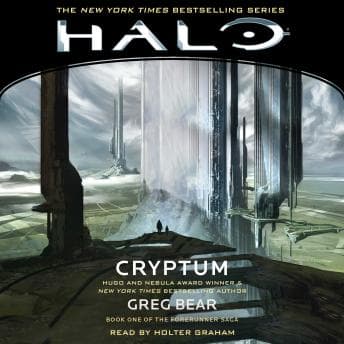

Look, I need to rant about something before we get into this: Holter Graham mispronounces names in a book about a species that has been established across multiple games, novels, and an entire wiki that's been curated by obsessive fans for over a decade. The Didact. The Librarian. These aren't obscure deep cuts - they're literally on the box art. It's 2024 and we have the internet. Google exists. I'm a software engineer who debugs distributed systems for a living, and even I know to RTFM before touching production. This is the audiobook equivalent of pushing to main without running tests.
Okay. Deep breath. Rant over. Because here's the thing - despite that frustration, I actually really enjoyed this book.
When Hard Sci-Fi Meets Your Favorite Shooter
I started this at 5:47 AM on a Tuesday, slumped against the window of a half-empty Caltrain car, expecting generic video game tie-in schlock. What I got instead was Greg Bear doing what Greg Bear does best: taking a universe built for explosions and asking "but what if we made it philosophically dense and slightly uncomfortable?"
The premise is deceptively simple - young Forerunner named Bornstellar gets bored with his privileged life, goes looking for ancient relics, accidentally wakes up the Didact (basically a legendary warrior-philosopher in cryo-sleep), and gets dragged into political intrigue spanning millennia. But Bear treats the Forerunners not as mysterious godlike aliens, but as a civilization with bureaucracy, class divisions, and the kind of existential dread that comes from being the dominant species in the galaxy and knowing - somewhere deep down - that you probably shouldn't be. Confessor wrestles with similar questions about power and whether the people in charge actually deserve to be there.
This is basically Foundation but for the Halo universe. The Mantle of Responsibility - the Forerunners' guiding philosophy about stewardship of all life - gets examined from angles the games never touched. It's not just noble. It's arrogant. It's maybe even wrong. And watching Bornstellar slowly realize that his entire civilization might be built on a lie? That hit different at 6:30 AM surrounded by other tech workers commuting to build products we're not sure should exist. That same uncomfortable self-awareness shows up in From Dead to Worse, where characters have to confront what their world actually is versus what they thought it was.
The Narrator Problem (And Why I'm Still Giving This 3.5 Stars)
Holter Graham has won multiple AudioFile awards, and honestly, his actual performance is solid. His voice for the Didact carries this ancient weight - tired but dangerous, like a system admin who's been on-call for ten thousand years. The young Bornstellar sounds appropriately naive without being annoying. Graham handles the political exposition dumps (and there are many) without putting you to sleep.
But those mispronunciations. Every time he says a name wrong, it yanks you out of the immersion like a production alert at 2 AM. If you're a Halo lore nerd, this will drive you absolutely insane. If you're coming in fresh, you probably won't notice - but then you'll develop wrong pronunciations that'll haunt you when you play the games.
The pacing is also... deliberate. This isn't an action audiobook. There are action sequences, sure, but Bear is way more interested in worldbuilding and philosophical meditation than combat. I listened at 1.5x and it felt right - 1.0x would've been a slog during the heavy exposition chapters.
The Science Actually Holds Up
Here's where my engineering brain got happy: Bear doesn't handwave the technology. The Forerunners' capabilities are absurd (they can move planets, build megastructures, manipulate slipspace like it's nothing), but there's internal consistency. The Domain - their galaxy-spanning information network - functions like a distributed database with eventual consistency problems. The Composers, the Halos, the politics around the Flood threat - it all connects in ways that reward paying attention.
I finished this in exactly 3 commutes (round trips), and I immediately bought the sequel. That's the real test, right? Despite the pronunciation issues, despite the slow burn pacing, I wanted more. The ending sets up something bigger, and Bear earns that cliffhanger by making you genuinely care about a civilization you know is doomed.
Who Gets Value Here (And Who Should Ctrl+Z)
Perfect for: Halo fans who want the lore deep dive, hard sci-fi readers who can tolerate video game origins, anyone who likes their space opera with philosophical weight. Also genuinely good for commutes - the chapters break well and you can zone out during exposition without losing critical plot beats.
Skip if: You're expecting Master Chief punching aliens, you need constant action to stay engaged, or mispronounced proper nouns will have you rage-quitting by chapter three. You know who you are.
Commit Message
8 hours 41 minutes of surprisingly thoughtful sci-fi that expands a video game universe into something genuinely literary. The narrator is competent but not exceptional. The pacing demands patience. But the worldbuilding? Chef's kiss. Greg Bear took a franchise about shooting aliens and wrote a meditation on empire, responsibility, and the hubris of thinking you deserve to rule.
Worth a credit if you're already invested in the Halo universe. Wait for a sale if you're curious but skeptical. Either way, listen at 1.5x minimum.