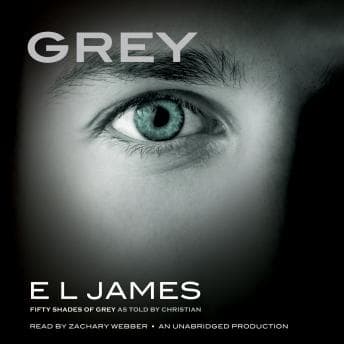

Okay, look. Let's just put it all out on the table before I even start.
I know what you're thinking. "Elena, really? Fifty Shades? Again?"
Yes. Really.
I was pulling an all-nighter on a branding package for a new mezcal bar here in Austin, Frida was asleep on my keyboard (as usual), and I needed something that would keep me awake but didn't require me to solve a murder mystery. I needed vibes. I needed angst. And honestly? I needed to know what was going on inside Christian Grey's head because—let's be real—the man is a walking red flag with a checkbook.
(And sorry, Abuela, but I definitely had to turn the volume down when the windows were open. The neighbors don't need to hear everything.)
But here is the thing I wasn't expecting: Zachary Webber basically ruined me.
Zachary Webber's Voice Is a Weapon
I usually listen at 1.0x speed because I like to savor the performance, but with this one? I would have slowed it down to 0.75x if I could, just to make it last longer. Zachary Webber doesn't just read this book; he inhabits it.
I've listened to a lot of romance—like, an embarrassing amount—and male narrators can be hit or miss. The narrator who did Fifty Shades Darker was fine, but this performance is on another level. Sometimes they sound like a game show host trying to be sexy. But Webber? He nailed the "tortured billionaire" vibe without making it sound cheesy. His voice is deep, warm, and has this gritty texture to it that just... works.
When Christian is spiraling (which is, let's face it, 90% of the book), Webber drops his voice into this raw, vulnerable register that actually made my chest ache. I went in expecting spice—and okay, the spice is definitely there—but I stayed for the emotional damage. There's a desolation in his delivery that explains so much about why Christian is the way he is. You stop seeing him as just a controlling jerk and start hearing the terrified kid underneath.
19 Hours Inside a Control Freak's Brain
So, the book is long. We're talking almost 19 hours. That is a serious commitment. Basically a part-time job.
Since it's retold from Christian's perspective, you get every single over-analytical thought. And Christian overthinks everything. If you thought Ana was in her head too much, wait until you meet this guy.
There were moments where the pacing dragged—specifically the email exchanges. Listening to someone read subject lines and timestamps back and forth gets repetitive. I found myself shouting at my monitor, "JUST CALL HER, MAN."
But then, just when I was about to zone out, Webber would deliver a line about his nightmares or his childhood trauma, and I'd be sucked right back in. The shift in perspective makes the story darker, heavier. It's less of a rom-com with whips and more of a psychological deep dive.
The Verdict
Is it perfect? No. Does it repeat the original story beat-for-beat? Yes.
But the audio experience is completely different. If you liked the original trilogy, this is non-negotiable—you have to listen to it. Honestly, I'd say the same about Fifty Shades Freed—the audio versions of this series just hit different. It fills in the blanks in a way that feels necessary.
And if you hated the original... well, honestly? Webber's performance might actually convert you. He brings a humanity to Christian that I think was missing before.
Who should listen: Fans of the original trilogy who want the emotional context, romance listeners who appreciate a strong male narrator, and anyone curious about what makes Christian tick. Who should skip: If you need fast pacing and can't handle 19 hours of internal monologue, this one will test your patience.
I didn't ugly-cry (record remains safe for now), but I definitely got misty-eyed around chapter 20. It felt heavy. It felt real. And frankly, it made a rainy Tuesday night in Austin feel a whole lot more intense.
Now, if you'll excuse me, I need to go pour a glass of wine and stare out the window dramatically.