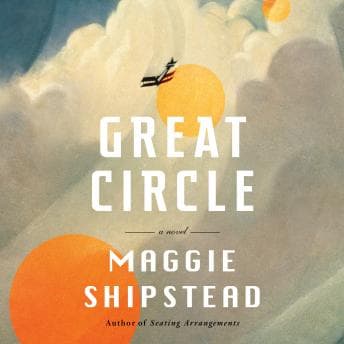

Twenty-five hours is a commitment. That's basically an entire semester of faculty meetings, or roughly 300 laps around the lakefront with Denise. So when I tell you I didn't want Great Circle to end, you understand what I'm saying.
Maggie Shipstead has written something that feels like it shouldn't work. A dual narrative spanning a century, jumping between a 1920s-era female aviator and a present-day Hollywood actress playing her in a film? On paper, it sounds like the kind of ambitious mess my grad school professors warned us about. But here's the thing—Shipstead pulls it off with the kind of structural confidence that reminds me of Middlemarch. (Yes, I'm comparing a contemporary novel to Eliot. My students would roll their eyes. I don't care.)
Two Narrators, One Cockpit
Cassandra Campbell handles Marian's story, and Alex McKenna takes Hadley's modern sections. This could've been jarring. It wasn't. Campbell brings this weathered warmth to Marian's narrative—she understands that a woman learning to fly in Prohibition-era Montana needs to sound both determined and a little reckless. The pacing during the flight sequences? Impeccable. You feel the altitude changes, the engine stutters, the vast emptiness of polar ice.
McKenna's Hadley is sharper, more cynical. She captures that particular exhaustion of someone who's famous for the wrong reasons—trapped in what Shipstead calls "cult celebrity" from a romantic film franchise. The contrast between these two voices mirrors the contrast between the women themselves, and it works beautifully.
They won an Earphones Award for this performance, which—look, awards don't always mean much, but in this case? Earned.
Marian's Pull Is Stronger (And That's Okay)
I'll be honest. The Marian sections are stronger. Her story has this propulsive quality—dropping out of school at fourteen, taking money from a bootlegger to fund flying lessons, eventually attempting to circumnavigate the globe over both poles. It's the kind of life that makes you wonder why you spent your twenties writing a dissertation on Victorian poetry.
Hadley's sections are good, but they're doing different work. They're more reflective, more meta—a contemporary woman trying to understand an historical one while also escaping her own constraints. Some listeners apparently found the dual structure challenging. I get it. There were moments during late-night grading sessions where I'd zone out during a Hadley chapter, only to snap back when we returned to Marian. That same pull between two women's intertwined stories—where one narrative grips you harder than the other—reminded me of My Brilliant Friend, though Ferrante's dual perspective works differently.
But that's not a flaw, exactly. It's the nature of the beast. Shipstead is asking you to sit with two different kinds of hunger for self-determination, separated by a century but connected by something deeper. The prose deserves to be savored—this is emphatically not a 1.5x speed situation.
Twenty-Five Hours, Mostly Earned
Yes, it's long. Could it have been trimmed by a couple hours? Probably. There are passages in the middle—particularly some of the World War II London sections—that meander. But Shipstead's research is so meticulous, her sense of place so vivid, that even the slower stretches feel intentional rather than padded.
This is a novel about obsession, really. Marian's obsession with flight, Hadley's obsession with escaping a version of herself she didn't choose, Shipstead's own obsession with getting every historical detail right. You can feel the years of research in every sentence about biplanes and polar navigation and the particular loneliness of women who want more than their era allows.
If you loved The Aviator's Wife or West with the Night, this is their spiritual successor—but bigger, more structurally ambitious, more willing to sit with ambiguity.
Who This Is For (And Who Should Bail)
Commuters with long drives. People who want to disappear into something substantial. Readers who appreciate that "epic" doesn't have to mean "bloated." Anyone who's ever felt trapped by other people's expectations of who they're supposed to be.
Skip if you need things to move quickly, or if dual timelines make you impatient. This book asks for your attention. It rewards it, but it asks.
Professor's Final Note
I finished it on a Sunday morning walk, Lake Michigan gray and choppy beside me, and I just stood there for a minute. That's the highest compliment I can give—a book that makes you stop walking to process what you've heard. Denise had to double back to find me. She understood.