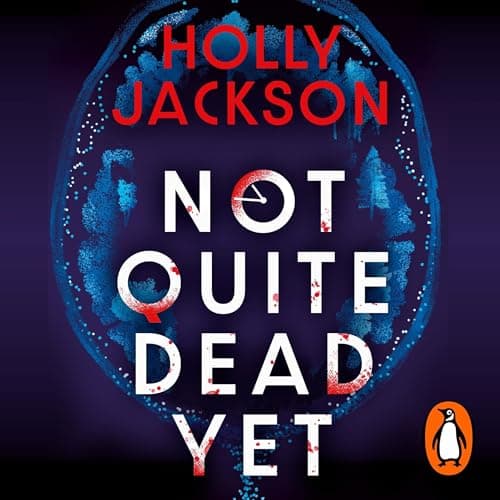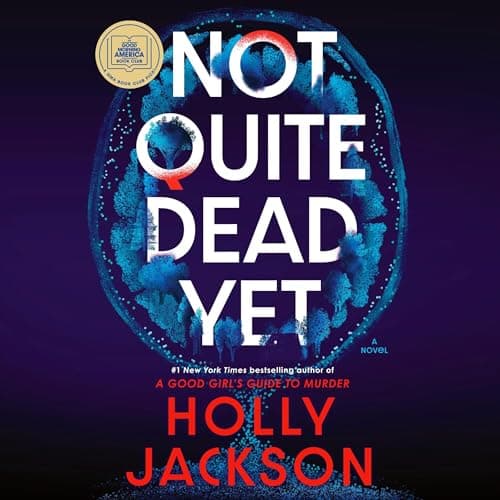

I started this one at 5:40 a.m. in the resident lounge, half in scrubs, half in denial, eating peanut butter crackers before rounds while the sky over the East River still looked bruised. Bad time to listen to a book about a 27-year-old woman being told, with medical certainty, exactly how she's going to die in seven days. Good time, maybe, if you want your thriller to punch straight through the sleep deprivation.
A lot of people are selling Not Quite Dead Yet on the hook alone — solve your own murder before your fatal aneurysm kills you — and to be fair, that hook is nasty in the best way. But the reason it works isn't just the countdown. It's that Holly Jackson understands what a deadline like that does to a person's relationships. Jet Mason isn't suddenly transformed into some saintly, hyper-competent detective because death is near. She's still messy, resentful, stalled out, and weirdly funny. That matters.
The clock is doing triage
Jet gets attacked on Halloween night, suffers a catastrophic head injury, and is told the injury will trigger a fatal aneurysm within the week. The detail that locked me in? She rejects an extremely risky operation because she wants a few guaranteed days rather than a gamble she may not survive. As someone who's actually run a code, that choice felt emotionally true even if it's designed for maximum thriller tension. People love to talk about what they'd do with "one last chance" like it's abstract. It's not. It's ugly. It's practical. It's full of family pressure and bad options.
And Jackson leans into that ugliness. Jet comes home to this wealthy-family-in-Woodstock setup where everybody has history with everybody, and suddenly every old wound looks like motive. Her former best friend is now her sister-in-law. Her ex-boyfriend is still orbiting. Her parents are trying to manage her choices while she's staring down a timeline no one can negotiate with. Then there's Billy, the childhood friend who becomes the one person willing to help her chase the truth instead of trying to wrap her in emotional bubble wrap.
That combination — family money, old intimacy, small-town memory, medical countdown — gives the mystery some real teeth. Jet isn't investigating random suspects. She's pulling at the threads of the life she never quite started, the people she thought she knew, and all the versions of herself she's been postponing with that "I'll do it later" mindset. That part hit harder than I expected. Between shifts and salah — this kept me going, not because it's comforting, but because it understands procrastination as a spiritual and emotional trap. You think you have time. Then one day you very much do not.
The pacing is strong for most of the runtime. Fourteen and a half hours can get mushy in a thriller if the middle starts stalling, but this one keeps introducing new suspicion without feeling like the author is just spinning the suspect wheel. The twists land because they grow out of Jet's changing understanding of the people around her. Not every reveal made me gasp out loud — I save that for truly ridiculous medicine and subway delays — but I stayed locked in. I had a similar reaction to Library of Lost Souls — the mystery kept pulling me forward even when the big moments didn't fully detonate.
Now the part people are fighting about
Alex McKenna's narration is the whole gamble here.
I get both camps. Truly.
If you bounce off a scratchier, younger-sounding voice, this may be a rough ride. There's a slightly child-like edge in the delivery that some listeners are going to hate immediately, especially with Jet's sarcasm and the frequent strong language. If that combo irritates you, it will not magically improve at hour six. I yelled at my phone on the subway during this one — not because the audio was broken, but because I could practically hear future reviews forming in real time: "Why does she sound so young?" Fair question.
But. McKenna also gets something crucial about Jet: the petulance, annoyance, and charm all living in the same sentence. Jet is immature in some ways because she's been emotionally suspended, and the performance leans into that instead of sanding it down. When she's angry, McKenna lets her sound ugly. When she's scared, she doesn't turn her into a porcelain doll. When Jet starts seeing her family and Billy and her own past a little more clearly, the emotional delivery deepens with her.
So no, I wouldn't call this flawless narration. Not even close. The voice quality will be make-or-break. But I also don't think it's bad in the lazy, flat, sleep-inducing sense. It's a strong interpretive choice with collateral damage. That's different.
One thing I appreciated: no gimmicky production clutter. No fake heartbeat sounds, no manipulative music cues telling you when to feel tense, no full-cast chaos. Just one narrator carrying a very interior, very personal unraveling. For a story this tied to one woman's deteriorating body and narrowing window, single-narrator was the right call.
What you're really signing up for
This is not a forensic-procedural thriller where the fun is watching experts solve a puzzle with perfect competence. Medical accuracy matters. Lives depend on it. And this book is using medicine more as a ticking structure than as a technical showcase. I was okay with that because the emotional logic held. The fear of a catastrophic brain event, the pressure from loved ones about treatment, the way mortality strips the varnish off old relationships — that all felt recognizable.
For people wondering about the romance label: don't come here expecting a swoony, dominant thread. The connection with Billy matters because of history, trust, and what it means to be seen at the end of your life — or near it. It supports the mystery and Jet's emotional arc. It doesn't hijack them.
If you loved the twisty readability of A Good Girl's Guide to Murder but wanted Holly Jackson to write for adults without losing her instinct for momentum, this is a solid lane change. Not perfect. Definitely divisive in audio. Still, the premise isn't just a marketing trick. It actually forces the story into harder questions about regret, loyalty, and whether solving the crime even changes the fact that the body keeps its own deadline.
Who should listen: Thriller fans who want their mysteries tangled up in family dysfunction and genuine emotional stakes — especially if you can handle a narrator who sounds young and scratchy rather than polished. Who should skip: If you need airtight medical procedural detail, or if a voice that reads younger than the character is an instant dealbreaker, sample first or grab the ebook.
My discharge note: borrow if you're narrator-sensitive, buy if you've sampled Alex McKenna and you're in. The story is worth hearing. The voice? That's the consent form.