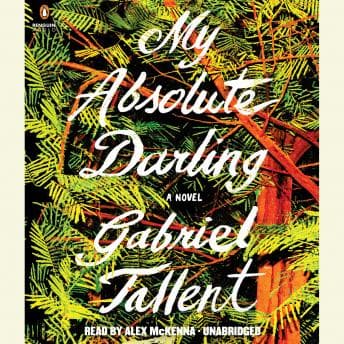

This book wrecked me.
I don't say that lightly. Twenty years of teaching high school English means I've built up some serious emotional calluses. I've guided teenagers through 1984, Beloved, The Road. I thought I was prepared for dark. I was not prepared for My Absolute Darling.
I started listening during my evening walks along the lakefront with Denise. By chapter three, I was walking alone. Not because she left—because I couldn't share this experience. This felt too private, too raw, like reading someone's diary written in blood. Denise asked why I kept coming home quiet. I didn't know how to explain that I'd spent an hour inside the head of a fourteen-year-old girl whose survival skills are the only thing standing between her and complete destruction.
The Weight of Every Word
Gabriel Tallent writes like someone who understands that language can be a weapon. The prose is dense—almost too dense at times—but that's the point. Turtle's world is suffocating, and Tallent makes you feel every inch of that confinement. When my students complain about Faulkner's long sentences, I tell them the form serves the function. Same principle here. The relentless detail, the way Tallent describes tide pools and gun maintenance with equal precision—it traps you in Turtle's hypervigilant mind.
And look, I'll be honest: there were moments I wanted to skip ahead. The pacing drags in places, particularly in the middle sections where Tallent seems determined to catalog every piece of survival knowledge Martin has drilled into his daughter. But then I realized—that's the abuse cycle. That's the monotony of survival. You can't rush through it because Turtle can't rush through it.
Alex McKenna Understood the Assignment
Here's where I need to talk about the narration, because McKenna's performance is the reason this audiobook exists as a separate artistic achievement from the novel itself.
Her voice for Turtle is husky, almost damaged-sounding. There's a quiver underneath everything, like a wire pulled too tight. When Turtle speaks—which isn't often, because this is a girl who's learned silence as survival—McKenna captures something I can only describe as controlled terror. The kind of calm that comes from years of reading your father's moods.
But what really got me was her Martin. She doesn't make him a monster. That would be too easy. She makes him charismatic. Wounded. Almost sympathetic in moments, which is infinitely more disturbing. (My students would hate this observation. They want villains to be obvious. Real life doesn't work that way.)
The transitions between characters feel natural—no jarring shifts, just the kind of vocal adjustment that makes you forget you're listening to one person. During the scenes with Jacob and Brett, those two teenage boys who become Turtle's first real connection to normalcy, McKenna lightens everything. You can hear the relief in her voice, the way Turtle's guard drops just slightly. It's subtle work. The kind of performance that deserves more recognition than it gets.
Who Should Listen (And Who Really Shouldn't)
I need to be direct here: this book contains graphic depictions of abuse—physical, emotional, sexual. Strong language throughout. Violence that serves the story but will genuinely disturb many listeners. If you're sensitive to these themes, this is not the audiobook for you. No judgment. Know your limits.
But if you can handle difficult material—if you believe, as I do, that literature's job is sometimes to make us uncomfortable—this is essential listening. It belongs on the shelf next to Room, next to Speak, next to every book that refuses to look away from what happens to children behind closed doors. The kind of story that stays with you—not unlike Becoming, which also explores what it takes to find your own voice when the world has other plans for you.
I've already recommended it to three colleagues in the English department. Two of them finished it. One couldn't get past the first few hours. All three said it changed how they think about the quiet students in their classrooms.
Final Thoughts Over Coffee
Stephen King called this one a triumph. I understand why, though I'd put it differently: My Absolute Darling is the kind of novel that makes you understand why we still tell stories about survival. Why the coming-of-age narrative matters. Why sometimes the bravest thing a person can do is simply leave.
At 15 hours and 48 minutes, it's a commitment. I listened at 1.0x because—as my students know—I believe the author chose those words. The pacing is intentional. The silences are intentional. Let it breathe.
I finished it three weeks ago. I'm still thinking about Turtle. I'm still thinking about the students I've taught who might have been living their own versions of this story. That's what great literature does. It doesn't let you go.