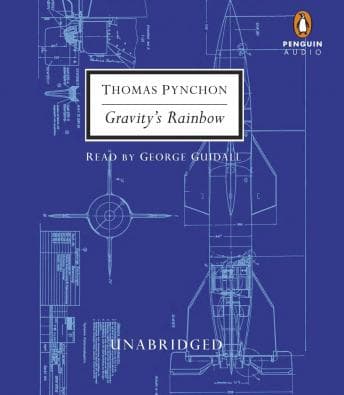

Thirty-seven hours. Let me say that again for the people in the back. THIRTY-SEVEN HOURS. That's roughly eighteen round-trip Caltrain commutes. That's almost two full weeks of my life surrendered to Thomas Pynchon's fever dream about rockets, paranoia, and Pavlovian conditioning during WWII. And I'm still not sure I can explain what happened.
Here's my complaint: this book broke my brain in a way that no distributed systems outage ever has. I've debugged race conditions at 3AM with more confidence than I had following Tyrone Slothrop's arc through the Zone. At one point - somewhere around hour 20, standing on the Caltrain platform in Millbrae because I'd missed my stop AGAIN - I genuinely asked myself if Pynchon was trolling me personally.
37 Hours of Beautiful, Weaponized Confusion
TL;DR: This is basically trying to read a microservices architecture diagram while on mushrooms, but for literature.
Let me be honest about what this audiobook is. It's not really a novel in the way your brain expects novels to work. It's a sprawling, recursive, hallucinatory epic where the narrative threads fork and merge like the worst git history you've ever seen. One minute you're tracking Slothrop's suspicious correlation between his sexual encounters and V-2 rocket strikes on London (yes, really), and the next you're in a fifteen-minute digression about the chemistry of Imipolex G, a fictional plastic that may or may not be sentient. There are songs. Actual songs that characters break into, musical-number style. And George Guidall - bless this man - sings them.
The opening with the air raid sirens sets the tone immediately: dread, displacement, the feeling that something is arcing toward you and you can't see it yet. That's the whole book, actually. A parabola. The rocket's arc. Gravity's rainbow. (It only took me about 25 hours to fully internalize that metaphor, which probably says more about me than Pynchon.)
Guidall as Your Calm Sherpa Through the Chaos
Here's the thing about Guidall's narration: he doesn't try to do distinct voices for every character, and with a cast this sprawling - we're talking dozens of named characters across multiple countries and timelines - that could be a problem. It sometimes is. But his approach is more like a steady hand on the wheel while the scenery outside is on fire. His reading pace has this quality where it feels like he wrote it, like he's discovered the internal rhythm of Pynchon's sentences and is just... channeling them. The prose is frenzied and dense and sometimes genuinely unhinged, but Guidall's calm, measured delivery acts as a stabilizer.
And the songs. I cannot overstate this. When Guidall hits one of Pynchon's absurdist musical numbers, he commits. He actually sings. It's not Broadway-quality, but it doesn't need to be - it captures the manic, vaudeville energy that Pynchon baked into the text. Those moments were the ones where I found myself grinning on the train like a weirdo.
Narrator rating: solid 3.5. Not Ray Porter (nobody is Ray Porter), but Guidall's restraint is arguably the only way to make this book listenable without causing actual psychotic breaks.
The Commute-Worthiness Problem
Okay, the hard truth. This is NOT commute-friendly. I tried. I really, genuinely tried to make this my 6AM Caltrain book, and for about four sessions I was just absorbing vibes and proper nouns without any connective tissue. If you zone out for ninety seconds during a Bobiverse chapter, you miss a funny robot quip. If you zone out for ninety seconds during Gravity's Rainbow, you've lost an entire subplot about a sentient light bulb named Byron (I am not making this up) and you will never recover.
I ended up shifting most of my listening to weekend deep-focus sessions - headphones, coffee, no distractions. Which is basically admitting defeat as an audiobook commuter, but this book demands it. The ROI on this audiobook is extremely high if you treat it like a project, not a passive listen. I kept the Gravity's Rainbow wiki open on my phone for the first ten hours until I finally let go and accepted the confusion as a feature, not a bug.
Perfect for: dedicated focus sessions, weekend deep listens, re-reads if you've tackled the physical book. Skip for: commute (unless you're way smarter than me), gym, anything requiring divided attention.
Who Gets a Ticket to the Zone
If you've read Pynchon before and want to experience the prose with Guidall's rhythm layered on top, this is genuinely worth it. If you're a first-timer and you go in expecting this to behave like a normal audiobook, you will bounce off it hard and leave a one-star review about how nothing makes sense. Both of those reactions are valid.
This is for the person who listens to a book and thinks "I want to be challenged" and actually means it. Not "challenged" like a hard sci-fi book with lots of technical terms. Challenged like your brain needs to operate in a fundamentally different mode for 37 hours.
Do NOT listen at 1.5x. I tried. Bad idea. 1.0x or maybe 1.1x max. Your brain needs the extra processing cycles.
The Parabola Comes Down
I can't say I understood Gravity's Rainbow. I can say it rewired something in how I think about narrative, technology, paranoia, and the way systems - human and mechanical - interlock in ways we can't fully map. Scattering gave me a similar feeling of incompleteness-as-design, where the gaps in the narrative are doing as much work as the text itself. As an engineer who spends her days tracing dependencies in distributed systems, there's something deeply uncomfortable and deeply honest about a novel that says: the system is too complex to understand, the connections are real but you'll never see all of them, and the rocket is already on its way down.
Kevin asked me what it was about and I talked for fifteen minutes and he just stared at me. Fair.
Three weeks of listening. No regrets. Wouldn't recommend it to most people I know. Absolutely recommend it to the specific kind of person who reads this far into a review about a 37-hour postmodern novel.