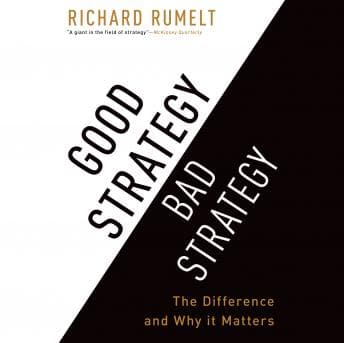

Look. I need to rant about something. Every single startup founder I've worked with — every one — has confused a mission statement with a strategy. "We're going to be the leading platform for X" is not a strategy. It's a LinkedIn bio. I've sat through all-hands meetings where leadership presents a slide deck full of buzzwords and financial targets and calls it "our strategic vision" and I want to scream into the void. Richard Rumelt wrote this book for people like me, the ones silently dying inside during those meetings.
I picked this up on a Sunday night when I couldn't sleep after a particularly soul-crushing week of cross-team alignment meetings (if you know, you know). Fear Less was another one I grabbed in that exact same late-night, brain-won't-quit headspace — different subject entirely, but it hit with the same "why did no one just say this clearly before" energy. Started it around midnight, figured I'd drift off. Instead I was up until 2AM nodding aggressively at my phone like a maniac.
The Anti-Bullshit Framework You Didn't Know You Needed
TL;DR: Worth your commute. This is basically a linter for strategy — it flags the bad patterns, explains why they're bad, and shows you what clean code looks like.
Rumelt's core argument is deceptively simple: a good strategy has three parts — a diagnosis of the challenge, a guiding policy for dealing with it, and coherent actions that execute that policy. He calls this the "kernel" of strategy. Everything else is noise. And he spends the first chunk of the book absolutely eviscerating what he calls "bad strategy" — the fluff, the vague aspirations, the refusal to make hard choices.
The examples are what make this land. His breakdown of Nvidia's pivot in the late '90s — focusing on the 3D graphics segment instead of trying to compete across all chip categories — is basically a case study in choosing what NOT to do. And his analysis of the first Gulf War versus the Afghanistan strategy failure is genuinely illuminating. He doesn't just say "focus is good." He shows you what focused strategy looks like when lives are on the line versus when it's just a PowerPoint deck.
My favorite section is his takedown of a major retail bank's "strategy" that was literally just a list of goals reworded as priorities. No diagnosis. No tradeoffs. No actual plan. I've seen this exact pattern at three different companies I've worked at. It's the enterprise equivalent of writing // TODO: fix this later and shipping it to production.
Sean Runnette Does the Heavy Lifting at 1.75x
Here's the thing about business audiobooks — the narrator has to make case studies interesting, which is roughly as hard as making someone enjoy reading Jira tickets. Runnette pulls it off. His delivery is clean and even-paced, no weird dramatic pauses where they don't belong, no over-inflecting the Important Business Insights. He reads it like an intelligent person explaining something they genuinely find interesting, which is exactly the energy a book like this needs.
I bumped this to 1.75x pretty early. Not because Runnette is slow — he's not — but because this is a business book that could've been about 25% shorter. The core ideas are rock solid, but there are stretches in the middle where Rumelt belabors a point that he already made perfectly well two examples ago. The Cisco and Global Crossing sections, for instance, cover similar ground and you feel the redundancy. At 1.75x, the pacing tightens up and you still catch everything.
Where It Clicks (and Where It Drags)
The first 4-5 hours are genuinely great. The "bad strategy" diagnosis section is sharp and specific enough that you'll start mentally cataloguing every strategy doc you've ever read. The middle section on sources of power — leverage, proximate objectives, chain-link systems — is where the meat is. His explanation of chain-link systems (where a strategy is only as strong as its weakest link, and you can't fix it by making one link really strong) is something I now think about every time I look at a system architecture.
Where it drags: hours 7-9ish. He goes deep on some historical and military examples that, while interesting on paper, feel like they're making points he already made. I caught myself zoning out on the Caltrain a couple of times during this stretch, and I'm usually locked in. If you're the type who skips ahead in business books — and honestly, who isn't — you won't miss critical concepts by speeding through some of the later case studies.
But here's what keeps this above the typical business book: Rumelt actually respects your intelligence. He doesn't repeat his framework seventeen times. He trusts you to build on earlier concepts. That's rare.
Perfect For: Anyone Who's Sat Through a "Strategy" Meeting and Felt Their Soul Leave Their Body
The ROI on this audiobook is high if you're in any kind of leadership, product, or engineering management role. Even as an IC, understanding why your company's strategy feels incoherent is weirdly therapeutic. Skip it if you want a quick tactical playbook — this is more about developing judgment than giving you a checklist.
Perfect for: train, long commute, gym. Skip for: bedtime (you'll want to take mental notes). I finished this in about 5 commutes at 1.75x, and I've already caught myself using the "kernel" framework in design docs.
Kevin asked me what I was listening to and I explained the chain-link systems concept and he said "please stop optimizing dinner." Fair.