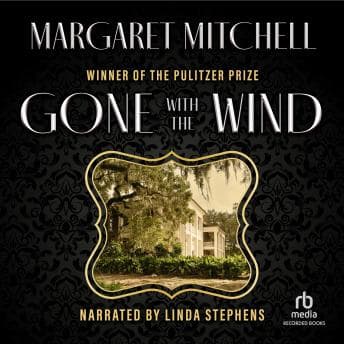

Forty-nine hours. Let that sink in for a second.
I started this audiobook in September. Finished it in November. And honestly? I'm a little sad it's over. (Don't tell my wife I said that - she's been asking me to clean the gutters for three months while I've been "busy" with Scarlett O'Hara.)
Look, here's the thing about Gone With the Wind: you probably think you know this book. Fiddle-dee-dee, tomorrow is another day, frankly my dear, etc. But sitting with the full unabridged text - all 49 hours of Margaret Mitchell's sprawling, complicated, deeply problematic epic - is a completely different experience than watching Vivien Leigh sweep across a screen. This is a book that demands your time and then rewards it in ways I wasn't expecting.
And Linda Stephens? She understands that this material requires a particular kind of patience.
### Why the Narration Makes This Worth 49 HoursLet me talk about the narration first because it's the reason I'm writing this review. Stephens does something that I've been trying to explain to my students for twenty years - she treats pause as punctuation. When Scarlett's world crumbles, Stephens doesn't rush to the next plot point. She sits in the silence. She lets the weight of a moment breathe. Her timing is honestly flawless, and in a book this long, that's not a small thing. Bad pacing in a 49-hour audiobook would be torture. This felt luxurious.
The voices, though. The voices are where Stephens really earns her Audie nomination. She's got distinct, convincing Southern dialects for every character - white and Black, wealthy and poor, Atlanta society and country folk. Mammy sounds different from Prissy who sounds different from Melanie who sounds different from Belle Watling. And Scarlett - petulant, calculating, occasionally monstrous Scarlett - Stephens captures every shade of her without ever tipping into caricature. It's performance art.
### The Elephant in the RoomNow. We need to talk about it.
This book was written in 1936 about the 1860s South, and it shows. The racial attitudes are... exactly what you'd expect from that context. Mitchell romanticizes the antebellum South in ways that made me uncomfortable, and the depictions of enslaved people reflect the Lost Cause mythology that was very much alive when she was writing. I'm not going to pretend otherwise. If you're going into this book, you need to go in with your eyes open.
But here's what I tell my students when we tackle difficult historical texts: context first, then analysis. Mitchell wasn't writing history - she was writing mythology. Understanding WHY this book captured America's imagination in 1936, what needs it was meeting, what lies it was telling and why people wanted to believe them - that's the work. And honestly, listening to it in 2024 with all that context? It's a fascinating, uncomfortable, important experience.
### Scarlett O'Hara Is Not a Good Person (And That's the Point)Because underneath the problematic framework, there's something Mitchell does extraordinarily well: she writes survival. Scarlett O'Hara is not a good person. She's selfish, manipulative, often cruel. But watching her claw her way through war and reconstruction, refusing to die, refusing to give up - there's something almost primal about it. Hemingway talked about courage being grace under pressure. Scarlett has no grace whatsoever. But she has something else. Something harder to name.
The prose deserves to be savored. Mitchell could write. The fall of Atlanta, Scarlett's return to Tara, the slow decay of everything the characters thought they knew - these sections are genuinely powerful. And Stephens delivers them with an emotional weight that had me stopping on the lakefront path, just standing there, letting a scene land.
If you loved the sweeping character work of Middlemarch (yes, the book I was listening to during Principal Martinez's budget presentation), this is its spiritual successor in some ways. Both books are interested in the gap between who we think we are and who we actually become when circumstances force our hand. Both books take their time. Both books reward patience. That same tension between identity and survival shows up in Hotel on the Corner of Bitter and Sweet, though in a completely different historical context.
My students would hate this. I love it.
### A Few Practical NotesThe audio quality is clean and professional. No weird production issues despite the length. I listened at 1.0x because - and I will die on this hill - the author chose those words and Stephens chose that pacing for a reason. Speeding it up would feel like fast-forwarding through a symphony.
### Who Should Listen (And Who Should Skip)If you're impatient with slow-burn storytelling, skip it. If you can't engage critically with historical texts that reflect the racism of their era, skip it. If you need something you can finish in a weekend, definitely skip it.
But if you want to understand why this book has sold 28 million copies, if you want to sit with a complicated piece of American mythology, if you want to hear what great audiobook narration sounds like at its absolute peak - this is worth your time.
### Class DismissedForty-nine hours. Worth pausing the faculty meeting for.