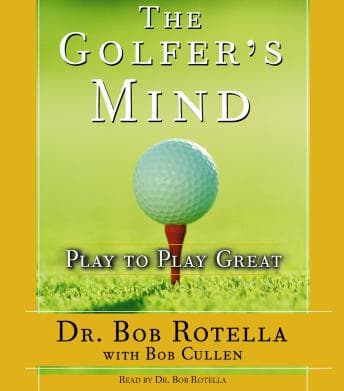

I was sitting in the bleachers at my nephew's baseball game last Saturday — one of those early summer afternoons where nobody's really keeping score and the hot dogs are questionable — when I figured I'd knock out something short from my queue. At 72 minutes, Bob Rotella's The Golfer's Mind is barely longer than a faculty meeting. And honestly? It was more useful than every faculty meeting I've attended this decade combined.
Now look. I'm an English teacher. I read Faulkner for fun. I am not the target demographic for golf psychology. But I've been playing nine holes with Denise's father every other Sunday for about three years now, and the man has watched me shank balls into parking lots with the kind of quiet disappointment usually reserved for students who confuse "their" and "they're." So when a colleague mentioned Rotella, I figured 72 minutes was a small price to pay for family harmony.
The Ten Commandments of Not Psyching Yourself Out
Rotella opens with his "Ten Commandments" for golfers, and the first one — "Play to play great. Don't play not to play poorly" — hit me like something I should've told my AP Lit students years ago. Replace "play" with "write" and it's the exact advice I give juniors paralyzed by their college essays. The whole framework is about approach versus avoidance mindset, and Rotella states it with the kind of clarity that makes you wonder why you needed someone to say it at all.
The book is organized by topic — butterflies, routine, setbacks, how winning happens — and each section reads like a short counseling session. It's designed as a quick-reference guide, something you'd flip to before a round the way my students flip to SparkNotes before a quiz. (I see you, period 4.) Davis Love Jr. apparently suggested this format twenty years before Rotella actually wrote it, and you can feel that DNA. It's not trying to be a narrative. It's trying to be useful.
And here's where I discovered something I didn't expect: the repetition that some listeners complain about — the overlap with his earlier Golf Is Not a Game of Perfect — actually works in this format. If you've read Rotella before, sure, you're getting the greatest hits. But greatest hits albums exist for a reason. The short, topical structure means you're getting concentrated doses rather than wading through setup.
Doc Reads Doc (And It Works Better Than It Should)
Rotella narrates this himself, and I want to be honest — author-narrated nonfiction is usually where audiobooks go to die. Academics reading their own work tend to sound like they're presenting at a conference where the projector just broke. But Rotella has a conversational, almost coaching-session delivery that fits the material perfectly. He sounds like he's talking to you across a table at the clubhouse, not lecturing from a podium. There's a warmth to it, an ease. He believes what he's saying, and you can hear twenty years of saying it to professionals who needed to hear it.
Is it a performance? No. There are no dramatic shifts, no character voices — this isn't that kind of book. But the narrator understands that pause is punctuation, and Rotella uses silence well between ideas. He lets concepts breathe. At 1.0x, it felt like exactly the right pace — unhurried, like the rhythm he keeps preaching about on the course.
What Hemingway and Your Golf Swing Have in Common
This reminds me of what Hemingway said about writing: "All you have to do is write one true sentence." Rotella's whole philosophy boils down to something similar — think one clear thought, commit to it, and execute. Strip away the doubt, the mechanical overthinking, the fear of the bad shot. His approach to the mental game is essentially minimalist. Trust the process you've practiced. Be present. Let go.
I teach kids every day who are so terrified of writing a bad essay that they can't write at all. Rotella is talking about golf, but he's really talking about the psychology of performance under pressure. The section on setbacks — how to process a bad hole without letting it contaminate the next one — is legitimately applicable to, well, life. My students would hate this. I love it. That same insistence on staying present under pressure — not letting one moment poison the next — runs through Breathe: A Life in Flow in ways that surprised me, and honestly that one has enough extra heft to satisfy if you want the full psychological argument rather than the laminated cheat sheet.
But I'll be fair: at 72 minutes, this is thin. If you've never read Rotella, start with Golf Is Not a Game of Perfect — that's the full meal. This is the laminated cheat sheet you keep in your golf bag. It's not trying to be deep. It's trying to be accessible and repeatable, and on those terms, it succeeds.
Who needs this and who should keep walking
If you're a golfer whose brain gets louder than your swing — buy this. If you've read all of Rotella's other books and want something new — this isn't it. If you're a non-golfer interested in sport psychology — honestly, you'll still get something out of it, but there are meatier options. And if you're looking for something to fill a short window — a lunch break, a warm-up drive to the course, one inning of your nephew's baseball game — the length is actually a feature, not a bug.
Worth Pausing the Faculty Meeting For? Almost.
At 72 minutes, The Golfer's Mind is a pep talk with a PhD behind it. It won't change your life, but it might change your next round. And at my skill level, I'll take any help I can get before Sunday dinner with Denise's dad.