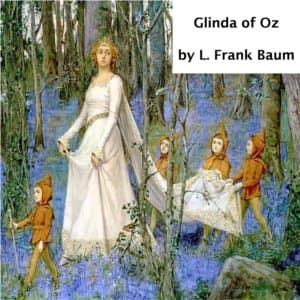

I was reorganizing my board game shelf at like 1 AM — you know, the kind of reorganization where you're not actually organizing anything, you're just moving Gloomhaven to a different spot and reading the backs of boxes you haven't opened — and I needed something light to listen to. Something that wasn't going to demand my full attention or make me feel guilty about not working on my thesis. So I threw on Glinda of Oz, the fourteenth and final Oz book Baum actually wrote before he died, and honestly? It hit different than I expected.
This is a weird little book. Not weird like Malazan weird, but weird in that Baum-was-clearly-running-out-of-road kind of way where you can feel him reaching into stranger and stranger corners of Oz to find new things to write about.
The Flatheads Have Literal Canned Brains and I'm Here For It
Okay so the setup: Dorothy and Ozma find out two obscure peoples in Oz — the Flatheads and the Skeezers — are about to go to war. The Flatheads are these beings who have flat heads (shocking, I know) and carry their brains in cans on top. The Skeezers live in a city on an island that can submerge underwater like a magic submarine. Baum just casually drops these concepts like they're nothing. A submersible city controlled by a single sorceress? Brains stored in literal tin cans as a fashion statement? My D&D group would love this — I'm stealing the Flatheads for my next campaign, full stop.
But here's the thing. Dorothy and Ozma walk right into the conflict and immediately get trapped when the Skeezer queen Coo-ee-oh sinks the island underwater and then gets transformed into a diamond swan. Yes. A diamond swan. And then nobody knows how to raise the island back up. So the back half of the book is basically Glinda assembling every magical heavy hitter in Oz to figure out the mechanics of how to un-sink this city. It's less of an adventure and more of a magical engineering problem. The progression is satisfying in this nerdy, puzzle-solving way — Glinda tries spell after spell, consults the Great Book of Records, and methodically works through the problem. It's Sanderson-level world-building? No. But for a kids' book from 1920, the internal logic of the magic actually holds up better than you'd think.
LibriVox Volunteers: The Potluck Narrator Experience
Alright, let's talk about the elephant in the room. This is a LibriVox recording, which means it's free, which means you get what you pay for — and sometimes that's perfectly fine and sometimes it's a little rough. The chapter-by-chapter volunteer approach means you're getting different readers with different mic setups, different energy levels, different levels of comfort behind a microphone. It's the narrator equivalent of a potluck dinner. Some chapters sound clear and well-paced, others have that slightly-too-close-to-the-mic intimacy that makes every breath audible. The contrast is stark when you've heard something like Good Omens: A Full Cast Production, where a full cast with real production budget turns ensemble reading into something almost theatrical. There's no consistency in how character voices are handled because, well, it's a different person every few chapters.
For a 4 hour 39 minute listen, it's manageable. But if you're someone who needs Steven Pacey-level vocal performance (Steven Pacey walked so other narrators could run, and I will keep saying this), this isn't that. Not even close. It's functional. It's free. It gets the words from Baum's page into your ears. Set your expectations at "enthusiastic volunteers reading a public domain classic" and you'll be fine.
Baum's Last Ride Through Oz
What makes this worth your time isn't the production — it's the historical curiosity of it. Baum died before this was even published, and you can feel a kind of wistfulness in the writing. The stakes are lower than earlier Oz books. Dorothy and Ozma are less adventurers and more diplomats who get in over their heads. There's something almost melancholy about Baum spending his last Oz story on the theme of preventing a war between people who don't understand each other. The Flatheads and Skeezers aren't evil — they're scared and prideful, and the whole conflict could've been avoided if anyone had just talked.
Is it the best Oz book? Absolutely not. The original Wizard of Oz and Ozma of Oz run circles around it. But as a farewell from the guy who built this entire world? There's a quiet sweetness to it.
Who's Rolling Initiative on This One
If you're an Oz completionist, this is essential listening — it's the last canonical Baum entry. If you've got kids who've already burned through the earlier books and need more, the runtime is short enough to knock out on a road trip. If you're a fantasy nerd who wants to see early 1900s world-building that accidentally invented some concepts we still use in RPGs and speculative fiction, it's a fun little artifact. But if you're coming in cold with no Oz background, start with book one. And if you need polished audio production, spend a credit on a professional recording — there are other versions out there.
I read this instead of writing my thesis. (Listened. Whatever.) Dr. Patel would not approve. But it was 1 AM, I was holding a copy of Betrayal at House on the Hill, and a diamond swan was happening. No regrets.