
What do you owe the people you left behind?
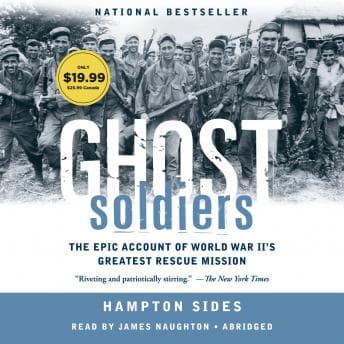
That question kept rattling around in my head as I walked the lakefront with Denise last Saturday morning, Lake Michigan doing its November thing — gray, flat, indifferent — while James Naughton was quietly describing men who hadn't seen clean water in three years. I'd started Ghost Soldiers expecting a straightforward rescue narrative. What Hampton Sides gave me instead was something closer to a moral reckoning with an entire chapter of American history most of us barely know.
The Raid Is the Hook, But Bataan Is the Story
Here's the thing about this book that caught me off guard: the raid on Cabanatuan — the 121 Rangers slipping thirty miles behind Japanese lines to free 513 POWs — that's maybe a third of what Sides is doing here. The rest is something harder and slower and, honestly, more important. He's reconstructing the three years before the rescue. The Bataan Death March. The camp itself. The starvation diets where men fought over rats and counted weevils in their rice as protein. The tropical ulcers so deep you could see bone. Sides doesn't flinch from any of it, and Naughton — to his enormous credit — doesn't either.
What struck me is how Sides handles the psychological architecture of captivity. He tracks specific prisoners, follows their deterioration, their small acts of defiance. One surgeon, Captain Grubb, performed operations with improvised tools while slowly dying himself. There's a moment where prisoners secretly maintain a radio — hiding it from guards who would have executed them on the spot — just to hear any news from the outside world. Not for tactical advantage. For hope. That's what Sides understands about extreme duress that a lot of military historians miss: survival isn't just physical. It's an act of imagination. You have to believe the world still exists beyond the wire.
This reminds me of what Hemingway said about courage being grace under pressure. But Hemingway made it sound elegant. Sides makes it sound like what it actually was — ugly, desperate, and occasionally absurd.
Naughton's Restraint Is the Performance
James Naughton narrates this like a man who trusts the material. No vocal theatrics. No dramatic pauses designed to make you cry. He reads with a kind of steady, authoritative warmth — like a historian who happens to care deeply about his subjects but won't manipulate you into feeling something. The narrator understands that pause is punctuation, and he uses silence after the worst passages the way a good teacher uses silence after a hard question. He lets it sit.
Where Naughton really earns his keep is in the tonal shifts. When Sides moves from the claustrophobic horror of the camp to the Rangers planning the raid — all precision, all tactical detail — Naughton's energy changes. Not dramatically, but you feel the shift from endurance to action. And when he handles the Filipino guerrillas and the local civilians who risked everything to help, there's a genuine respect in his delivery. No condescension, no exoticizing. Just credibility.
At six hours, this is a lean listen. Sides is a narrative journalist, not an academic, and the prose moves. But Naughton never rushes. I listened at 1.0x because — and my students would roll their eyes — the author chose those words, and the weight of what's being described deserves real time.
Where It Sits on the Shelf
People compare this to Flags of Our Fathers and Unbroken, and those comparisons aren't wrong, but they miss something. Laura Hillenbrand's Unbroken is fundamentally a biography — Zamperini's story. Sides is doing something more diffuse and, I think, more ambitious. He's weaving individual stories into a systemic indictment. The men of Bataan weren't just unlucky. They were abandoned by command decisions, by MacArthur's retreat, by a War Department that chose Europe first and then spent decades not talking about it. Sides is polite about this. But the facts aren't.
If you loved Unbroken, this is its spiritual successor — but angrier beneath the surface, and more interested in the collective than the individual hero.
My one complaint, and it's minor: the book occasionally toggles between timelines in ways that feel slightly disorienting in audio. Reading a physical book, you can flip back. Listening on the lakefront while dodging cyclists, you sometimes lose track of whether you're in 1942 or 1945. That's a structural choice, not a flaw, but it means this requires your attention. Don't put this on during a faculty meeting. (I would know.)
Worth Canceling Your Evening Plans
This is a six-hour listen that will stay with you for weeks. Matthew McConaughey's Greenlights is the last audiobook that hit me the same way — different war entirely, different stakes, but that same quality of a narrator reckoning honestly with things most people would rather smooth over. My students would hate this — no romance, no twist ending, just men trying not to die and other men walking thirty miles to save them. I love it. The prose deserves to be savored, Naughton delivers it with exactly the right restraint, and Hampton Sides makes you understand something essential: the greatest rescue mission of WWII wasn't just about the raid. It was about remembering the people everyone else had already written off.
Denise asked me why I was so quiet on the walk home. I didn't have a good answer. Some books just do that.








![Steve Jobs [unabridged audiobook] audiobook cover](/_next/image?url=https%3A%2F%2Fcovers.audiobooks.com%2Fimages%2Fcovers%2Ffull%2F9788499923406.jpg&w=1920&q=75)