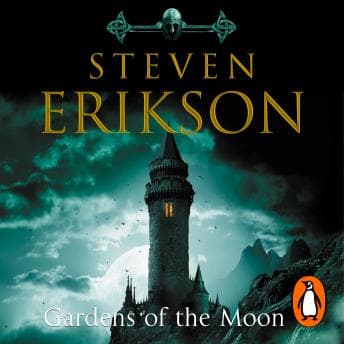

What if someone handed you a 1,200-piece jigsaw puzzle with no box art, dumped the pieces on the floor, and said "trust me, this becomes the most incredible picture you've ever seen"? That's Gardens of the Moon. And I'm here to tell you - after 26 hours of Ralph Lister in my ears while I procrastinated on my thesis in increasingly creative ways - the picture is worth it. Mostly.
Erikson Doesn't Hold Your Hand (He Barely Acknowledges You Exist)
Let me be real: the first five hours of this audiobook are an act of faith. You're dropped into the siege of Pale with zero context. There's a Bridgeburner squad, an empire with internal politics that make Game of Thrones look like student council elections, and gods literally playing chess with mortal lives. Erikson was an archaeologist and anthropologist before he wrote this, and it shows - he builds his world the way you'd excavate a dig site. Layer by layer. You don't get explanations. You get fragments and you piece it together yourself.
And honestly? The magic system is chef's kiss. Warrens - these pocket dimensions that mages tap into for power - are unlike anything I've encountered in fantasy. Each Warren has its own flavor, its own rules, its own dangers. When Tattersail accesses her Warren during the battle sequences, there's this sense of reaching into something vast and barely understood. This is Sanderson-level world-building, except where Sanderson gives you a physics textbook, Erikson gives you a half-burned scroll in a dead language and expects you to figure it out. I gave Oathbringer high marks for its magic system too, but even Sanderson's most ambitious Stormlight entries feel like a well-lit tutorial compared to the deliberate obscurity Erikson weaponizes here.
My D&D group would love this. The Bridgeburners basically ARE an adventuring party - Whiskeyjack as the weary squad leader, Quick Ben as the mage with way too many secrets, Kalam as the assassin who'd definitely multiclass rogue/fighter. And the gods meddling in mortal affairs? That's literally every campaign I've ever run where the players accidentally became pawns of Oponn.
Ralph Lister vs. The Mountain of Characters
Here's where it gets complicated. Lister has genuinely excellent cadence - the man knows how to pace a sentence, and in a book this dense, that's not nothing. His Kruppe is a standout performance. Kruppe speaks in this bombastic third person, all self-aggrandizing bluster, and Lister leans into the humor of it with this theatrical, almost Falstaffian delivery that had me grinning during what is otherwise a pretty grim book. Every time Kruppe showed up, I actually looked forward to his scenes purely for the voice work.
But - and this is a real but - the female characters are a problem. Tattersail, Sorry, Lady Simtal - they all get this breathy, wispy treatment that makes them blur together in audio. Tattersail is a powerful, battle-hardened sorceress who survived the massacre at Pale, and her voice sounds like she's perpetually whispering a secret at a tea party. It's a mismatch. And Kalam - this massive, dangerous assassin from Seven Cities - gets a voice that's lighter than you'd expect. It's not deal-breaking, but every time he spoke I had to mentally recalibrate.
Steven Pacey walked so other narrators could run, and Lister... is doing a solid jog here. He's not sprinting. With a cast this enormous (we're talking dozens of named characters across multiple plotlines), he does an admirable job of differentiation for the male characters specifically. The demon Pearl scene is genuinely unsettling in his delivery. But the female voice issue keeps this from being a truly great narration performance.
If You Don't Like Info-Dumps, This Isn't For You (But You're Wrong)
I listened to most of this during late-night coding sessions when I should've been working on my procedural generation thesis. (I read this instead of writing my thesis. Dr. Patel, if you're reading this, I was doing "research on complex narrative systems.") And I'll say this: Gardens of the Moon is NOT a background listen. I had to rewind multiple times when I zoned into my code and missed a critical detail about Anomander Rake or the Pannion Domin setup. This book demands your full attention.
The pacing can be rough. There's a stretch in the middle where you're juggling the Bridgeburners' infiltration of Darujhistan, Crokus's rooftop adventures, Sorry's possession subplot, and Kruppe's prophetic dreams all at once. It's a LOT. But when the threads start converging - when Rake descends on Darujhistan and everything clicks - the progression is satisfying in a way that rewards the investment.
Yes, it's 26 hours. Yes, it's worth it. But only if you're the kind of reader who treats confusion as a challenge rather than a flaw. This is book one of TEN. Erikson is playing the longest game in fantasy.
Who's Rolling Initiative On This One
If you love complex fantasy that respects your intelligence, if you've ever complained that a book over-explained its world, if you play tabletop RPGs and think "what if the DM was also an anthropologist with a PhD?" - this is your jam. Come for the epic scope, stay for Kruppe's monologues.
Skip it if you need clear protagonist arcs from page one, if breathy female narration will drive you up a wall, or if you want your fantasy spoon-fed. No judgment. (A little judgment.)
Tom's Thesis Can Wait Another Week
Gardens of the Moon is the hardest first book in any fantasy series I've ever tackled. It's also the one I'm most excited to continue. The world Erikson built here is staggering - ancient races, ascended gods, magical Warrens, converging storylines across continents - and this is just the foundation. Lister's narration gets you through the density with solid pacing even if his female voices need serious work. I'm already queuing up Deadhouse Gates. My thesis timeline weeps.