
Everyone says anthology audiobooks are uneven. That's supposed to be the caveat, the disclaimer you slap on before recommending one. And yeah, fine, this collection has some stories that bounced right off me - but I wasn't expecting to be sitting in my apartment at 2 AM, board game night long over, friends gone home, staring at the ceiling while a medical droid philosophized about what it means to attach a prosthetic hand to a kid who just lost a fight with his own father. The 2-1B story wrecked me in a way I genuinely did not see coming from a Star Wars short fiction anthology.
I read this instead of writing my thesis. Multiple times.
Forty Authors Walk Into Cloud City
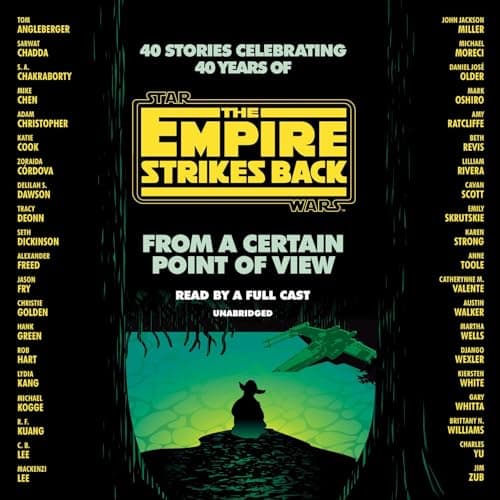
So the premise: forty writers each take a scene from Empire Strikes Back and retell it through the eyes of someone in the background. The wampa. An Ugnaught. A bounty hunter's droid partner. A tauntaun caretaker. It's basically the literary equivalent of that thing we all do in D&D where the DM has this epic main quest, but the party wants to know the backstory of the random blacksmith NPC. And honestly? Some of these backstories are better than they have any right to be.
Martha Wells writing about Ugnaught clan politics beneath Cloud City feels like it was ripped from a Murderbot side story - practical, lived-in, with characters who have opinions about labor organization while the galaxy burns above them. Hank Green's naturalist studying tauntauns on Hoth reads like a nature documentary transcript written by someone who actually cares about fictional xenobiology. And Seth Dickinson's story about an Imperial officer on one of those Star Destroyers Vader keeps force-choking people on? That's the kind of moral weight you get from Use of Weapons, except compressed into twenty minutes. The cost of serving an empire that treats you as disposable. The magic system is chef's kiss - except the magic here is just, you know, fascism.
R.F. Kuang and Kiersten White both show up with stories that feel distinctly theirs even inside someone else's sandbox. When you put authors of this caliber in a shared universe, you get something wild - the tonal shifts between stories become a feature, not a bug. One minute you're getting philosophical, the next you're inside the head of a wampa who - and I cannot stress this enough - just wanted to eat Luke and then lost its arm for the trouble. Mark Oshiro turns that into something genuinely sad.
The Narrator Roster is the Real Alliance
Nine narrators rotating through forty stories. This is where the audiobook format earns its keep versus just reading the text. Jonathan Davis (not the Korn guy, as the internet helpfully clarifies every time) carries a huge chunk of the book, and his range across wildly different POVs is impressive - he shifts register between alien creatures and Imperial officers without breaking a sweat. Marc Thompson does the heavy Star Wars lifting you'd expect from someone who's narrated half the expanded universe. Sam Witwer brings genuine menace when the darker stories call for it.
But the standout for me was how the production handles transitions between narrators. Each voice change signals a new perspective, a new corner of the Empire Strikes Back timeline, and it keeps your brain engaged in a way that a single narrator plowing through forty tonal shifts wouldn't. It's not full-cast drama - there's no sound effects or music - but the narrator rotation functions almost like a D&D table where different players are narrating their characters' downtime scenes between sessions.
Some Stories Hit Like a Thermal Detonator, Others Fizzle
Look, I'll be straight: not all forty stories land. A few - and listener consensus backs me up here - feel like they exist because someone needed to fill the scene gap rather than because anyone had a burning story to tell from that moment. "Ion Control" gets specifically called out as dead weight, and yeah, I zoned out during that one. There are maybe five or six stories where I found myself reaching for the skip-forward button, which in an eighteen-hour anthology means roughly two hours of material that's just... fine. Present. Not doing much.
But here's the thing - the highs are high. The Dagobah cave sequence, the 2-1B droid story, the bounty hunter partnership between Dengar and IG-88. When this collection works, it's Sanderson-level world-building applied to a universe you already know, peeling back layers you never thought to look for. My D&D group would love this - it's basically what happens when you let forty DMs each run a one-shot in the same campaign setting.
Consensus says this one's better than the first From a Certain Point of View book (the one covering A New Hope), and I agree. The same thing that makes the prequel-era novelization of Star Wars: Episode III: Revenge of the Sith work so well applies here - when authors actually care about the emotional architecture underneath the spectacle, the expanded universe stops feeling like merchandise and starts feeling like literature. The stories feel more ambitious, more willing to be weird or philosophical or genuinely emotional rather than just filling in lore gaps.
Who Gets This and Who Bounces
If you love Empire Strikes Back and want to see it through a kaleidoscope of new lenses - grab this. If you're into short fiction anthologies where quality varies but the peaks justify the valleys - grab this. If you need a single throughline narrative with consistent pacing, or if you're not already familiar with the movie's plot beats, you're going to be lost and frustrated. Skip it too if anthologies in general make you twitchy - two hours of filler across eighteen hours is a better ratio than most, but it's still there.
Yes, it's 18 hours. Yes, it's worth it. Even with the handful of stories I'd skip on a relisten.
Roll for Initiative on That Credit
I came in expecting fan service and got genuine literary ambition from authors who clearly love this universe but refuse to be lazy about it. The 2-1B droid story alone - a medical droid contemplating consciousness while performing surgery on Luke Skywalker - is worth your time. Not every story in a forty-story anthology needs to be perfect. It needs enough moments that make you pause your thesis work and stare at the ceiling. This one has plenty.