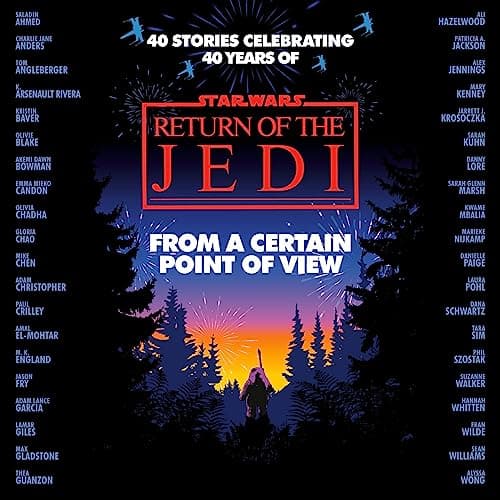

Let me cut to the chase - I expected this to be a nostalgia cash grab. Forty authors, forty stories, all riffing on a forty-year-old movie? That's a recipe for a mess. And honestly? Some of it is a mess. But enough of it lands that I'm glad I stuck through almost twenty hours of it while refinishing the back deck last weekend. Ranger parked himself in the shade and listened to the whole thing with me. He perked up during the rancor trainer story. Good boy knows tragedy when he hears it.
Here's where the consensus and I part ways. A lot of folks online rave about this collection like every story is gold. It's not. It's maybe 60% solid, 25% interesting but forgettable, and 15% stuff that had me reaching for the skip-forward button. But that 60% - when it hits, it hits hard.
Forty Stories and Only One Sarlacc Digestive Tract
The standouts earn their place. Olivie Blake's Palpatine story genuinely unsettled me - she gets inside the Emperor's head during that throne room confrontation with Luke and makes you feel the cold calculation underneath all that cackling evil. It's not action-heavy, it's psychological, and it works because she doesn't try to make Palpatine sympathetic. He's a monster who thinks he's a god. That's scarier than any lightsaber fight.
Saladin Ahmed's rancor trainer piece is the emotional gut punch of the collection. You know that guy in the movie who cries when Luke kills the rancor? Ahmed gives him a whole life, a whole relationship with that creature, and suddenly that three-second reaction shot from 1983 means something completely different. I've seen grown men bond with working dogs in ways civilians wouldn't understand - the parallel hit me sideways. Eat Prey Love works that same territory - the bond between humans and something the world writes off as just an animal - though it doesn't land with anything close to Ahmed's precision.
Charlie Jane Anders writing from the Sarlacc's perspective is exactly as weird as it sounds. It's a sentient pit with a thousand-year digestive cycle contemplating its existence. I respect the swing even if I'm not sure it connected.
The Ewok stories are a mixed bag. Mary Kenney's Wicket piece is fun - the idea that Wicket just wanted a quiet day and instead got dragged into a galactic rebellion has a comedic energy that works. But there's also an Ewok shaman story exploring Ewok religious beliefs that felt like it was trying too hard to add philosophical weight to teddy bears with spears. Your mileage will vary.
Jon Hamm as Boba Fett and Other Things I Didn't Know I Needed
The full cast narration is where the audiobook format earns its keep over the print version. Jon Hamm voicing Boba Fett again - he did it in the previous anthology too - is just right. Gravel and menace without going cartoon villain. Sam Witwer brings that same intensity he's known for in Star Wars voice work. Marc Thompson is a Star Wars audiobook veteran and it shows; the man can shift between characters without it feeling like a performance.
With sixteen-plus narrators rotating through forty stories, there's inevitably some unevenness. A few of the less prominent narrators blend together in my memory. But nobody's bad. Nobody made me wince. The production is clean - no sound effects or music, just good voice work. For an anthology this size, that's worth noting.
At 1.25x speed, the pacing felt right for most stories, though a few of the more contemplative pieces (looking at you, Sarlacc) might benefit from slowing down.
The Problem With Anthologies - and This One Specifically
Some listeners wanted more direct movie scenes - the actual dialogue from Return of the Jedi retold from new angles. The previous two anthologies in this series apparently delivered more of that. This one goes wider, telling stories that happen adjacent to or around the film's events rather than directly recreating iconic scenes. If you're hoping to relive the Endor battle or the Death Star trench from a stormtrooper's perspective with movie-accurate dialogue, you'll be disappointed.
The other issue is simple math. Forty stories in twenty hours means each one averages about thirty minutes. Some need more room to breathe. Some overstay their welcome. The Mike Chen piece about Anakin becoming one with the Force deserved a novella. A couple of the shorter entries feel like writing exercises rather than complete stories.
But here's what I keep coming back to: the best entries in this collection fundamentally change how you watch Return of the Jedi. That rancor trainer. The story of Commander Igar bringing Luke to Vader on Endor - suddenly a nothing scene has weight and moral complexity. Mon Mothma's secret machinations behind the Rebel Alliance's strategy. These aren't just fan fiction. They're legitimate expansions that make the source material richer.
Mission Debrief: Worth the Long Haul?
If you're a Star Wars fan who wants to see Return of the Jedi through forty different lenses - some brilliant, some just okay - this is a solid investment of your listening hours. It's not as tight as the best single-author Star Wars novels, but the highs are genuinely high. The Palpatine and rancor trainer stories alone justify the credit. And the full cast narration makes this the right format for this material.
Skip this if you want a focused, single-narrative Star Wars novel or if twenty hours of uneven quality sounds like a slog. This is strictly for fans who love poking around the margins of the original trilogy.
Just know what you're signing up for. It's a marathon, not a sprint. I'd suggest treating it like a deployment playlist - dip in and out over a couple weeks rather than trying to power through in one stretch. Ranger and I finished the deck, finished the book, and I immediately rewatched the rancor scene on YouTube. Ahmed ruined me. Mission accomplished.