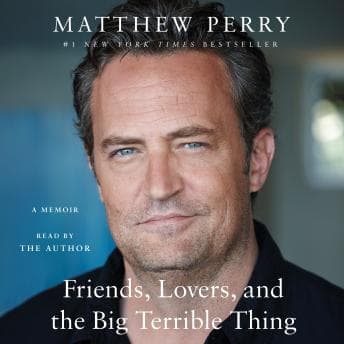

Bottom Line Up Front
Look, I don't usually do celebrity memoirs. Most of them are ghost-written PR exercises with maybe 20 pages of actual insight buried under 300 pages of "and then I met [famous person] at a party." But this one? This one hit different. I finished it during a red-eye to Boston, couldn't sleep anyway, and by the time we landed I was genuinely sad it was over. That almost never happens.
The Voice You Already Know (Sort Of)
Here's the thing about Matthew Perry narrating his own memoir—you think you know what you're getting. Chandler Bing. The sarcasm. The timing. And yeah, that's there. But there's something else underneath that I wasn't expecting.
Perry reads this like he's sitting across from you at a diner at 2 AM, three coffees deep, finally telling you the real story. His delivery is warm but not polished. You can hear the vulnerability in his voice when he talks about waking up in hospitals, about the surgeries, about the sheer volume of substances that should have killed him. When he says "I should be dead" in the opening—it's not dramatic. It's just... factual. And that lands way harder than any theatrical delivery would.
The humor is still there, obviously. Perry's self-deprecating wit carries you through some genuinely dark material. But here's what surprised me: the jokes feel less like deflection and more like survival mechanism. My parents used humor the same way—crack a joke about the 16-hour day, laugh about the difficult customer, keep moving. It's how some people process pain without drowning in it.
What Actually Works Here
I've seen addiction narratives in business contexts—founders who crashed, executives who lost everything, the whole redemption arc thing. Most of them feel sanitized. That's the difference between real memoir and mythology—Truth About Tall Tales explores how we sanitize stories into legends, which is exactly what Perry refuses to do here. No lessons learned, growth achieved, here's my five-step framework for recovery. Perry doesn't do that.
He's messy. He's repetitive sometimes. He circles back to the same wounds multiple times because—and this is the part that feels true—that's how addiction actually works. It's not linear. You don't learn the lesson once and move on. You learn it, forget it, crash, learn it again. The audiobook reflects that, and while some listeners find it long-winded (fair), I think it's honest.
The Friends stuff is there, and it's fascinating if you're a fan. But honestly? The real value is in the earlier chapters—the kid shuttling between divorced parents, the teenage tennis prodigy, the young actor desperate for recognition. This is what my parents did instinctively—working themselves to exhaustion trying to fill some void. Now it has a TED talk. And a memoir. And apparently 14 trips to rehab.
Perry doesn't spare himself. He talks about being difficult, about pushing people away, about the relationships he destroyed. There's a rawness here that most celebrity memoirs carefully edit out. Jenny would say I'm being harsh on other celebrity memoirs. Jenny is right. But she'd also agree this one earns its runtime.
Fair Warning
Not everything lands perfectly.
There are moments where Perry's shade toward certain people feels a little petty. Some tangents meander longer than they need to. And if you're not a Friends fan at all, some of the behind-the-scenes stuff might feel like inside baseball you didn't ask for.
Also—and I say this as someone who listens to everything at 2.0x—I actually slowed down to 1.25x for this one. Perry's natural rhythm has these pauses, these beats where the weight of what he's saying needs a second to land. Speed it up too much and you lose that. My 2.0x speed couldn't save this one. Didn't need to.
The content warnings are real, by the way. Addiction, medical trauma, mental health struggles—it's all here in detail. If that's triggering territory for you, know what you're walking into.
Who This Is Actually For
Best for: Long commutes. Travel days. Basically any time you have 8+ hours and want something that feels like a genuine conversation rather than a performance. Friends fans will obviously get extra value, but this works even if you've never seen an episode. (Do those people exist? Unclear.)
Skip if: You want tight, focused narrative. You're sensitive to repetition. You're looking for a recovery success story with a neat bow on top. This isn't that.
The Verdict
I measure every business book against my parents' dry cleaning shop hustle. Most fail that test. This isn't a business book, but Perry's story passes a similar test—does this feel like real life, or does it feel like someone performing real life?
It feels real. Uncomfortably so, sometimes.
Matthew Perry died about a year after this came out, which makes listening to it now feel different than it would have in 2022. There's a weight to hearing him talk about survival, about hope, about maybe finally being okay—knowing how the story actually ends. But that's not a reason to skip it. If anything, it's a reason to listen.
The key takeaway is worth the listen. And for once, so are the other 8 hours.





![Steve Jobs [unabridged audiobook] audiobook cover](/_next/image?url=https%3A%2F%2Fcovers.audiobooks.com%2Fimages%2Fcovers%2Ffull%2F9788499923406.jpg&w=1920&q=75)