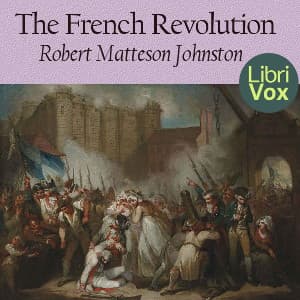

Look, I need to get something off my chest: if you're going to write a "short history" of the French Revolution, maybe don't gloss over the military campaigns like they're footnotes. Johnston spends more time on constitutional committees than he does on Valmy, and that's a choice that had me muttering at my phone while waiting for Ranger's vet appointment to wrap up. The dog was calmer than I was.
Let me cut to the chase - this is a free LibriVox recording of a 1909 overview text, and it delivers exactly what that description promises. Nothing more, nothing less. Six hours of brisk, dry, academic summary of the Revolution from the Estates-General through Napoleon's rise. If you're looking for drama, passion, or the smell of gunpowder, you're in the wrong place.
A Cambridge Man's View from 30,000 Feet
Robert Matteson Johnston was an Eton and Cambridge-educated American military historian, which is an interesting pedigree for someone writing about the French Revolution. And you can feel that education in every sentence - this reads like a very competent lecture series delivered to undergraduates who need to pass an exam next week. He's methodical, he's organized, and he is utterly, almost aggressively, dispassionate. The Terror? Handled with the emotional weight of a supply requisition form. Danton's execution? A paragraph. The fall of the Bastille gets its due, but Johnston seems more interested in what the National Assembly was debating that week than what the mob was doing with the governor's head on a pike.
What Johnston does well - and I'll give him credit here - is structure. He breaks the Revolution into clear phases and explains the political machinery driving each transition. If you've ever been confused about the difference between the Girondins and the Jacobins, or why the Directory was doomed from the start, this book lays it out cleanly. He's particularly good at tracing how financial collapse created the conditions for revolution - the section on France's debt crisis reads like a case study you'd present at a corporate risk briefing. I've actually thought about recommending those chapters to a couple of my consulting clients who think institutional collapse only happens in movies.
But here's where it lost me: Johnston wrote this as a companion to his Napoleon biography, and it shows. The Revolution itself sometimes feels like a prelude rather than the main event. The human cost - the 16,000+ guillotined during the Terror, the Vendée uprising, the sheer chaos of revolutionary Paris - gets compressed into clinical summaries. He tells you what happened. He rarely makes you feel why it mattered.
The LibriVox Lottery
Anyone who's listened to LibriVox knows the deal. Volunteer narrators, varying quality, zero production budget. This recording is... fine. Multiple readers rotate through chapters, which means you're constantly adjusting to different voices, different microphone setups, different reading speeds. Some volunteers read with clarity and decent pacing. Others sound like they're reading aloud for the first time since grade school. The French pronunciation is all over the map - I heard "Robespierre" pronounced about four different ways across six hours. No one's going to confuse this with a professional production from Audible.
I bumped it up to 1.25x and a couple of the slower readers still felt like they were wading through mud. The transitions between readers can be jarring - you'll get used to one voice for two chapters and then suddenly you're listening to someone with completely different energy and mic quality. It's free, so complaints feel ungrateful, but it does affect the experience.
Who Should Deploy This
If you're a history student who needs a framework before diving into deeper reads like Simon Schama's "Citizens" or Mike Duncan's work, this is a solid - and free - starting point. It's the skeletal outline onto which you can hang the details from better books. If you're already well-read on the French Revolution, you'll find nothing new here. And if you want the story told with fire and urgency? Skip this and go find Duncan's "Revolutions" podcast instead.
For my fellow military history buffs: the campaign details are thin. Johnston clearly had the knowledge (his background was in military history) but deliberately kept this at survey level. Frustrating when you know the author could've gone deeper on the Coalition Wars but chose not to.
Mission Debrief
Worth your time? Here's the debrief: it's free, it's short, and it does its job as a primer. The author clearly did their homework - this was a respected scholar working from primary sources in 1909. But the LibriVox production is inconsistent, the prose is dry even by Edwardian academic standards, and the book's deliberate brevity means you're getting the Wikipedia version of one of history's most consequential upheavals. Ranger slept through most of it, which tells you something about the excitement level. He perked up a lot more when I was listening to Zookeeper's Wife: A War Story — that one actually makes you feel the weight of history the way Johnston never quite manages here. Pick it up if you want a free, no-frills introduction. Just don't expect it to make you feel anything about the people who lived and died through it.