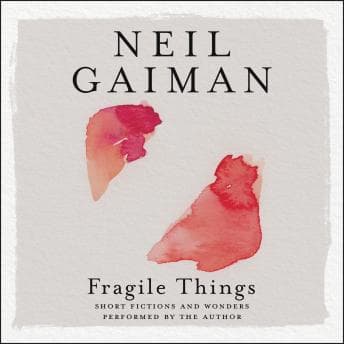

Neil Gaiman reading his own short stories is the literary equivalent of a chef cooking dinner at your house. You're not just getting the food — you're getting every intention behind it, every pause that tells you exactly how long to let a sentence sit before the next one arrives.
I started Fragile Things during a Saturday morning walk along the lakefront with Denise, thinking a short story collection would be perfect for the stop-and-start rhythm of dodging joggers and stopping to argue about where to get lunch. And it was — until "The Monarch of the Glen" hit and I found myself standing completely still near Montrose Harbor, ignoring Denise pointing at something, because Gaiman had me locked into a Shadow story I didn't know I needed. She eventually just kept walking. I caught up.
The Introduction Is the Best Short Story in the Collection
Here's the thing nobody tells you: Gaiman's introduction to this collection is itself a piece of writing worth the listen. He walks you through where each story came from — which ones were written in hotel rooms at 3 AM, which were commissioned, which ones scared him. It's like getting the liner notes to an album where the musician is honest about which tracks almost didn't make it. Most authors phone in their introductions. Gaiman treats his like a conversation with someone he trusts. You get context for every piece that follows, and that context changes how you hear them.
This matters for the audiobook specifically because when you arrive at, say, a poem wedged between two prose pieces, you already know why it's there. You're not confused — you're prepared. And yes, there are poems in here. Some of them work better spoken aloud than they ever could on a page. Some of them... well. My students would hate this. I love it.
Gaiman's Voice Does What Most Narrators Won't
Let me be specific about what Gaiman does that professional narrators often don't: he reads below the drama. Where a hired voice might punch up a horror beat or lean hard into a scare, Gaiman pulls back. There's this quality — a kind of calm sweetness in his delivery that makes the dark moments darker by contrast. When anger surfaces in a character, it arrives as a subtle shift in pressure, not a shout. It's the difference between a teacher who raises their voice to get attention and one who gets quieter. (I've been teaching twenty years. Trust me — quieter works.)
He doesn't do wildly different voices for different characters. What he does instead is adjust the temperature of his reading. Some stories get warm, almost conspiratorial. Others go cool and precise. "A Study in Emerald" — his Sherlock Holmes meets Lovecraft mashup — gets this clipped, Victorian restraint that sells the whole conceit without ever winking at you. He trusts you to keep up.
The pace is deliberate. This is a 1.0x book, absolutely. Speeding up Gaiman reading Gaiman would be like fast-forwarding through a jazz solo to get to the next song. The prose deserves to be savored, and he knows exactly where the weight falls in his own sentences because — well, he wrote them.
Not Every Story Lands (And That's Fine)
A short story collection is never a perfect batting average. Some pieces here feel like exercises — well-crafted exercises from a writer who could probably write a compelling grocery list, but exercises nonetheless. A few of the shorter pieces between the major stories function more as palate cleansers than meals. At nearly eleven hours, there are stretches where the collection drifts, and I found myself grading papers during a couple of the middle entries with less guilt than I probably should've felt.
But then something like "The Monarch of the Glen" — essentially a novella featuring Shadow from American Gods — comes along and reminds you why you're here. If you loved American Gods, this is its spiritual successor in miniature, and hearing Gaiman read Shadow's quiet stoicism is worth the price of admission alone.
Who Gets an A, Who Gets Sent to Study Hall
This is for Gaiman fans, obviously, but more than that — it's for anyone who believes an author reading their own work is something fundamentally different from narration. It's interpretation from the source. If you need constant plot momentum, a short story collection will frustrate you regardless. If you want someone whispering strange, dark, beautiful things to you while you walk a cold lakefront, this is your book.
Skip this if you're looking for horror that screams. Gaiman's horror whispers, and sometimes it recites poetry first. That same quality — darkness delivered with restraint and a kind of literary trust in the reader — is actually what drew me to Adventures of Tom Sawyer as an audiobook too, though Twain's version of that restraint lands in a very different neighborhood.
The Red Pen Stays in the Drawer
I don't give this collection full marks because not every story earns its place, and the pacing across eleven hours is inherently uneven — that's the nature of collections. But Gaiman narrating Gaiman is something close to essential listening for anyone who cares about the relationship between a writer and their words. The narrator understands that pause is punctuation. Worth pausing the faculty meeting for. (Sorry again, Principal Martinez.)